Pepke Michael Le, Kvalnes Thomas, Ranke Peter Sjolte, Araya-Ajoy Yimen G, Wright Jonathan, Sæther Bernt-Erik, Jensen Henrik, Ringsby Thor Harald
Department of Biology, Centre for Biodiversity Dynamics (CBD) Norwegian University of Science and Technology (NTNU) Trondheim Norway.
Ecol Evol. 2022 Jul 31;12(8):e9144. doi: 10.1002/ece3.9144. eCollection 2022 Aug.
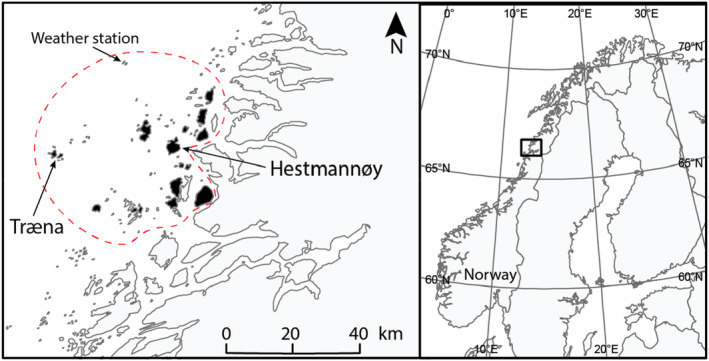
Environmental conditions during early-life development can have lasting effects shaping individual heterogeneity in fitness and fitness-related traits. The length of telomeres, the DNA sequences protecting chromosome ends, may be affected by early-life conditions, and telomere length (TL) has been associated with individual performance within some wild animal populations. Thus, knowledge of the mechanisms that generate variation in TL, and the relationship between TL and fitness, is important in understanding the role of telomeres in ecology and life-history evolution. Here, we investigate how environmental conditions and morphological traits are associated with early-life blood TL and if TL predicts natal dispersal probability or components of fitness in 2746 wild house sparrow () nestlings from two populations sampled across 20 years (1994-2013). We retrieved weather data and we monitored population fluctuations, individual survival, and reproductive output using field observations and genetic pedigrees. We found a negative effect of population density on TL, but only in one of the populations. There was a curvilinear association between TL and the maximum daily North Atlantic Oscillation index during incubation, suggesting that there are optimal weather conditions that result in the longest TL. Dispersers tended to have shorter telomeres than non-dispersers. TL did not predict survival, but we found a tendency for individuals with short telomeres to have higher annual reproductive success. Our study showed how early-life TL is shaped by effects of growth, weather conditions, and population density, supporting that environmental stressors negatively affect TL in wild populations. In addition, shorter telomeres may be associated with a faster pace-of-life, as individuals with higher dispersal rates and annual reproduction tended to have shorter early-life TL.
生命早期发育过程中的环境条件会产生持久影响,塑造个体在适应性和与适应性相关性状方面的异质性。端粒是保护染色体末端的DNA序列,其长度可能受生命早期条件的影响,并且在一些野生动物种群中,端粒长度(TL)已与个体表现相关联。因此,了解产生TL变异的机制以及TL与适应性之间的关系,对于理解端粒在生态学和生活史进化中的作用至关重要。在这里,我们研究了环境条件和形态特征如何与生命早期的血液TL相关联,以及TL是否能预测20年间(1994 - 2013年)从两个种群中采集的2746只野生家麻雀雏鸟的出生扩散概率或适应性组成部分。我们获取了天气数据,并通过野外观察和基因谱系监测了种群波动、个体存活和繁殖产出。我们发现种群密度对TL有负面影响,但仅在其中一个种群中如此。在孵化期间,TL与每日最大北大西洋涛动指数之间存在曲线关联,这表明存在能导致最长TL的最佳天气条件。扩散个体的端粒往往比非扩散个体短。TL不能预测存活率,但我们发现端粒短的个体有年度繁殖成功率较高的趋势。我们的研究表明生命早期的TL是如何受到生长、天气条件和种群密度的影响而形成的,支持了环境压力源对野生种群的TL有负面影响这一观点。此外,较短的端粒可能与更快的生活节奏相关,因为扩散率和年度繁殖率较高的个体往往生命早期的TL较短。