Nithiuthai Jitsupa, Siriussawakul Arunotai, Junkai Rangsinee, Horugsa Nutthakorn, Jarungjitaree Sunit, Triyasunant Namtip
Department of Anesthesiology, Faculty of Medicine Siriraj Hospital, Mahidol University, Bangkok, Thailand.
Siriraj Integrated Perioperative Geriatric Excellent Research Center, Faculty of Medicine Siriraj Hospital, Mahidol University, Bangkok, Thailand.
Perioper Med (Lond). 2021 Dec 8;10(1):43. doi: 10.1186/s13741-021-00214-3.
The incidence of postoperative pulmonary complications (PPCs) is increasing in line with the rise in the number of surgical procedures performed on geriatric patients. In this study, we determined the incidence and risk factors of PPCs in elderly Thai patients who underwent upper abdominal procedures, and we investigated whether the Assess Respiratory Risk in Surgical Patients in Catalonia (ARISCAT) score helps to predict PPCs in Thais.
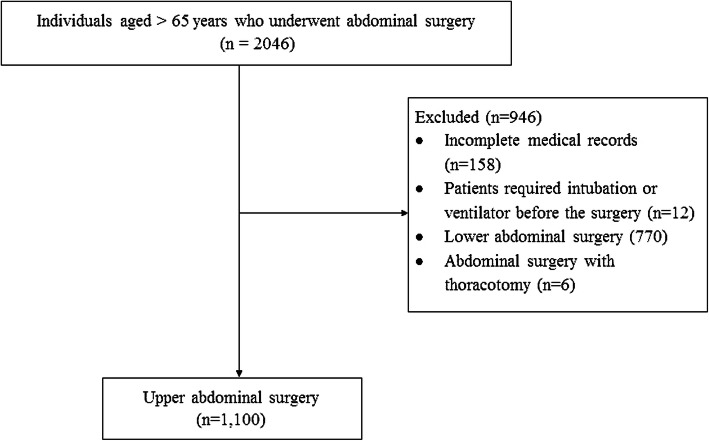
A retrospective study was conducted on upper abdominal surgical patients aged over 65 years who had been admitted to the surgical ward of Siriraj Hospital, Mahidol University, Thailand, between January 2016 and December 2019. Data were collected on significant PPCs using the European Perioperative Clinical Outcome definitions. To identify risk factors, evaluations were made of the relationships between the PPCs and various preoperative, intraoperative, and postoperative factors, including ARISCAT scores.
In all, 1100 elderly postoperative patients were analyzed. Their mean age was 73.6 years, and 48.5% were male. Nearly half of their operations were laparoscopic cholecystectomies. The incidence of PPCs was 7.7%, with the most common being pleural effusion, atelectasis, and pneumonia. The factors associated with PPCs were preoperative oxygen saturation less than 96% (OR = 2.6, 1.2-5.5), albumin level below 3.5 g/dL (OR = 1.7, 1.0-2.8), duration of surgery exceeding 3 h (OR = 2.0, 1.0-4.2), and emergency surgery (OR = 2.8, 1.4-5.8). There was a relationship between ARISCAT score and PPC incidence, with a correlation coefficient of 0.226 (P < 0.001). The area under the curve was 0.72 (95% CI, 0.665-0.774; P < 0.001).
PPCs are common in elderly patients. They are associated with increased levels of postoperative morbidities and extended ICU and hospital stays. Using the ARISCAT score as an assessment tool facilitates the classification of Thai patients into PPC risk groups. The ARISCAT scoring system might be able to be similarly applied in other Southeast Asian countries.
随着老年患者外科手术数量的增加,术后肺部并发症(PPCs)的发生率也在上升。在本研究中,我们确定了接受上腹部手术的泰国老年患者中PPCs的发生率和危险因素,并调查了加泰罗尼亚外科患者呼吸风险评估(ARISCAT)评分是否有助于预测泰国患者的PPCs。
对2016年1月至2019年12月期间入住泰国玛希隆大学诗里拉吉医院外科病房的65岁以上上腹部手术患者进行了一项回顾性研究。使用欧洲围手术期临床结果定义收集有关重大PPCs的数据。为了确定危险因素,评估了PPCs与各种术前、术中和术后因素之间的关系,包括ARISCAT评分。
总共分析了1100例老年术后患者。他们的平均年龄为73.6岁,男性占48.5%。近一半的手术是腹腔镜胆囊切除术。PPCs的发生率为7.7%,最常见的是胸腔积液、肺不张和肺炎。与PPCs相关的因素包括术前氧饱和度低于96%(OR = 2.6,1.2 - 5.5)、白蛋白水平低于3.5 g/dL(OR = 1.7,1.0 - 2.8)、手术持续时间超过3小时(OR = 2.0,1.0 - 4.2)和急诊手术(OR = 2.8,1.4 - 5.8)。ARISCAT评分与PPCs发生率之间存在关系,相关系数为0.226(P < 0.001)。曲线下面积为0.72(95% CI,0.665 - 0.774;P < 0.001)。
PPCs在老年患者中很常见。它们与术后发病率增加以及ICU和住院时间延长有关。使用ARISCAT评分作为评估工具有助于将泰国患者分类到PPC风险组中。ARISCAT评分系统可能能够在其他东南亚国家类似地应用。