Gurkan Burcu, Su Xiao, Klemm Aidan, Kim Yonghwan, Mallikarjun Sharada Shaama, Rodriguez-Katakura Andres, Kron Kareesa J
Chemical and Biomedical Engineering, Case Western Reserve University, Cleveland, OH 44106, USA.
Department of Chemical and Biomolecular Engineering, University of Illinois at Urbana-Champaign, Urbana, IL 61801, USA.
iScience. 2021 Nov 11;24(12):103422. doi: 10.1016/j.isci.2021.103422. eCollection 2021 Dec 17.
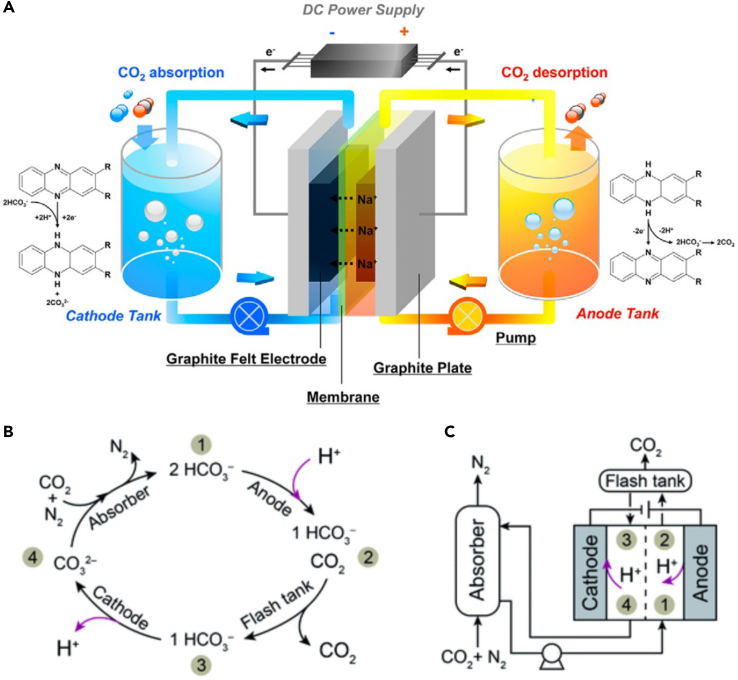
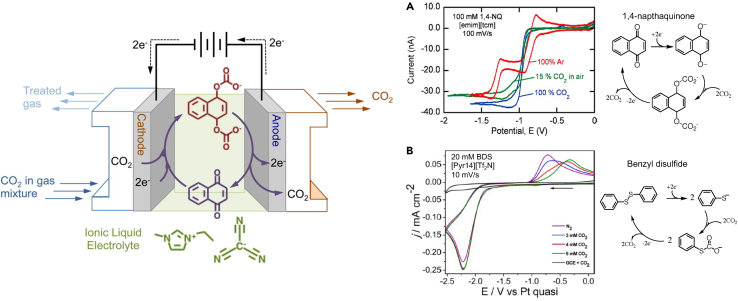
The desire toward decarbonization and renewable energy has sparked research interests in reactive CO separations, such as direct air capture that utilize electricity as opposed to conventional thermal and pressure swing processes, which are energy-intensive, cost-prohibitive, and fossil-fuel dependent. Although the electrochemical approaches in CO capture that support negative emissions technologies are promising in terms of modularity, smaller footprint, mild reaction conditions, and possibility to integrate into conversion processes, their practice depends on the wider availability of renewable electricity. This perspective discusses key advances made in electrolytes and electrodes with redox-active moieties that reversibly capture CO or facilitate its transport from a CO-rich side to a CO-lean side within the last decade. In support of the discovery of new heterogeneous electrode materials and electrolytes with redox carriers, the role of computational chemistry is also discussed.
对脱碳和可再生能源的需求引发了对反应性CO分离的研究兴趣,例如直接空气捕获,它利用电力,而不是传统的热变压和变压吸附过程,这些过程能源密集、成本高昂且依赖化石燃料。尽管支持负排放技术的CO捕获电化学方法在模块化、占地面积小、反应条件温和以及有可能集成到转化过程方面很有前景,但其实际应用取决于可再生电力的更广泛供应。本视角讨论了在过去十年中,含有可逆捕获CO或促进其从富CO侧传输到贫CO侧的氧化还原活性部分的电解质和电极方面取得的关键进展。为了支持发现具有氧化还原载体的新型非均相电极材料和电解质,还讨论了计算化学的作用。