Department of Transfusion Medicine and Haematology, Laboratory of Regenerative Medicine-Cell Factory, Fondazione IRCCS Ca' Granda Ospedale Maggiore Policlinico, Milan, Italy.
PLoS One. 2021 Dec 8;16(12):e0260902. doi: 10.1371/journal.pone.0260902. eCollection 2021.
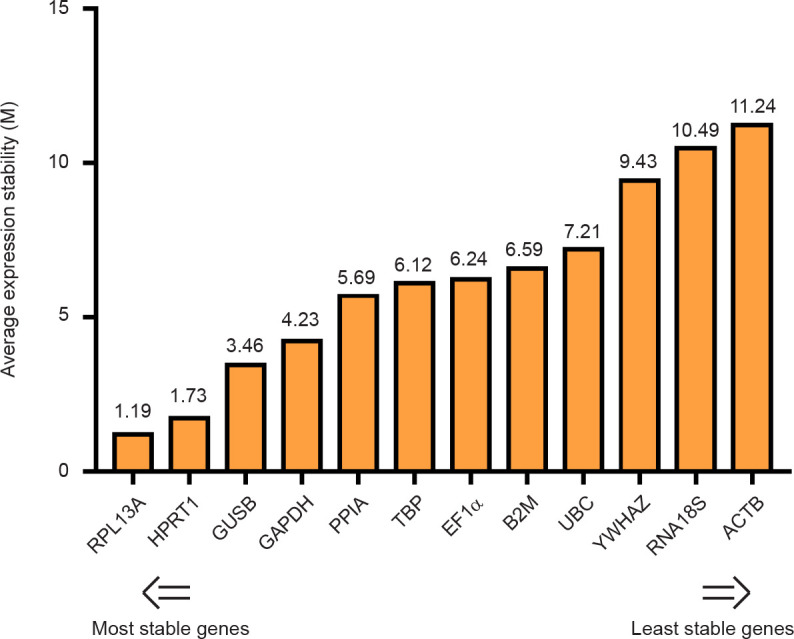
In the last few years, there has been a considerable increase in the use of organoids, which is a new three-dimensional culture technology applied in scientific research. The main reasons for their extensive use are their plasticity and multiple applications, including in regenerative medicine and the screening of new drugs. The aim of this study was to better understand these structures by focusing on the choice of the best housekeeping gene (HKG) to perform accurate molecular analysis on such a heterogeneous system. This feature should not be underestimated because the inappropriate use of a HKG can lead to misleading data and incorrect results, especially when the subject of the study is innovative and not totally explored like organoids. We focused our attention on the newly described human pancreatic organoids (hPOs) and compared 12 well-known HKGs (ACTB, B2M, EF1α, GAPDH, GUSB, HPRT, PPIA, RNA18S, RPL13A TBP, UBC and YWHAZ). Four different statistical algorithms (NormFinder, geNorm, BestKeeper and ΔCt) were applied to estimate the expression stability of each HKG, and RefFinder was used to identify the most suitable genes for RT-qPCR data normalization. Our results showed that the intragroup and intergroup comparisons could influence the best choice of the HKG, making clear that the identification of a stable reference gene for accurate and reproducible RT-qPCR data normalization remains a critical issue. In summary, this is the first report on HKGs in human organoids, and this work provides a strong basis to pave the way for further gene analysis in hPOs.
在过去的几年中,类器官的应用有了相当大的增加,这是一种新的三维培养技术,应用于科学研究。它们被广泛应用的主要原因是其可塑性和多种应用,包括再生医学和新药筛选。本研究的目的是通过关注选择最佳管家基因 (HKG) 来更好地理解这些结构,以便在这种异质系统上进行准确的分子分析。这一特性不容忽视,因为 HKG 的不当使用可能导致误导性数据和不正确的结果,尤其是当研究对象是像类器官这样具有创新性且尚未完全探索的对象时。我们将注意力集中在新描述的人类胰腺类器官 (hPO) 上,并比较了 12 种众所周知的 HKG(ACTB、B2M、EF1α、GAPDH、GUSB、HPRT、PPIA、RNA18S、RPL13A、TBP、UBC 和 YWHAZ)。应用了四种不同的统计算法(NormFinder、geNorm、BestKeeper 和 ΔCt)来估计每个 HKG 的表达稳定性,并使用 RefFinder 来确定最适合 RT-qPCR 数据归一化的基因。我们的结果表明,组内和组间比较会影响 HKG 的最佳选择,这清楚地表明,确定用于准确和可重复 RT-qPCR 数据归一化的稳定参考基因仍然是一个关键问题。总之,这是人类类器官中 HKG 的首次报道,这项工作为进一步在 hPO 中进行基因分析提供了坚实的基础。