Gazı State Hospital, Emergency Clinic Samsun, Turkey.
Department of Cardiology, Harran University Faculty of Medicine, Sanliurfa, Turkey.
Am J Emerg Med. 2021 Dec;50:631-635. doi: 10.1016/j.ajem.2021.09.046. Epub 2021 Sep 23.
COVID-19; It spread rapidly around the world and led to a global pandemic. Indicators of poor prognosis are important in the treatment and follow-up of COVID-19 patients and have always been a matter of interest to researchers. The aim of this study was to investigate the relationship between frontal QRS-T angle values and clinical severity and prognosis in COVID-19 patients.
This prospective case-control study was conducted with 130 COVID-19 patients whose diagnosis was confirmed by reverse transcriptase-polymerase chain reaction (RT-PCR) and 100 healthy controls. The CURB-65 score was used as the clinical severity score.
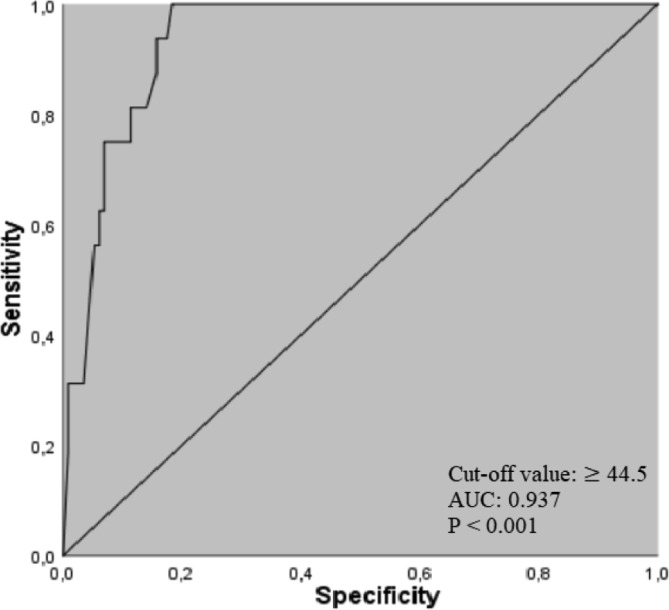
A total of 130 patients and 100 healthy controls were included in the study. When the patient and control groups were compared a significant difference was found between QT (378.07 ± 33.75 vs. 368.63 ± 19.65, p < 0.001), QTc (410.79 ± 28.19 vs. 403.68 ± 11.70, p < 0.001), QRS time (95.04 ± 21.67 vs. 91.42 ± 11.08, p < 0.001) and frontal QRS-T angle (36.57 ± 22.86 vs. 22.72 ± 14.08, p < 0.001). According to clinical severity scoring, QT (370.27 ± 25.20 vs. 387.75 ± 40.19, p = 0.003), QTc (402.18 ± 19.92 vs. 421.48 ± 33.08, p < 0.001), frontal QRS-T angle (32.25 ± 18.79 vs. 41.94 ± 26.27), p = 0.0.16) parameters were found to be significantly different. Age (odds ratio [OR], 1.201; 95% confidence interval [CI], 1.111-1.298; p < 0.001) and frontal QRS-T angle ([OR], 1.045; 95% [CI], 1.015-1.075; p = 0.003) values were found to be an independent predictor for the severity of the disease. Frontal QRS-T angle ([OR], 1.101; 95% [CI], 1.030-1.176; p = 0.004), and CRP ([OR], 1.029; 95% [CI], 1.007-1.051; p = 0.01) parameters were found to be independent predictors for the mortality of the disease. As a mortality indicator; for the frontal QRS-T angle of ≥44.5°, specificity and sensitivity were 93.8% and 84.2%, respectively.
Frontal QRS-T angle can be used as a reproducible, convenient, inexpensive, new and powerful predictor in determining the clinical severity and prognosis of COVID-19 patients.
COVID-19 在全球迅速传播,导致了全球大流行。不良预后指标在 COVID-19 患者的治疗和随访中非常重要,一直是研究人员关注的焦点。本研究旨在探讨 COVID-19 患者额面 QRS-T 角值与临床严重程度和预后的关系。
本前瞻性病例对照研究纳入了 130 例经逆转录-聚合酶链反应(RT-PCR)确诊的 COVID-19 患者和 100 例健康对照者。使用 CURB-65 评分作为临床严重程度评分。
共纳入 130 例患者和 100 例健康对照者。与对照组相比,患者组的 QT(378.07±33.75 与 368.63±19.65,p<0.001)、QTc(410.79±28.19 与 403.68±11.70,p<0.001)、QRS 时间(95.04±21.67 与 91.42±11.08,p<0.001)和额面 QRS-T 角(36.57±22.86 与 22.72±14.08,p<0.001)均显著延长。根据临床严重程度评分,QT(370.27±25.20 与 387.75±40.19,p=0.003)、QTc(402.18±19.92 与 421.48±33.08,p<0.001)、额面 QRS-T 角(32.25±18.79 与 41.94±26.27,p=0.016)的参数均显著不同。年龄(比值比[OR],1.201;95%置信区间[CI],1.111-1.298;p<0.001)和额面 QRS-T 角(OR,1.045;95%CI,1.015-1.075;p=0.003)是疾病严重程度的独立预测因素。额面 QRS-T 角(OR,1.101;95%CI,1.030-1.176;p=0.004)和 CRP(OR,1.029;95%CI,1.007-1.051;p=0.01)是疾病死亡率的独立预测因素。作为死亡率指标,额面 QRS-T 角≥44.5°的特异性和敏感性分别为 93.8%和 84.2%。
额面 QRS-T 角可作为一种重复性好、方便、廉价、新的、有力的预测指标,用于确定 COVID-19 患者的临床严重程度和预后。