Sangwan Jacques Singh, Petit Claire, Rose Romane Sainte, Frapsauce Cynthia, Dijols Laura, Rigot Jean Marc, Guérif Fabrice
Service de Médecine et Biologie de la Reproduction, Hôpital Bretonneau, F-37044, Tours, France.
Service de Gynécologie-Obstétrique, Hôpital Robert Debré, F-37400, Amboise, France.
Basic Clin Androl. 2021 Dec 9;31(1):30. doi: 10.1186/s12610-021-00149-1.
Non-obstructive azoospermia (NOA) with history of cryptorchidism and idiopathic NOA are the most common forms of NOA without genetic aetiology. Of all patients with one of these two types of NOA, only a few will have a positive TEsticular Sperm Extraction (TESE). Of those with positive extraction followed by sperm freezing, not all will have a child after TESE-ICSI. What are the ways and probabilities of taking home a baby for patients with NOA and a history of cryptorchidism compared with patients with idiopathic NOA?
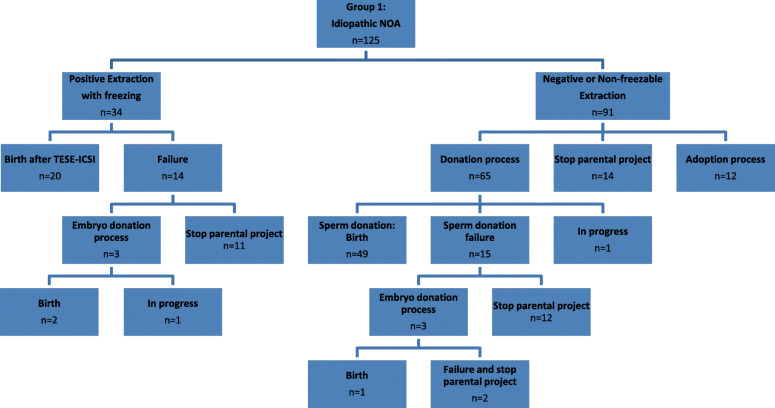
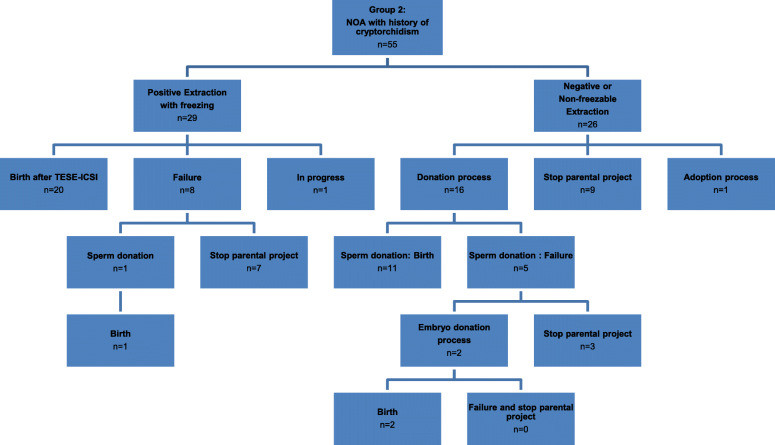
Patients with idiopathic NOA or NOA and a history of cryptorchidism who underwent their first TESE were included. The patients were divided into two groups: Group 1 was composed of 125 patients with idiopathic NOA and Group 2 of 55 patients with NOA and a history of surgically treated cryptorchidism. Our results showed that more than half of the NOA patients succeeded in becoming parents. The main way to fulfil their plans for parenthood is to use sperm or embryo donation (72%) for men with idiopathic NOA, whereas the majority of men with NOA and a history of cryptorchidism had a child after TESE-ICSI (58.8%).
In our centre, before considering TESE for a patient with NOA, we explain systematically TESE-ICSI alternatives (sperm donation, embryo donation or adoption). As a result, the couple can consider each solution to become parents.
伴有隐睾病史的非梗阻性无精子症(NOA)和特发性NOA是无遗传病因的NOA最常见的形式。在所有患有这两种类型NOA之一的患者中,只有少数人睾丸精子提取(TESE)结果呈阳性。在那些提取结果呈阳性并随后进行精子冷冻的患者中,并非所有人在TESE-ICSI后都能有孩子。与特发性NOA患者相比,伴有隐睾病史的NOA患者抱婴回家的方式和概率是怎样的?
纳入首次接受TESE的特发性NOA患者或伴有隐睾病史的NOA患者。患者分为两组:第1组由125例特发性NOA患者组成,第2组由55例伴有隐睾病史且接受过手术治疗的NOA患者组成。我们的结果表明,超过一半的NOA患者成功成为父母。实现生育计划的主要方式是特发性NOA男性使用精子或胚胎捐赠(72%),而大多数伴有隐睾病史的NOA男性在TESE-ICSI后有了孩子(58.8%)。
在我们中心,在考虑为NOA患者进行TESE之前,我们会系统地向其解释TESE-ICSI的替代方案(精子捐赠、胚胎捐赠或领养)。这样,夫妻双方可以考虑每种成为父母的解决方案。