Deng Libin, Xu Jingsong, Chen Wei, Guo Shicheng, Steiner Robert D, Chen Qi, Cheng Zhujun, Xu Yanmei, Yao Bei, Li Xiaoyan, Wang Xiaozhong, Deng Keyu, Schrodi Steven J, Zhang Dake, Xin Hongbo
The Second Affiliated Hospital of Nanchang University, Nanchang, China.
Institute of Translational Medicine, Nanchang University, Nanchang, China.
Front Genet. 2021 Nov 22;12:769699. doi: 10.3389/fgene.2021.769699. eCollection 2021.
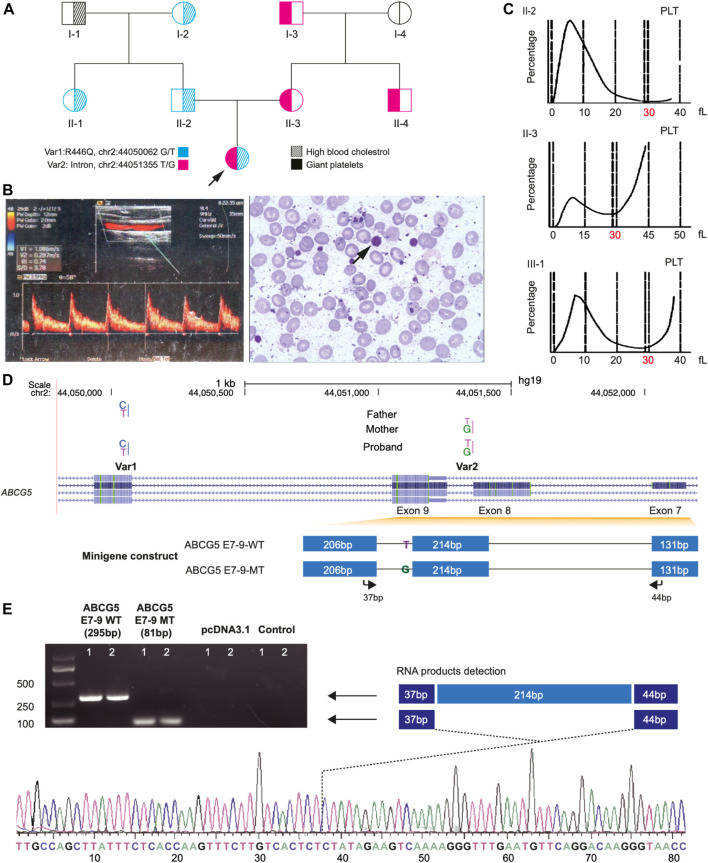
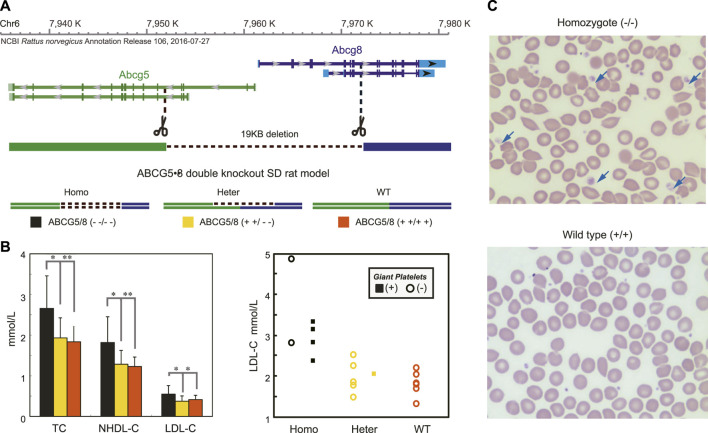
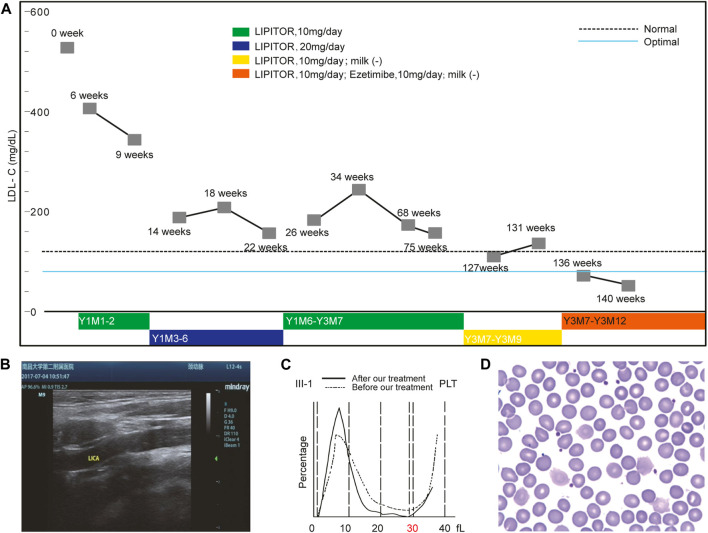
To investigate refractory hypercholesterolemia, a female patient and relatives were subjected to whole-genome sequencing. The proband was found to have compound heterozygous substitutions p. Arg446Gln and c.1118+3G>T in , one of two genes causing sitosterolemia. When tracing these variants in the full pedigree, all maternally related heterozygotes for the intronic variant exhibited large platelets (over 30 fl), which segregated in an autosomal dominant manner, consistent with macrothrombocytopenia, or large platelet syndrome which may be associated with a bleeding tendency. cell-line and rat model experiments supported a pathogenic role for the variant and the macrothrombocytopenia was recapitulated in heterozygous rats and human cell lines exhibiting that single variant. Ezetimibe treatment successfully ameliorated all the symptoms of the proband with sitosterolemia and resolved the macrothrombocytopenia of the treated heterozygote relatives. Subsequently, in follow up these observations, platelet size, and size distribution were measured in 1,180 individuals; 30 were found to be clinically abnormal, three of which carried a single known pathogenic variant (p.Arg446Ter) and two individuals carried novel variants of uncertain significance. In this study, we discovered that identification of large platelets and therefore a possible macrothrombocytopenia diagnosis could easily be inadvertently missed in clinical practice due to variable instrument settings. These findings suggest that heterozygosity may cause macrothrombocytopenia, that Ezetimibe treatment may resolve macrothrombocytopenia in such individuals, and that increased attention to platelet size on complete blood counts can aid in the identification of candidates for genetic testing who might benefit from Ezetimibe treatment.
为研究难治性高胆固醇血症,对一名女性患者及其亲属进行了全基因组测序。先证者被发现存在两个导致谷甾醇血症的基因之一中的复合杂合替代,即p.Arg446Gln和c.1118 + 3G>T。在整个家系中追踪这些变异时,内含子变异的所有母系相关杂合子均表现出大血小板(超过30 fl),其以常染色体显性方式分离,与大血小板减少症或可能与出血倾向相关的大血小板综合征一致。细胞系和大鼠模型实验支持该变异的致病作用,并且在表现出该单一变异的杂合大鼠和人类细胞系中重现了大血小板减少症。依折麦布治疗成功改善了先证者的谷甾醇血症的所有症状,并解决了接受治疗的杂合子亲属的大血小板减少症。随后,在对这些观察结果的随访中,对1180名个体测量了血小板大小和大小分布;发现30人临床上异常,其中3人携带单一已知致病变异(p.Arg446Ter),2人携带意义不确定的新变异。在本研究中,我们发现由于仪器设置的变化,在临床实践中很容易无意中遗漏大血小板的识别以及因此可能的大血小板减少症诊断。这些发现表明,该基因杂合性可能导致大血小板减少症,依折麦布治疗可能解决此类个体的大血小板减少症,并且在全血细胞计数时增加对血小板大小的关注有助于识别可能从依折麦布治疗中受益的该基因检测候选者。