Pérez-Muñoz Eréndira Patricia, Antunes-Ricardo Marilena, Martínez-Ávila Mariana, Guajardo-Flores Daniel
Tecnológico de Monterrey, Escuela de Ingeniería y Ciencias, Monterrey, Mexico.
Tecnológico de Monterrey, The Institute for Obesity Research, Monterrey, Mexico.
Front Nutr. 2022 May 20;9:878306. doi: 10.3389/fnut.2022.878306. eCollection 2022.
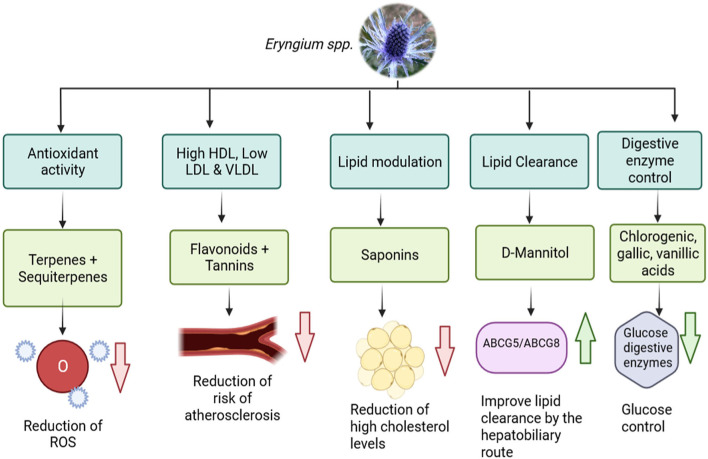
Medicinal plants possess natural compounds that can be used as an alternative for synthetic medicines that may cause long-term side effects on patients such as neurocognitive effects, muscular and hepatic toxicity. Metabolic Syndrome is associated with increased risk of several diseases such as diabetes, cardiovascular disease, dyslipidemia, and hypertension thus, becoming the greatest challenge as a growing public health concern worldwide. Latin-American countries possess a wide diversity of medicinal plants that have been used to treat different health conditions since pre-Hispanic times. spp. has been studied due to their beneficial properties mainly to treat diabetes, dyslipidemia, blood pressure, and digestive problems. This review gives an update mainly on the pharmacological activities of the spp., summarizing the biological activities and plausible mechanism of action of their bioactive components toward metabolic syndrome. For instance, flavonoids and tannins proved to increase the levels of HDL and reduced the levels of VLDL, LDL. On the other hand, phenolic acids improved glucose metabolism through the inhibition of phosphoenolpyruvate carboxykinase and glucose 6-phosphatase (G6Pase) and reestablished the impaired activity of enzymes related to glucose oxidation and glycogen synthesis. The terpenes and sesquiterpenes like β-farnese, β-pinene, and calamenene exhibited a protective effect by reducing the oxidizing damage by the regulation of the Reactive Oxygen Species (ROS). Saponins controlled the dyslipidemia by reducing the serum concentrations of lipids, triglycerides and total cholesterol. Finally, the aerial parts of had the capacity of inhibiting dietary carbohydrate digestive enzymes, thus controlling glucose levels. The plant is normally consumed as an infusion to obtain the benefits of the plants, however novel technologies such as cavitation, ultrasound assisted, microwave assisted, and supercritical fluid have been applied to improve the extraction yields and selectivity of bioactive compounds. The common treatment to control diabetic dyslipidemia are synthetic medicines such as metformin and ezetimibe, which allows the regulation of glucose, cholesterol and insulin resistance. However, patients that take these medications may present side effects such as muscular toxicity, hepatic toxicity, neurocognitive effects, just to name a few. More studies regarding the efficacy and safety of the use of traditional medicinal herbs are required. However, these materials may be used in the treatment of diabetes related conditions to ensure life quality and reduce side effects among the diabetic population.
药用植物含有天然化合物,可作为合成药物的替代品,合成药物可能会对患者产生长期副作用,如神经认知影响、肌肉和肝脏毒性。代谢综合征与多种疾病的风险增加相关,如糖尿病、心血管疾病、血脂异常和高血压,因此,作为全球日益严重的公共卫生问题,它正成为最大的挑战。拉丁美洲国家拥有丰富多样的药用植物,自前西班牙时期以来就被用于治疗各种健康状况。由于其有益特性,主要用于治疗糖尿病、血脂异常、血压和消化问题,对[植物名称]属植物进行了研究。本综述主要介绍了[植物名称]属植物的药理活性,总结了其生物活性成分对代谢综合征的生物学活性和可能的作用机制。例如,黄酮类化合物和单宁被证明可提高高密度脂蛋白水平并降低极低密度脂蛋白、低密度脂蛋白水平。另一方面,酚酸通过抑制磷酸烯醇丙酮酸羧激酶和葡萄糖6 -磷酸酶(G6Pase)改善葡萄糖代谢,并恢复与葡萄糖氧化和糖原合成相关酶的受损活性。萜类化合物和倍半萜类化合物,如β -法尼烯、β -蒎烯和卡拉烯,通过调节活性氧(ROS)减少氧化损伤,发挥保护作用。皂苷通过降低血清脂质、甘油三酯和总胆固醇浓度来控制血脂异常。最后,[植物名称]的地上部分具有抑制膳食碳水化合物消化酶的能力,从而控制血糖水平。通常将[植物名称]作为浸剂食用以获得植物的益处,然而,诸如空化、超声辅助、微波辅助和超临界流体等新技术已被应用于提高生物活性化合物的提取产率和选择性。控制糖尿病血脂异常的常用治疗方法是使用合成药物,如二甲双胍和依泽替米贝,它们可调节血糖、胆固醇和胰岛素抵抗。然而,服用这些药物的患者可能会出现副作用,如肌肉毒性、肝脏毒性、神经认知影响等。需要更多关于使用传统草药的疗效和安全性的研究。然而,这些材料可用于治疗与糖尿病相关的病症,以确保生活质量并减少糖尿病患者群体的副作用。