Wang Baomin, Yang Yumei, Yuan Haoyue, Li Xiaomu
Department of Endocrinology and Metabolism, Zhongshan Hospital, Fudan University, Shanghai 200032, China.
Int J Endocrinol. 2021 Nov 29;2021:9536730. doi: 10.1155/2021/9536730. eCollection 2021.
Glucose metabolism is frequently impaired in patients with Cushing's syndrome (CS) due to chronic exposure to excess glucocorticoids. Inflammation plays an essential role in the pathophysiology of diabetes mellitus (DM). The present study aimed to investigate the potential associations of inflammatory blood cell parameters, including white blood cell (WBC) count, neutrophil count, neutrophilic granulocyte percentage (NEUT%), lymphocyte count (LYM), and lymphocyte proportion (LYM%), with diabetes mellitus in Cushing's syndrome patients.
The cross-sectional study was conducted in Zhongshan Hospital of Fudan University, China. A total of 150 patients with Cushing's syndrome were retrospectively screened from 2017 to 2019. The demographic data, clinical data, and blood samples (lipids, adrenal, glucose, and inflammatory blood cell parameters) were recorded. Statistical analyses were carried out by using the SPSS software package, version 13.0.
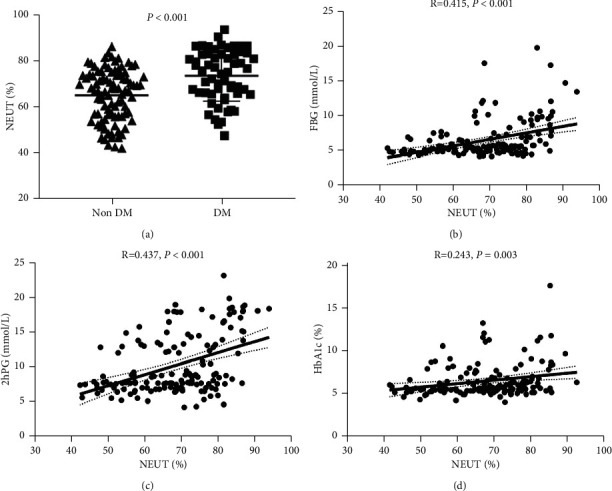
In this study, the prevalence of diabetes mellitus was 38.7% in patients with Cushing's syndrome. Patients with DM had higher WBC, neutrophil, NEUT% levels than patients without DM ( < 0.05). As the NEUT% increased, a stepwise increase in glucose and glycated hemoglobin (HbA1c) level was observed. In addition, in the multivariate logistic regression, NEUT% was a significant independent risk factor for DM, regardless of gender, age, body mass index (BMI), and triglyceride and 12 midnight cortisol (12 MN cortisol) level (OR = 2.542, 95% CI 1.337-4.835, < 0.001).
In conclusion, elevated NEUT% level was linked to diabetes in patients with Cushing's syndrome. The neutrophilic granulocyte percentage may be referred to as a new predictor for diabetes in Cushing's syndrome patients.
由于长期暴露于过量糖皮质激素,库欣综合征(CS)患者的葡萄糖代谢常受损。炎症在糖尿病(DM)的病理生理学中起重要作用。本研究旨在探讨炎症血细胞参数,包括白细胞(WBC)计数、中性粒细胞计数、中性粒细胞百分比(NEUT%)、淋巴细胞计数(LYM)和淋巴细胞比例(LYM%)与库欣综合征患者糖尿病之间的潜在关联。
本横断面研究在中国复旦大学附属中山医院进行。回顾性筛选了2017年至2019年期间共150例库欣综合征患者。记录了人口统计学数据、临床数据和血液样本(血脂、肾上腺、血糖和炎症血细胞参数)。使用SPSS 13.0软件包进行统计分析。
在本研究中,库欣综合征患者的糖尿病患病率为38.7%。糖尿病患者的白细胞、中性粒细胞、中性粒细胞百分比水平高于非糖尿病患者(<0.05)。随着中性粒细胞百分比的增加,血糖和糖化血红蛋白(HbA1c)水平呈逐步上升趋势。此外,在多因素逻辑回归分析中,无论性别、年龄、体重指数(BMI)、甘油三酯和午夜12点皮质醇(12 MN皮质醇)水平如何,中性粒细胞百分比都是糖尿病的显著独立危险因素(OR = 2.542,95%CI 1.337 - 4.835,<0.001)。
总之,中性粒细胞百分比升高与库欣综合征患者的糖尿病有关。中性粒细胞百分比可作为库欣综合征患者糖尿病的新预测指标。