KIET Group of Institutions, Delhi NCR, Ghaziabad, India.
Govt. Bikram College of Commerce, Patiala, India.
J Healthc Eng. 2021 Nov 29;2021:6712424. doi: 10.1155/2021/6712424. eCollection 2021.
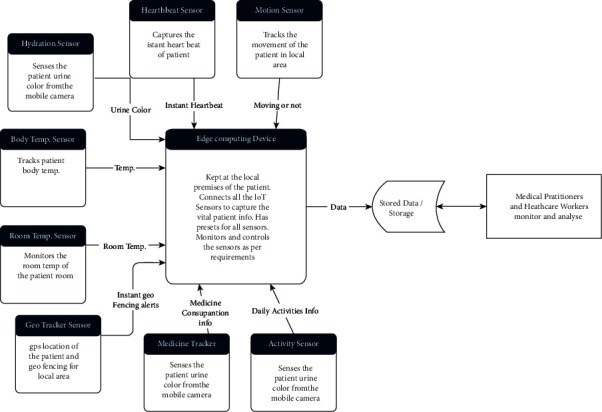
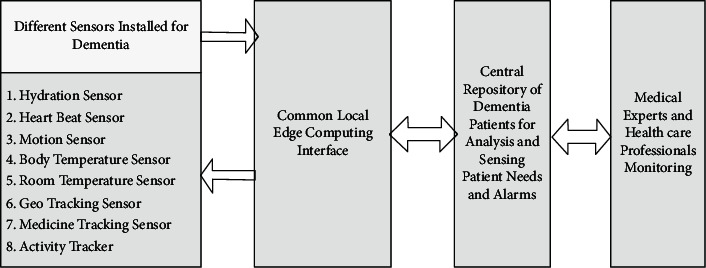
The Internet of Medical Things (IoMT) has emerged as one of the most important key applications of IoT. IoMT makes the diagnosis and care more convenient and reliable with proven results. The paper presents the technology, open issues, and challenges of IoMT-based systems. It explores the various types of sensors and smart equipment based on IoMT and used for diagnosis and patient care. A comprehensive survey of early detection and postdetection care of the neural disorder dementia is conducted. The paper also presents a postdiagnosis dementia care model named "Demencare." This model incorporates eight sensors capable of tracking the daily routine of dementia patient. The patients can be monitored locally by an edge computing device kept at their premises. The medical experts may also monitor the patients' status for any deviation from normal behavior. IoMT enables better postdiagnosis care for neural disorders, like dementia and Alzheimer's. The patient's behavior and vital parameters are always available despite the remote location of the patients. The data of the patients may be classified, and new insights may be obtained to tackle patients in a better manner.
物联网医疗(IoMT)已成为物联网最重要的关键应用之一。IoMT 通过已证明的结果使诊断和护理更加方便和可靠。本文介绍了基于 IoMT 的系统的技术、开放问题和挑战。它探讨了基于 IoMT 的各种类型的传感器和智能设备,用于诊断和患者护理。对神经障碍痴呆症的早期检测和检测后护理进行了全面调查。本文还提出了一种名为“Demencare”的诊断后痴呆症护理模型。该模型结合了八个传感器,能够跟踪痴呆症患者的日常生活。患者可以通过放置在其场所的边缘计算设备进行本地监测。医疗专家也可以监测患者的状态,以发现任何异常行为。IoMT 使神经障碍(如痴呆症和阿尔茨海默病)的诊断后护理得到改善。即使患者位于远程位置,也可以随时获得患者的行为和生命参数。可以对患者的数据进行分类,并获得新的见解,以便更好地治疗患者。