
用于三维神经元培养的大孔多糖基支架的物理化学性质调控
Tuning Physicochemical Properties of a Macroporous Polysaccharide-Based Scaffold for 3D Neuronal Culture.
作者信息
Gerschenfeld Gaspard, Aid Rachida, Simon-Yarza Teresa, Lanouar Soraya, Charnay Patrick, Letourneur Didier, Topilko Piotr
机构信息
Ecole Normale Supérieure, PSL Research University, CNRS, Inserm, Institut de Biologie de l'Ecole Normale Supérieure (IBENS), F-75005 Paris, France.
Collège Doctoral, Sorbonne Université, F-75005 Paris, France.
出版信息
Int J Mol Sci. 2021 Nov 25;22(23):12726. doi: 10.3390/ijms222312726.
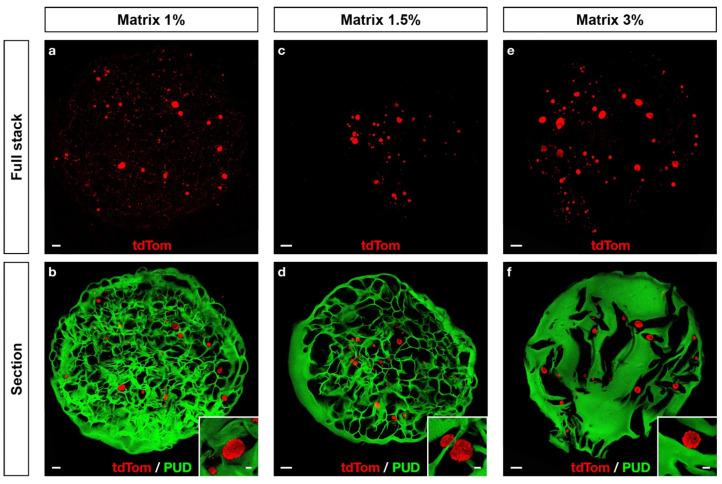
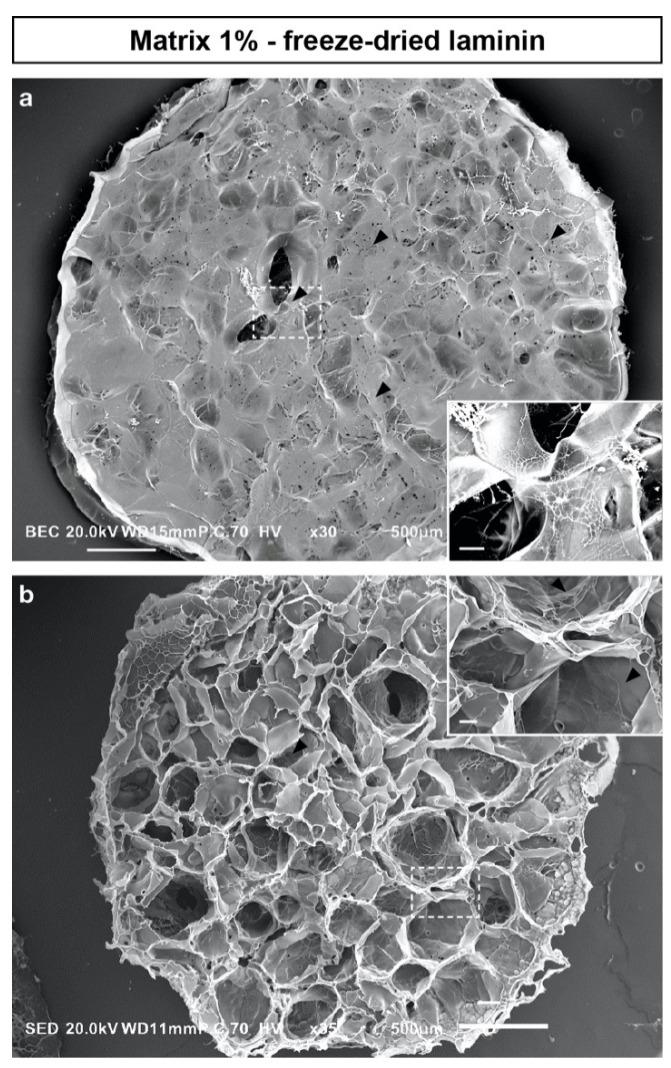
Central nervous system (CNS) lesions are a leading cause of death and disability worldwide. Three-dimensional neural cultures in biomaterials offer more physiologically relevant models for disease studies, toxicity screenings or in vivo transplantations. Herein, we describe the development and use of pullulan/dextran polysaccharide-based scaffolds for 3D neuronal culture. We first assessed scaffolding properties upon variation of the concentration (1%, 1.5%, 3% /) of the cross-linking agent, sodium trimetaphosphate (STMP). The lower STMP concentration (1%) allowed us to generate scaffolds with higher porosity (59.9 ± 4.6%), faster degradation rate (5.11 ± 0.14 mg/min) and lower elastic modulus (384 ± 26 Pa) compared with 3% STMP scaffolds (47 ± 2.1%, 1.39 ± 0.03 mg/min, 916 ± 44 Pa, respectively). Using primary cultures of embryonic neurons from embryos, we observed that in 3D culture, embryonic neurons remained in aggregates within the scaffolds and did not attach, spread or differentiate. To enhance neuronal adhesion and neurite outgrowth, we then functionalized the 1% STMP scaffolds with laminin. We found that treatment of the scaffold with a 100 μg/mL solution of laminin, combined with a subsequent freeze-drying step, created a laminin mesh network that significantly enhanced embryonic neuron adhesion, neurite outgrowth and survival. Such scaffold therefore constitutes a promising neuron-compatible and biodegradable biomaterial.
中枢神经系统(CNS)损伤是全球范围内导致死亡和残疾的主要原因。生物材料中的三维神经培养为疾病研究、毒性筛选或体内移植提供了更具生理相关性的模型。在此,我们描述了基于支链淀粉/葡聚糖多糖的支架用于三维神经元培养的开发和应用。我们首先评估了交联剂三聚偏磷酸钠(STMP)浓度(1%、1.5%、3%)变化时的支架性能。与3% STMP支架(分别为47±2.1%、1.39±0.03 mg/min、916±44 Pa)相比,较低的STMP浓度(1%)使我们能够制备出具有更高孔隙率(59.9±4.6%)、更快降解速率(5.11±0.14 mg/min)和更低弹性模量(384±26 Pa)的支架。使用来自胚胎的原代胚胎神经元培养物,我们观察到在三维培养中,胚胎神经元聚集在支架内,不附着、伸展或分化。为了增强神经元的黏附及神经突生长,我们随后用层粘连蛋白对1% STMP支架进行功能化处理。我们发现,用100 μg/mL层粘连蛋白溶液处理支架,并随后进行冷冻干燥步骤,可形成层粘连蛋白网状网络,显著增强胚胎神经元的黏附、神经突生长和存活。因此,这种支架构成了一种有前景的与神经元相容且可生物降解的生物材料。


 Zotero 插件