• 文献检索
  • 文档翻译
  • 深度研究
  • 学术资讯
  • Suppr Zotero 插件Zotero 插件
  • 邀请有礼
  • 套餐&价格
  • 历史记录
应用&插件
Suppr Zotero 插件Zotero 插件浏览器插件Mac 客户端Windows 客户端微信小程序
定价
高级版会员购买积分包购买API积分包
服务
文献检索文档翻译深度研究API 文档MCP 服务
关于我们
关于 Suppr公司介绍联系我们用户协议隐私条款
关注我们

Suppr 超能文献

核心技术专利:CN118964589B侵权必究
粤ICP备2023148730 号-1Suppr @ 2026

文献检索

告别复杂PubMed语法,用中文像聊天一样搜索,搜遍4000万医学文献。AI智能推荐,让科研检索更轻松。

立即免费搜索

文件翻译

保留排版,准确专业,支持PDF/Word/PPT等文件格式,支持 12+语言互译。

免费翻译文档

深度研究

AI帮你快速写综述,25分钟生成高质量综述,智能提取关键信息,辅助科研写作。

立即免费体验

体外策略使 3D 生理相关模型血管化。

In Vitro Strategies to Vascularize 3D Physiologically Relevant Models.

机构信息

Université de Paris, INSERM U1148, X Bichat Hospital, Paris, F-75018, France.

Elvesys Microfluidics Innovation Center, Paris, 75011, France.

出版信息

Adv Sci (Weinh). 2021 Oct;8(19):e2100798. doi: 10.1002/advs.202100798. Epub 2021 Aug 5.

DOI:10.1002/advs.202100798
PMID:34351702
原文链接:https://pmc.ncbi.nlm.nih.gov/articles/PMC8498873/
Abstract

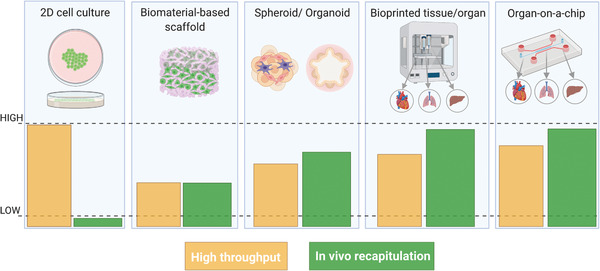
Vascularization of 3D models represents a major challenge of tissue engineering and a key prerequisite for their clinical and industrial application. The use of prevascularized models built from dedicated materials could solve some of the actual limitations, such as suboptimal integration of the bioconstructs within the host tissue, and would provide more in vivo-like perfusable tissue and organ-specific platforms. In the last decade, the fabrication of vascularized physiologically relevant 3D constructs has been attempted by numerous tissue engineering strategies, which are classified here in microfluidic technology, 3D coculture models, namely, spheroids and organoids, and biofabrication. In this review, the recent advancements in prevascularization techniques and the increasing use of natural and synthetic materials to build physiological organ-specific models are discussed. Current drawbacks of each technology, future perspectives, and translation of vascularized tissue constructs toward clinics, pharmaceutical field, and industry are also presented. By combining complementary strategies, these models are envisioned to be successfully used for regenerative medicine and drug development in a near future.

摘要

三维模型的血管化是组织工程的主要挑战,也是其临床和工业应用的关键前提。使用专门材料构建的预血管化模型可以解决一些实际限制,例如生物构建体在宿主组织中的整合不理想,并将提供更类似于体内的可灌注组织和器官特异性平台。在过去的十年中,已经通过许多组织工程策略尝试制造血管化的生理相关的 3D 构建体,这些策略在这里被分类为微流控技术、3D 共培养模型,即球体和类器官,以及生物制造。在这篇综述中,讨论了预血管化技术的最新进展,以及越来越多地使用天然和合成材料来构建生理器官特异性模型。还介绍了每种技术的当前缺点、未来展望以及血管化组织构建体向临床、制药领域和工业的转化。通过结合互补策略,预计这些模型将在不久的将来成功用于再生医学和药物开发。
https://cdn.ncbi.nlm.nih.gov/pmc/blobs/1239/8498873/2f43a374b26e/ADVS-8-2100798-g007.jpg
https://cdn.ncbi.nlm.nih.gov/pmc/blobs/1239/8498873/5e7ce560bbc5/ADVS-8-2100798-g014.jpg
https://cdn.ncbi.nlm.nih.gov/pmc/blobs/1239/8498873/f733fec2efe6/ADVS-8-2100798-g012.jpg
https://cdn.ncbi.nlm.nih.gov/pmc/blobs/1239/8498873/e43fba718104/ADVS-8-2100798-g008.jpg
https://cdn.ncbi.nlm.nih.gov/pmc/blobs/1239/8498873/337cba35e60e/ADVS-8-2100798-g011.jpg
https://cdn.ncbi.nlm.nih.gov/pmc/blobs/1239/8498873/41fd54e130f9/ADVS-8-2100798-g010.jpg
https://cdn.ncbi.nlm.nih.gov/pmc/blobs/1239/8498873/6fe539ad7340/ADVS-8-2100798-g003.jpg
https://cdn.ncbi.nlm.nih.gov/pmc/blobs/1239/8498873/4ee7a5552c60/ADVS-8-2100798-g002.jpg
https://cdn.ncbi.nlm.nih.gov/pmc/blobs/1239/8498873/c1f7feae47eb/ADVS-8-2100798-g006.jpg
https://cdn.ncbi.nlm.nih.gov/pmc/blobs/1239/8498873/2f43a374b26e/ADVS-8-2100798-g007.jpg
https://cdn.ncbi.nlm.nih.gov/pmc/blobs/1239/8498873/5e7ce560bbc5/ADVS-8-2100798-g014.jpg
https://cdn.ncbi.nlm.nih.gov/pmc/blobs/1239/8498873/f733fec2efe6/ADVS-8-2100798-g012.jpg
https://cdn.ncbi.nlm.nih.gov/pmc/blobs/1239/8498873/e43fba718104/ADVS-8-2100798-g008.jpg
https://cdn.ncbi.nlm.nih.gov/pmc/blobs/1239/8498873/337cba35e60e/ADVS-8-2100798-g011.jpg
https://cdn.ncbi.nlm.nih.gov/pmc/blobs/1239/8498873/41fd54e130f9/ADVS-8-2100798-g010.jpg
https://cdn.ncbi.nlm.nih.gov/pmc/blobs/1239/8498873/6fe539ad7340/ADVS-8-2100798-g003.jpg
https://cdn.ncbi.nlm.nih.gov/pmc/blobs/1239/8498873/4ee7a5552c60/ADVS-8-2100798-g002.jpg
https://cdn.ncbi.nlm.nih.gov/pmc/blobs/1239/8498873/c1f7feae47eb/ADVS-8-2100798-g006.jpg
https://cdn.ncbi.nlm.nih.gov/pmc/blobs/1239/8498873/2f43a374b26e/ADVS-8-2100798-g007.jpg

相似文献

1
In Vitro Strategies to Vascularize 3D Physiologically Relevant Models.体外策略使 3D 生理相关模型血管化。
Adv Sci (Weinh). 2021 Oct;8(19):e2100798. doi: 10.1002/advs.202100798. Epub 2021 Aug 5.
2
Bioprinting for vascular and vascularized tissue biofabrication.用于血管和血管化组织生物制造的生物打印
Acta Biomater. 2017 Mar 15;51:1-20. doi: 10.1016/j.actbio.2017.01.035. Epub 2017 Jan 11.
3
Advances in tissue engineering of vasculature through three-dimensional bioprinting.通过三维生物打印实现的血管组织工程进展。
Dev Dyn. 2021 Dec;250(12):1717-1738. doi: 10.1002/dvdy.385. Epub 2021 Jul 2.
4
High-throughput fabrication of vascularized spheroids for bioprinting.高通量制造用于生物打印的血管化球体。
Biofabrication. 2018 Jun 12;10(3):035009. doi: 10.1088/1758-5090/aac7e6.
5
3D Bioprinting for Vascularized Tissue Fabrication.用于血管化组织构建的3D生物打印
Ann Biomed Eng. 2017 Jan;45(1):132-147. doi: 10.1007/s10439-016-1653-z. Epub 2016 May 26.
6
Multiscale bioprinting of vascularized models.多尺度生物打印血管化模型。
Biomaterials. 2019 Apr;198:204-216. doi: 10.1016/j.biomaterials.2018.08.006. Epub 2018 Aug 3.
7
Strategies for 3D bioprinting of spheroids: A comprehensive review.球形聚集体的 3D 生物打印策略:全面综述。
Biomaterials. 2022 Dec;291:121881. doi: 10.1016/j.biomaterials.2022.121881. Epub 2022 Oct 28.
8
3D bioprinted liver tissue and disease models: Current advances and future perspectives.3D生物打印肝脏组织与疾病模型:当前进展与未来展望
Biomater Adv. 2023 Sep;152:213499. doi: 10.1016/j.bioadv.2023.213499. Epub 2023 Jun 5.
9
Vascularized microfluidic organ-chips for drug screening, disease models and tissue engineering.用于药物筛选、疾病模型和组织工程的血管化微流控器官芯片。
Curr Opin Biotechnol. 2018 Aug;52:116-123. doi: 10.1016/j.copbio.2018.03.011. Epub 2018 Apr 12.
10
Biomaterial-based 3D bioprinting strategy for orthopedic tissue engineering.用于骨科组织工程的基于生物材料的3D生物打印策略
Acta Biomater. 2023 Jan 15;156:4-20. doi: 10.1016/j.actbio.2022.08.004. Epub 2022 Aug 10.

引用本文的文献

1
Mapping the arterial vascular network in an intact human kidney using hierarchical phase-contrast tomography.使用分层相衬断层扫描技术绘制完整人类肾脏中的动脉血管网络。
Npj Imaging. 2025 Sep 3;3(1):39. doi: 10.1038/s44303-025-00090-2.
2
Three-dimensional cell sheet model improves prediction accuracy of osteogenic potential for biodegradable magnesium-based metals.三维细胞片层模型提高了可降解镁基金属成骨潜力的预测准确性。
Bioact Mater. 2025 Aug 23;54:291-310. doi: 10.1016/j.bioactmat.2025.08.013. eCollection 2025 Dec.
3
Organoids/organs-on-chips towards biomimetic human artificial skin.

本文引用的文献

1
Microtechnology-based methods for organoid models.基于微技术的类器官模型构建方法。
Microsyst Nanoeng. 2020 Oct 5;6:76. doi: 10.1038/s41378-020-00185-3. eCollection 2020.
2
A Review of Vat Photopolymerization Technology: Materials, Applications, Challenges, and Future Trends of 3D Printing.光固化3D打印技术综述:3D打印的材料、应用、挑战及未来趋势
Polymers (Basel). 2021 Feb 17;13(4):598. doi: 10.3390/polym13040598.
3
On-chip high-definition bioprinting of microvascular structures.片上高清生物打印微脉管结构
用于仿生人类人造皮肤的类器官/芯片上器官
Burns Trauma. 2025 May 3;13:tkaf029. doi: 10.1093/burnst/tkaf029. eCollection 2025.
4
In situ vascularization and epithelialization of segmental bioengineered trachea based on marrow-derived stem/progenitor cells.基于骨髓源干细胞的节段性生物工程气管的原位血管化和上皮化
Mater Today Bio. 2025 Jun 14;33:101990. doi: 10.1016/j.mtbio.2025.101990. eCollection 2025 Aug.
5
A Versatile Platform for Designing and Fabricating Multi-Material Perfusable 3D Microvasculatures.一个用于设计和制造多材料可灌注三维微血管系统的多功能平台。
Micromachines (Basel). 2025 Jun 8;16(6):691. doi: 10.3390/mi16060691.
6
Engineering in vitro vascular microsystems.体外血管微系统工程
Microsyst Nanoeng. 2025 May 22;11(1):100. doi: 10.1038/s41378-025-00956-w.
7
Pericytes Promote More Vascularization than Stromal Cells via an Interleukin-6-Dependent Mechanism in Microfluidic Chips.在微流控芯片中,周细胞通过白细胞介素-6依赖性机制比基质细胞促进更多血管生成。
Adv Sci (Weinh). 2025 Apr;12(14):e2408131. doi: 10.1002/advs.202408131. Epub 2025 Jan 30.
8
Rethinking Biomedical Titanium Alloy Design: A Review of Challenges from Biological and Manufacturing Perspectives.重新思考生物医学钛合金设计:从生物学和制造角度审视挑战
Adv Healthc Mater. 2025 Feb;14(4):e2403129. doi: 10.1002/adhm.202403129. Epub 2024 Dec 23.
9
Bioengineered human arterial equivalent and its applications from vascular graft to disease modeling.生物工程化的人体动脉等效物及其从血管移植到疾病建模的应用。
iScience. 2024 Oct 19;27(11):111215. doi: 10.1016/j.isci.2024.111215. eCollection 2024 Nov 15.
10
vascularization of 3D cell aggregates in microwells with integrated vascular beds.具有集成血管床的微孔中3D细胞聚集体的血管化
Mater Today Bio. 2024 Sep 19;29:101260. doi: 10.1016/j.mtbio.2024.101260. eCollection 2024 Dec.
Biofabrication. 2021 Feb 13;13(1):015016. doi: 10.1088/1758-5090/abb063.
4
Modeling the Human Body on Microfluidic Chips.在微流控芯片上对人体进行建模。
Trends Biotechnol. 2021 Aug;39(8):838-852. doi: 10.1016/j.tibtech.2021.01.004. Epub 2021 Feb 10.
5
Vascularized organoids on a chip: strategies for engineering organoids with functional vasculature.芯片上的血管化类器官:构建具有功能性脉管系统类器官的策略
Lab Chip. 2021 Feb 9;21(3):473-488. doi: 10.1039/d0lc01186j.
6
Dual 3D printing for vascularized bone tissue regeneration.双重 3D 打印用于血管化骨组织再生。
Acta Biomater. 2021 Mar 15;123:263-274. doi: 10.1016/j.actbio.2021.01.012. Epub 2021 Jan 14.
7
Vascularized Organoids: A More Complete Model.血管化类器官:一个更完整的模型。
Int J Stem Cells. 2021 May 30;14(2):127-137. doi: 10.15283/ijsc20143.
8
Protocol for Large-Scale Production of Kidney Organoids from Human Pluripotent Stem Cells.人类多能干细胞大规模生产肾类器官的方案。
STAR Protoc. 2020 Oct 29;1(3):100150. doi: 10.1016/j.xpro.2020.100150. eCollection 2020 Dec 18.
9
A blueprint for translational regenerative medicine.转化再生医学蓝图。
Sci Transl Med. 2020 Dec 2;12(572). doi: 10.1126/scitranslmed.aaz2253.
10
Channeled polysaccharide-based hydrogel reveals influence of curvature to guide endothelial cell arrangement in vessel-like structures.基于通道化多糖的水凝胶揭示了曲率对引导内皮细胞在血管样结构中排列的影响。
Mater Sci Eng C Mater Biol Appl. 2021 Jan;118:111369. doi: 10.1016/j.msec.2020.111369. Epub 2020 Aug 11.