
环境正义与循环经济:分析巴西福塔莱萨即将到来的循环经济中拾荒者的正义问题。
Environmental Justice and Circular Economy: Analyzing Justice for Waste Pickers in Upcoming Circular Economy in Fortaleza, Brazil.
作者信息
Amorim de Oliveira Ísis
机构信息
Nagoya University: Graduate School of Environmental Studies (GSES) - Social Human Environment (SHE), Nagoya, Aichi Japan.
出版信息
Circ Econ Sustain. 2021;1(3):815-834. doi: 10.1007/s43615-021-00045-w. Epub 2021 May 19.
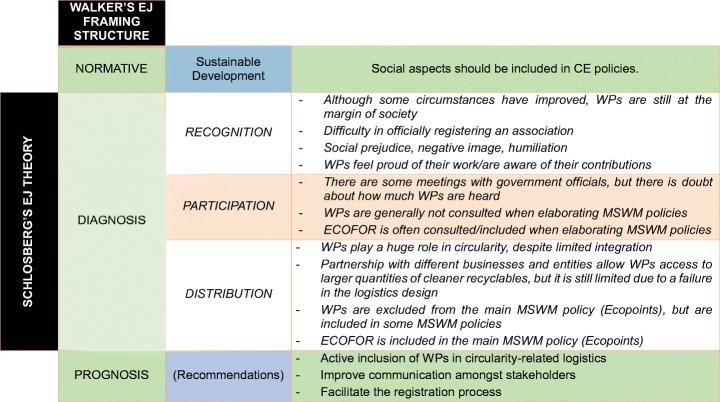
Sustainable development (SD) presents three pillars: environment, equality, and economy. Many scholars agree that circular economy (CE) currently displays a social gap, as most studies so far focus mostly on economic aspects and, occasionally, environmental too. Although some developed countries and especially the EU heavily promote it, there is little possibility of developing countries accepting CE unless it can fill what it is lacking. This study suggests the use of Schlosberg's tripartite environmental justice (EJ) perspective to complete the concept of CE, bringing it closer to that of SD. Due to their significant contribution to both circularity and the environment, and, likewise, due to their poor social conditions, this paper focuses on the social group of WPs, mainly in Brazil. After conducting 19 semi-structured interviews, EJ was applied to the case of the Ecopoints in Fortaleza (northeastern Brazil) and each element-recognition, distribution, and participation-detected conflicts, such as underappreciation, continuously reduced access to recyclables, distrust, and miscommunication. If CE is successful in LMCs, it will heavily rely on WPs. The analysis suggests that it is necessary to recognize their contributions in order to value their work and consequently, promote their social inclusion.
可持续发展呈现出三个支柱
环境、平等和经济。许多学者一致认为,循环经济目前存在社会差距,因为迄今为止大多数研究主要集中在经济方面,偶尔也涉及环境方面。尽管一些发达国家,尤其是欧盟大力推广循环经济,但除非能弥补其不足之处,否则发展中国家接受循环经济的可能性很小。本研究建议运用施洛斯伯格的三方环境正义视角来完善循环经济的概念,使其更接近可持续发展的概念。鉴于工人阶级对循环性和环境都有重大贡献,同样,由于他们社会条件较差,本文主要聚焦于巴西的工人阶级这一社会群体。在进行了19次半结构化访谈后,环境正义被应用于福塔莱萨(巴西东北部)的生态点案例,并且识别、分配和参与这三个要素都发现了冲突,比如不被重视、可回收物获取机会不断减少、不信任以及沟通不畅。如果循环经济在低收入和中等收入国家取得成功,将严重依赖工人阶级。分析表明,有必要认可他们的贡献,以便重视他们的工作,从而促进他们的社会包容。


 Zotero 插件