Gutberlet Jutta, Uddin Sayed Mohammad Nazim
a Department of Geography , University of Victoria , Victoria , Canada.
Int J Occup Environ Health. 2017 Oct;23(4):299-310. doi: 10.1080/10773525.2018.1484996. Epub 2018 Jun 20.
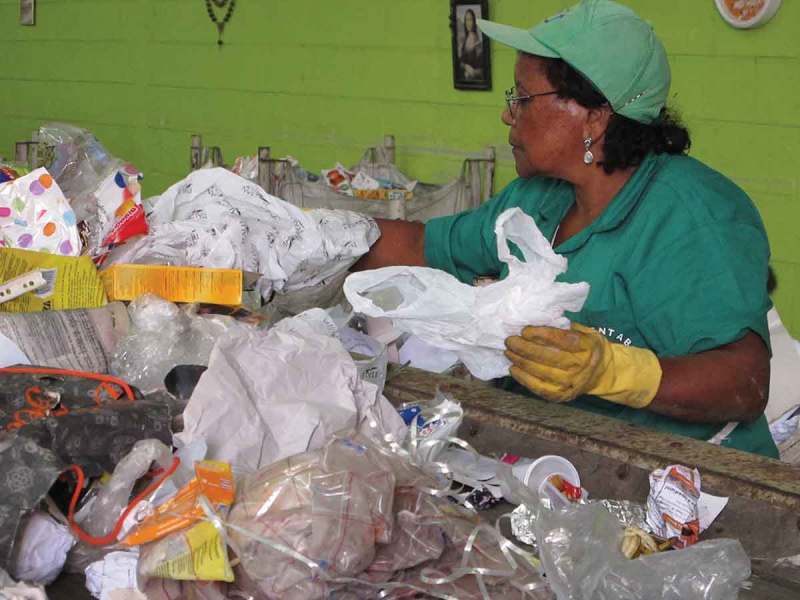
Household waste has evolved into a core urban challenge, with increased quantities of waste being generated and with more complex material compositions, often containing toxic and hazardous elements. Critical systems theory understands cities as urban metabolisms, with different material and energy flows, highlighting the circularity in production, consumption, and discard. Waste pickers in low- and medium-income countries work on dumps and landfills, sifting through highly contaminated household waste and are exposed to health hazards. This paper discusses the risk factors, hazards, and vulnerabilities waste pickers are exposed to during collection and separation of recyclables, based on the review of literature on waste and environmental health and on findings from participatory research with waste pickers conducted in Brazil. We take a social and environmental justice perspective and identify the vulnerabilities and waste-borne hazards of household waste, associated with these workers, their communities, watersheds, and the environment. Household waste, although not always per se toxic or hazardous, can become a hazard if not collected or inadequately managed. Those communities where household waste is not collected or waste collection is insufficient are the most critical places. Informal and organized waste pickers, municipal or private waste collectors/workers, small waste traders and sometimes residents, particularly small children, may be considered vulnerable if exposed to waste-borne hazards. The results include recommendations to address household waste-borne hazards and vulnerabilities, according to waste workers involved in this research.
家庭垃圾已演变成城市面临的一项核心挑战,垃圾产生量不断增加,物质成分愈发复杂,且往往含有有毒有害物质。批判系统理论将城市理解为城市新陈代谢,存在不同的物质和能量流动,强调生产、消费及丢弃过程中的循环性。中低收入国家的拾荒者在垃圾场和填埋场工作,从高度污染的家庭垃圾中筛选可回收物,面临健康风险。本文基于对垃圾与环境卫生相关文献的综述以及在巴西对拾荒者开展的参与式研究结果,探讨了拾荒者在收集和分拣可回收物过程中面临的风险因素、危害及脆弱性。我们从社会和环境正义的角度出发,确定了与这些工人、他们的社区、流域及环境相关的家庭垃圾的脆弱性和垃圾带来的危害。家庭垃圾本身虽不一定有毒或有害,但如果收集不当或管理不善,就可能成为一种危害。那些家庭垃圾未被收集或收集不足的社区是最关键的地方。如果接触到垃圾带来的危害,非正规和有组织的拾荒者、市政或私人垃圾收集者/工人、小垃圾交易商,有时还有居民,特别是小孩子,可能会被视为弱势群体。根据参与本研究的垃圾处理工人的情况,研究结果包括应对家庭垃圾带来的危害和脆弱性的建议。