Klinik für Innere Medizin II, Universitätsklinikum Jena, Jena, Germany.
Hematology Am Soc Hematol Educ Program. 2021 Dec 10;2021(1):106-112. doi: 10.1182/hematology.2021000238.
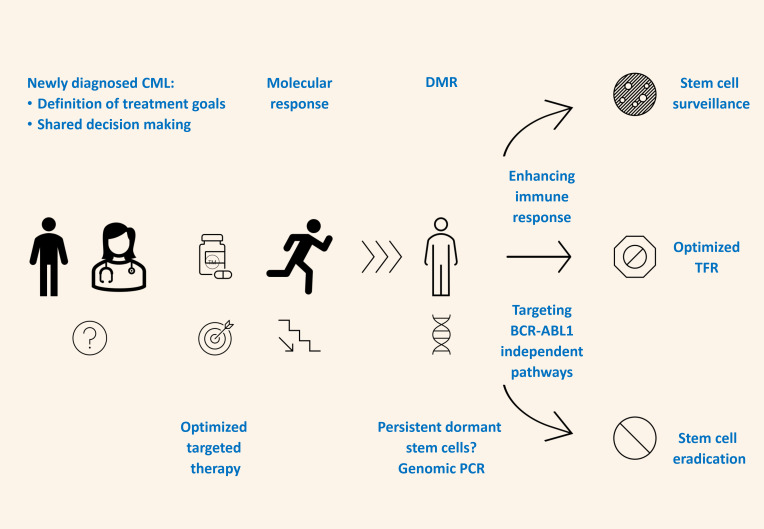
Treatment-free remission (TFR) is a new and significant goal of chronic myeloid leukemia management. TFR should be considered for patients in stable deep molecular response (DMR) after careful discussion in the shared decision-making process. Second-generation tyrosine kinase inhibitors (TKIs) improve the speed of response and the incidence of DMR. Treatment may be changed to a more active TKI to improve the depth of response in selected patients who have not reached DMR. Stem cell persistence is associated with active immune surveillance and activation of BCR-ABL1-independent pathways, eg, STAT3, JAK1/2, and BCL2. Ongoing studies aim to prove the efficacy of maintenance therapies targeting these pathways after TKI discontinuation.
无治疗缓解(TFR)是慢性髓性白血病管理的一个新的重要目标。在共同决策过程中经过仔细讨论后,应考虑为处于稳定深层分子反应(DMR)的患者实现 TFR。第二代酪氨酸激酶抑制剂(TKI)可提高反应速度和 DMR 的发生率。对于未达到 DMR 的某些患者,可通过改变治疗方法,使用更积极的 TKI 来提高反应深度。干细胞持续存在与活跃的免疫监视和 BCR-ABL1 非依赖性途径(如 STAT3、JAK1/2 和 BCL2)的激活有关。正在进行的研究旨在证明 TKI 停药后针对这些途径的维持治疗的疗效。