Department of Neurology, The Third Affiliated Hospital of Sun Yat-Sen University, Guangzhou, Guangdong, People's Republic of China.
State Key Laboratory of Organ Failure Research, Guangdong-Hong Kong-Macao Greater Bay Area Center for Brain Science and Brain-Inspired Intelligence, Guangdong Key Laboratory of Psychiatric Disorders, Collaborative Innovation Center for Brain Science, Department of Neurobiology, School of Basic Medical Sciences, Key Laboratory of Mental Health of the Ministry of Education, Southern Medical University, Guangzhou, Guangdong, People's Republic of China.
Neurotherapeutics. 2022 Jan;19(1):421-433. doi: 10.1007/s13311-021-01168-6. Epub 2021 Dec 10.
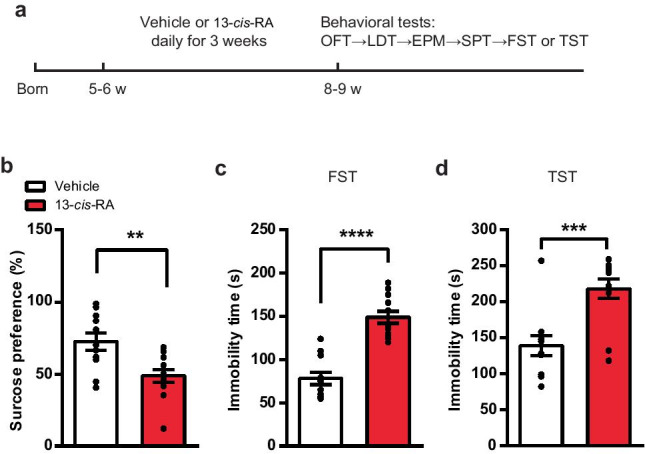
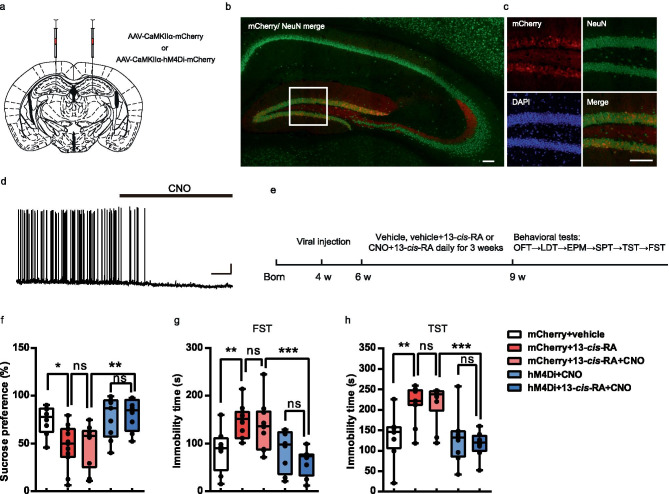
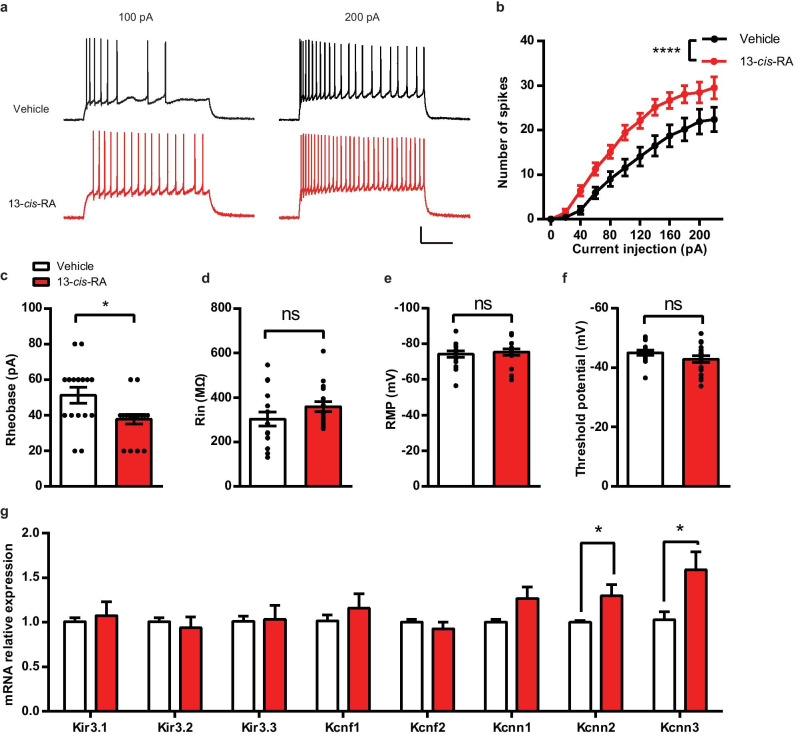
Depression is a common but serious mental disorder and can be caused by the side effects of medications. Evidence from abundant clinical case reports and experimental animal models has revealed the association between the classic anti-acne drug 13-cis-retinoic acid (13-cis-RA) and depressive symptoms. However, direct experimental evidence of this mechanism and information on appropriate therapeutic rescue strategies are lacking. Herein, our data revealed that chronic administration of 13-cis-RA to adolescent mice induced depression-like behavior but not anxiety-like behavior. We next demonstrated that chronic 13-cis-RA application increased neural activity in the dentate gyrus (DG) using c-Fos immunostaining, which may be critically involved in some aspects of depression-like behavior. Therefore, we assessed electrophysiological functions by obtaining whole-cell patch-clamp recordings of dentate granule cells (DGCs), which revealed that chronic 13-cis-RA treatment shifted the excitatory-inhibitory balance toward excitation and increased intrinsic excitability. Furthermore, a pharmacogenetic approach was performed to repeatedly silence DGCs, and this manipulation could rescue depression-like behavior in chronically 13-cis-RA-treated mice, suggesting DGCs as a potential cellular target for the direct alleviation of 13-cis-RA-induced depression.
抑郁症是一种常见但严重的精神障碍,可能是药物的副作用引起的。大量临床病例报告和实验动物模型的证据表明,经典的抗痤疮药物 13-顺式维甲酸(13-cis-RA)与抑郁症状之间存在关联。然而,这种机制的直接实验证据和适当的治疗挽救策略的信息尚缺乏。在此,我们的数据显示,13-cis-RA 慢性给药会诱导青春期小鼠出现类似抑郁的行为,但不会引起焦虑样行为。我们接下来证明,慢性 13-cis-RA 应用通过 c-Fos 免疫染色增加了齿状回(DG)中的神经活动,这可能与某些类似抑郁的行为方面密切相关。因此,我们通过获得齿状颗粒细胞(DGCs)的全细胞膜片钳记录来评估电生理功能,结果显示慢性 13-cis-RA 处理会使兴奋-抑制平衡向兴奋倾斜,并增加内在兴奋性。此外,我们还进行了药理学遗传方法来反复沉默 DGCs,这种操作可以挽救慢性 13-cis-RA 处理的小鼠的类似抑郁行为,表明 DGCs 可能是直接缓解 13-cis-RA 诱导的抑郁的潜在细胞靶点。