
基于智能手机的耳镜检查:临床实践中的方法评估
Smartphone-enabled otoscopy: method evaluation in clinical practice.
作者信息
Kravchychyn Fernanda Dal Bem, Meurer Ana Taíse de Oliveira, Nogueira Maria Helena Salgado Delamain Pupo, Balieiro Fernando Oto, Balsalobre Fernando de Andrade, Barauna Filho Iulo Sérgio, Stamm Aldo Eden Cassol
机构信息
Hospital Edmundo Vasconcelos, São Paulo, SP, Brazil.
Hospital Edmundo Vasconcelos, São Paulo, SP, Brazil.
出版信息
Braz J Otorhinolaryngol. 2023 Jan-Feb;89(1):122-127. doi: 10.1016/j.bjorl.2021.08.012. Epub 2021 Nov 15.
OBJECTIVE
To assess the diagnostic agreement between smartphone-enabled otoscopy and rigid otoendoscopy in tympanic membrane and middle ear diseases.
METHODS
A cross-sectional study was carried out to analyze otoscopies in patients seen at a general otorhinolaryngology (ORL) outpatient clinic, from June to December 2019. Eighty-three images of patients obtained from otoscopies performed through a smartphone device and a rigid endoscope were included, recorded, and stored for further analysis. The images were first analyzed by an experienced otologist, who assigned his diagnostic impression (defined as the gold standard) on each of the images. After this analysis, the images were displayed to a group of secondary raters (an experienced otorhinolaryngologist, a second-year resident in ORL, and a general practitioner). A questionnaire was applied related to each image.
RESULTS
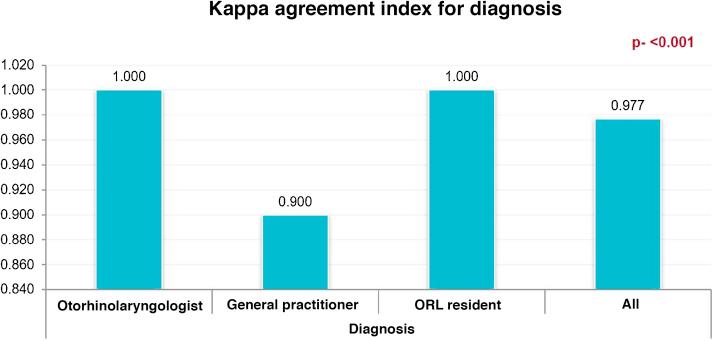
There was high agreement between the smartphone device and the otoendoscopy images for all professionals, with a Kappa coefficient of 0.97 (p < 0.001). The smartphone device showed a diagnostic sensitivity of 81.1% and a specificity of 71.1%. As for the otoendoscopy, it showed a sensitivity of 84.7% and a specificity of 72.4%. The image classification as "2 = Good" was the most frequent one, with 34.9% for otoendoscopy and 31.6% for the smartphone device.
CONCLUSION
There was a high diagnostic agreement between smartphone device-guided otoscopy and the rigid otoendoscopy, demonstrating the feasibility of using this device in clinical practice.
目的
评估使用智能手机的耳镜检查与硬性耳内镜检查在鼓膜和中耳疾病诊断中的一致性。
方法
开展一项横断面研究,分析2019年6月至12月在普通耳鼻喉科门诊就诊患者的耳镜检查情况。纳入通过智能手机设备和硬性内镜进行耳镜检查获得的83例患者图像,进行记录和存储以便进一步分析。图像首先由一名经验丰富的耳科医生进行分析,该医生对每张图像给出诊断印象(定义为金标准)。在此分析之后,将图像展示给一组二级评估者(一名经验丰富的耳鼻喉科医生、一名耳鼻喉科二年级住院医师和一名全科医生)。针对每张图像应用一份问卷。
结果
对于所有专业人员,智能手机设备与耳内镜图像之间存在高度一致性,卡帕系数为0.97(p < 0.001)。智能手机设备显示诊断敏感性为81.1%,特异性为71.1%。至于耳内镜检查,其敏感性为84.7%,特异性为72.4%。图像分类为“2 = 良好”最为常见,耳内镜检查为34.9%,智能手机设备为31.6%。
结论
智能手机设备引导的耳镜检查与硬性耳内镜检查之间存在高度诊断一致性,证明了在临床实践中使用该设备的可行性。


 Zotero 插件