Departement of Psychology, University of Montréal, Montreal, Canada; Centre for Interdisciplinary Research in Rehabilitation of Greater Montreal (CRIR) - IURDPM, CIUSSS du Centre-Sud-de-l'Île-de-Montréal, Montreal, Canada.
Centre for Interdisciplinary Research in Rehabilitation of Greater Montreal (CRIR) - IURDPM, CIUSSS du Centre-Sud-de-l'Île-de-Montréal, Montreal, Canada; School of Rehabilitation, University of Montréal, Montreal, Canada.
Arch Gerontol Geriatr. 2022 Mar-Apr;99:104606. doi: 10.1016/j.archger.2021.104606. Epub 2021 Dec 5.
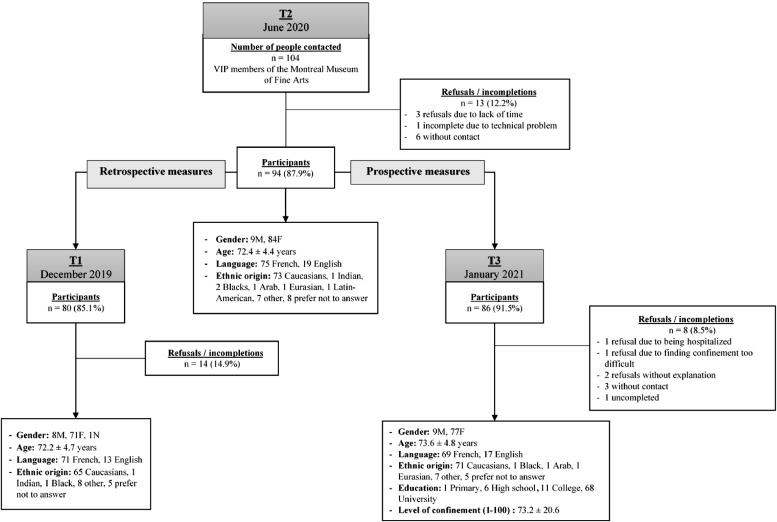
. The concept of lockdown in relation to COVID-19 is thought to have an indirect impact on the quality of life and well-being of the elderly due to its consequences on the physical, psychological, and cognitive health of individuals. However, previous published studies on this subject are limited in terms of methodological approach used, including the absence of pre-confinement status and the type of experimental design, which is often cross-sectional. The present study proposes a longitudinal design with pre-confinement measures. It assesses changes in quality of life, perceived health, and well-being by comparing the period before lockdown (T1 = December 2019), three months after the start of the first lockdown (T2 = June 2020), and during the second lockdown (T3 = January 2021) due to COVID-19.
. This study is conducted with a group of 72 healthy elderly persons. They completed an electronic (online) survey assessing personal factors, activities, and participation as well as responding to the EuroQol-5D and Warwick-Edinburgh Mental Well-being Scale.
. A decrease in quality of life, perceived health and well-being was observed between T1 and T2 and between T1 and T3, but no difference was reported between the two lockdown periods. The variables associated with these changes included energy level, level of happiness, physical activity, change in medical condition, memory difficulties, level of perceived isolation and age.
. This study will help to target variables that may have a deleterious effect on older adults for consideration in future confinement settings and for preventive purposes.
由于 COVID-19 封锁措施对个人身心健康的影响,与 COVID-19 相关的封锁概念被认为会对老年人的生活质量和幸福感产生间接影响。然而,之前关于这一主题的研究在使用的方法学方法方面存在局限性,包括缺乏隔离前的状态和实验设计类型,通常是横断面研究。本研究提出了一种具有隔离前措施的纵向设计。它通过比较封锁前的时期(T1=2019 年 12 月)、第一次封锁开始后三个月(T2=2020 年 6 月)和由于 COVID-19 而进行的第二次封锁期间(T3=2021 年 1 月),评估生活质量、感知健康和幸福感的变化。
本研究对 72 名健康老年人进行了研究。他们完成了一项电子(在线)调查,评估个人因素、活动和参与情况,并回答了 EuroQol-5D 和 Warwick-Edinburgh 心理健康量表的问题。
在 T1 和 T2 之间以及在 T1 和 T3 之间观察到生活质量、感知健康和幸福感下降,但两次封锁期间没有差异。与这些变化相关的变量包括能量水平、幸福感水平、身体活动、医疗状况变化、记忆困难、感知隔离程度和年龄。
本研究将有助于确定可能对老年人产生不利影响的变量,以便在未来的隔离环境中考虑,并为预防目的提供依据。