Springer Nature, Mairangi Bay, Private Bag 65901, Auckland, 0754, New Zealand.
Drugs. 2022 Jan;82(1):55-62. doi: 10.1007/s40265-021-01650-7.
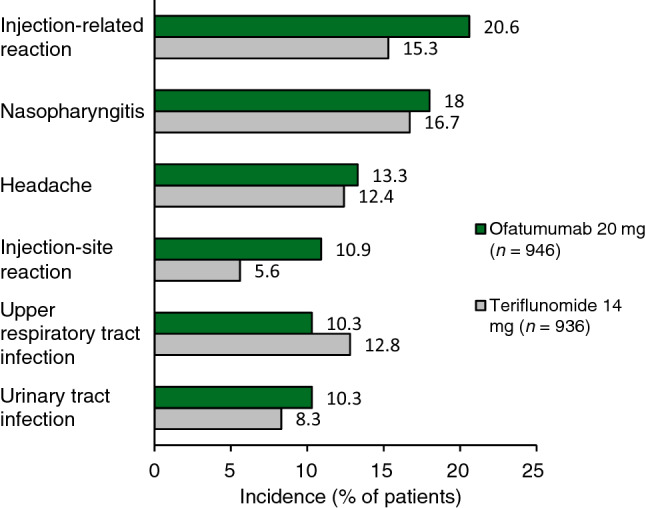
Ofatumumab (Kesimpta) is a fully human anti-CD20 monoclonal antibody that can be self-administered by patients and is approved in several countries worldwide for the treatment of relapsing forms of multiple sclerosis (MS). In two identical phase III trials in adults with relapsing forms of MS, subcutaneous ofatumumab was more effective than oral teriflunomide in reducing the annualized relapse rate, as well as reducing MRI-detected lesion activity and limiting worsening of disability. Ofatumumab had a generally manageable tolerability profile; the most common adverse events (AEs) included nasopharyngitis, headache, upper respiratory tract infections and urinary tract infections. AEs of special interest (AESIs) included infections and injection-related reactions, which were generally manageable. There was no apparent association between changes in immunoglobulin G or M levels and the risk of serious infections after 3.5 years of ofatumumab treatment. Thus, ofatumumab is a convenient treatment option that is effective and has a generally manageable tolerability profile in adults with relapsing forms of MS.
奥法妥木单抗(Kesimpta)是一种全人源抗 CD20 单克隆抗体,可由患者自行给药,已在全球多个国家获得批准,用于治疗复发型多发性硬化症(MS)。在两项针对复发型 MS 成人患者的双盲、对照、III 期临床试验中,与口服特立氟胺相比,皮下注射奥法妥木单抗能更有效地降低年复发率,减少 MRI 检出的病灶活动度,并限制残疾恶化。奥法妥木单抗具有总体可控的耐受性;最常见的不良反应(AE)包括鼻咽炎、头痛、上呼吸道感染和尿路感染。特别关注的不良反应(SAEIs)包括感染和与注射相关的反应,这些反应通常是可控的。在接受奥法妥木单抗治疗 3.5 年后,免疫球蛋白 G 或 M 水平的变化与严重感染风险之间似乎没有关联。因此,奥法妥木单抗是一种方便的治疗选择,对复发型 MS 成人患者有效,且具有总体可控的耐受性。