Velez Ivan D, Santacruz Eduardo, Kutcher Simon C, Duque Sandra L, Uribe Alexander, Barajas Jovany, Gonzalez Sandra, Patino Ana Cristina, Zuluaga Lina, Martínez Luis, Muñoz Estefanía, Mejia María Camila, Arbelaez María Patricia, Pulido Henry, Jewell Nicholas P, Dufault Suzanne M, O'Neill Scott L, Simmons Cameron P, Anders Katherine L, Tanamas Stephanie K
World Mosquito Program, Universidad de Antioquia, Medellin, Colombia.
World Mosquito Program, Institute of Vector Borne Disease, Monash University, Melbourne, VIC, Australia.
F1000Res. 2019 Aug 1;8:1327. doi: 10.12688/f1000research.19858.2. eCollection 2019.
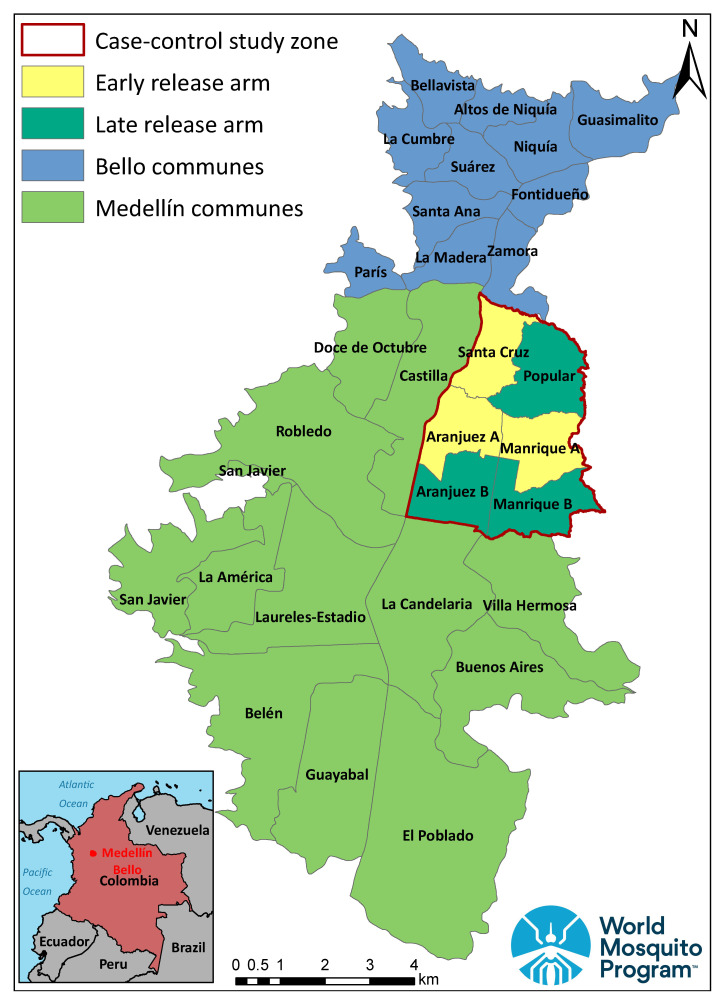
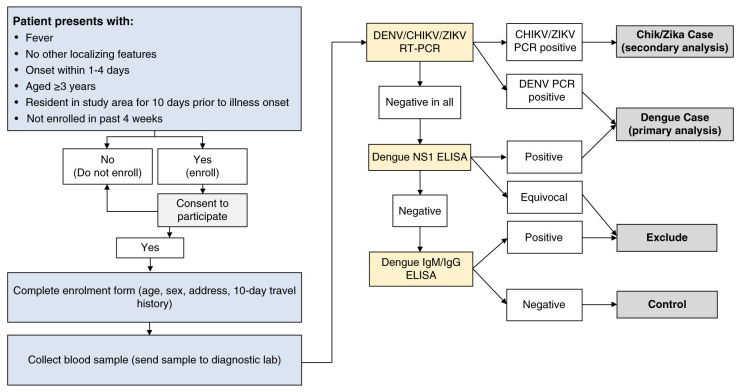
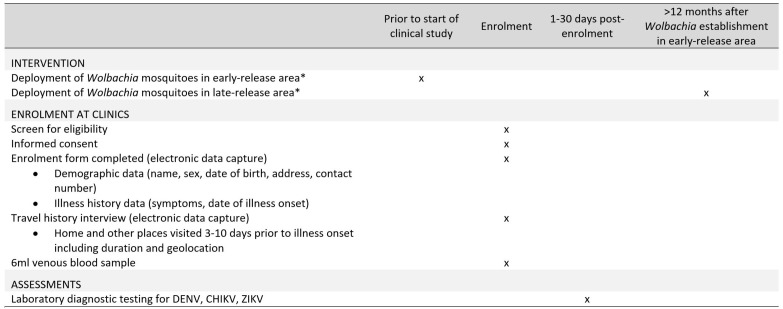
Dengue, chikungunya and Zika are viral infections transmitted by mosquitoes, and present major public health challenges in tropical regions. Traditional vector control methods have been ineffective at halting disease transmission. The World Mosquito Program has developed a novel approach to arbovirus control using stably transfected with the bacterium, which have significantly reduced ability to transmit dengue, Zika and chikungunya in laboratory experiments. Field releases in eight countries have demonstrated establishment in local populations. We describe a pragmatic approach to measuring the epidemiological impact of city-wide deployments in Bello and Medellín, Colombia. First, an interrupted time-series analysis will compare the incidence of dengue, chikungunya and Zika case notifications before and after releases, across the two municipalities. Second, a prospective case-control study using a test-negative design will be conducted in one quadrant of Medellín. Three of the six contiguous release zones in the case-control area were allocated to receive the first deployments in the city and three to be treated last, approximating a parallel two-arm trial for the >12-month period during which exposure remains discordant. Allocation, although non-random, aimed to maximise balance between arms in historical dengue incidence and demographics. Arboviral disease cases and arbovirus-negative controls will be enrolled concurrently from febrile patients presenting to primary care, with case/control status classified retrospectively following laboratory diagnostic testing. Intervention effect is estimated from an aggregate odds ratio comparing -exposure odds among test-positive cases versus test-negative controls. The study findings will add to an accumulating body of evidence from global field sites on the efficacy of the method in reducing arboviral disease incidence, and can inform decisions on wider public health implementation of this intervention in the Americas and beyond. ClinicalTrials.gov: NCT03631719. Registered on 15 August 2018.
登革热、基孔肯雅热和寨卡病毒病是由蚊子传播的病毒感染性疾病,在热带地区构成重大公共卫生挑战。传统的病媒控制方法在阻止疾病传播方面效果不佳。世界蚊子计划开发了一种控制虫媒病毒的新方法,即使用经细菌稳定转染的蚊子,在实验室实验中,这些蚊子传播登革热、寨卡病毒和基孔肯雅热的能力显著降低。在八个国家进行的野外释放试验已证明这些蚊子能在当地种群中定殖。我们描述了一种务实的方法,用于衡量在哥伦比亚贝洛和麦德林全市范围内部署这种蚊子的流行病学影响。首先,一项中断时间序列分析将比较这两个城市在释放蚊子前后登革热、基孔肯雅热和寨卡病毒病例通报的发病率。其次,将在麦德林的一个象限开展一项采用检测阴性设计的前瞻性病例对照研究。病例对照区域内六个相邻释放区中的三个被分配接受该市的首批部署,另外三个最后接受处理,这近似于一项为期超过12个月的平行双臂试验,在此期间暴露情况不一致。尽管分配并非随机,但目的是使两组在历史登革热发病率和人口统计学方面达到最大程度的平衡。虫媒病毒病病例和虫媒病毒阴性对照将从到初级保健机构就诊的发热患者中同时纳入,病例/对照状态在实验室诊断检测后进行回顾性分类。干预效果通过比较检测阳性病例与检测阴性对照之间的暴露比值的综合比值比来估计。该研究结果将补充来自全球野外地点的越来越多的证据,证明这种方法在降低虫媒病毒病发病率方面的有效性,并可为在美洲及其他地区更广泛地实施这种干预措施的公共卫生决策提供参考。ClinicalTrials.gov注册号:NCT03631719。于2018年8月15日注册。