Qiu Yuran, Wang Yuanhao, Chai Zongtao, Ni Duan, Li Xinyi, Pu Jun, Chen Jie, Zhang Jian, Lu Shaoyong, Lv Chuan, Ji Mingfei
Department of Urology, Changzheng Hospital, Naval Military Medical University, Shanghai 200003, China.
Department of Pathophysiology, Key Laboratory of Cell Differentiation and Apoptosis of Chinese Ministry of Education, Shanghai Jiao Tong University, School of Medicine, Shanghai 200025, China.
Acta Pharm Sin B. 2021 Nov;11(11):3433-3446. doi: 10.1016/j.apsb.2021.02.014. Epub 2021 Feb 25.
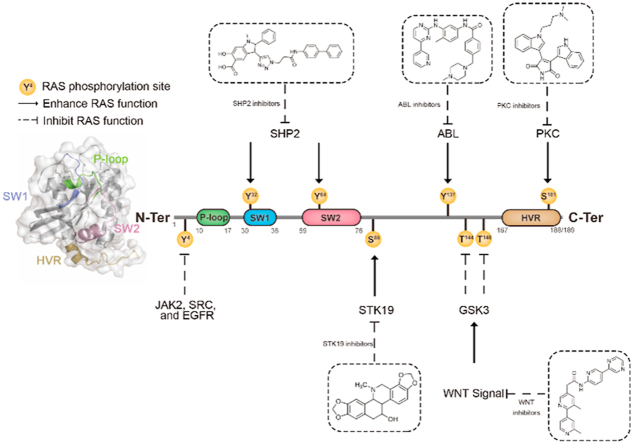
RAS, a member of the small GTPase family, functions as a binary switch by shifting between inactive GDP-loaded and active GTP-loaded state. RAS gain-of-function mutations are one of the leading causes in human oncogenesis, accounting for ∼19% of the global cancer burden. As a well-recognized target in malignancy, RAS has been intensively studied in the past decades. Despite the sustained efforts, many failures occurred in the earlier exploration and resulted in an 'undruggable' feature of RAS proteins. Phosphorylation at several residues has been recently determined as regulators for wild-type and mutated RAS proteins. Therefore, the development of RAS inhibitors directly targeting the RAS mutants or towards upstream regulatory kinases supplies a novel direction for tackling the anti-RAS difficulties. A better understanding of RAS phosphorylation can contribute to future therapeutic strategies. In this review, we comprehensively summarized the current advances in RAS phosphorylation and provided mechanistic insights into the signaling transduction of associated pathways. Importantly, the preclinical and clinical success in developing anti-RAS drugs targeting the upstream kinases and potential directions of harnessing allostery to target RAS phosphorylation sites were also discussed.
RAS是小GTP酶家族的成员之一,通过在无活性的GDP结合状态和活性的GTP结合状态之间转换,发挥二元开关的作用。RAS功能获得性突变是人类肿瘤发生的主要原因之一,占全球癌症负担的19%左右。作为恶性肿瘤中一个公认的靶点,RAS在过去几十年中受到了深入研究。尽管付出了持续的努力,但在早期探索中仍出现了许多失败,导致RAS蛋白具有“不可成药”的特性。最近已确定几个位点的磷酸化是野生型和突变型RAS蛋白的调节因子。因此,直接靶向RAS突变体或上游调节激酶的RAS抑制剂的开发为解决抗RAS难题提供了新的方向。更好地理解RAS磷酸化有助于未来的治疗策略。在这篇综述中,我们全面总结了RAS磷酸化的当前进展,并对相关信号通路的转导机制进行了深入探讨。重要的是,还讨论了靶向上游激酶的抗RAS药物的临床前和临床成功案例以及利用变构作用靶向RAS磷酸化位点的潜在方向。