Zhou Suna, Wang Xuequan, Ding Jiapei, Yang Haihua, Xie Youyou
Laboratory of Cellular and Molecular Radiation Oncology, The Affiliated Taizhou Hospital, Wenzhou Medical University, Taizhou, China.
Department of Radiation Oncology, The Affiliated Taizhou Hospital, Wenzhou Medical University, Taizhou, China.
Front Cell Dev Biol. 2021 Nov 25;9:757184. doi: 10.3389/fcell.2021.757184. eCollection 2021.
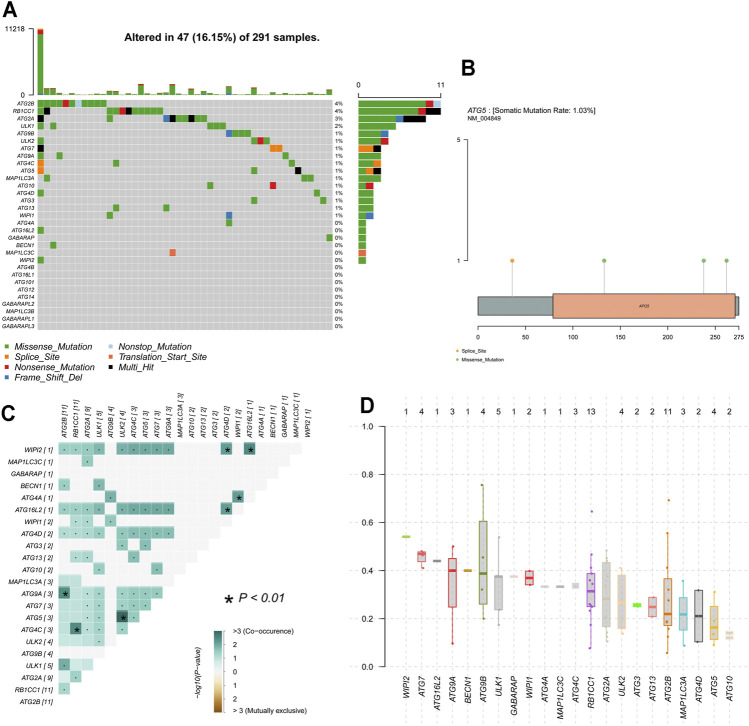
Cervical cancer has the second-highest incidence and mortality of female malignancy. The major causes of mortality in patients with cervical cancer are invasion and metastasis. The epithelial-mesenchymal transition (EMT) process plays a major role in the acquisition of metastatic potential and motility. Autophagy-related genes (ARGs) are implicated in the EMT process, and autophagy exerts a dual function in EMT management at different phases of tumor progression. However, the role of specific ARGs during the EMT process has not yet been reported in cervical cancer. Based on the data from the Genome Atlas (TCGA) cervical squamous cell carcinoma and endocervical adenocarcinoma (CESC) sequencing database, we performed the prognosis analysis for those ARGs obtained from the Human Autophagy database. ATG5 was identified as the only important harmful marker influencing survival of cervical cancer patients by univariate Cox regression (HR 1.7; 95% CI: 1.0-2.8, = 0.047), and the 5-years survival rate for the high- and low-ATG5 expression groups was 0.486 (0.375-0.631) and 0.782 (0.708-0.863), respectively. TCGA CESC methylation data showed that eight methylation sites of ATG5 could also be significantly associated with the overall survival (OS) of cervical cancer patients. Single-sample gene-set enrichment and gene functional enrichment results showed that ATG5 was correlated with some cancer-related pathways, such as phagocytosis-related genes, endocytosis-related genes, immune-related genes, EMT score, and some EMT signature-related genes. Next, cell migration and invasion assay and Western blot were applied to detect the function of ATG5 in EMT of cervical cancer. In cervical cancer cells, ATG5 knockdown resulted in attenuation of migration and invasion. The functional study showed that knockdown of ATG5 could reverse EMT process by P-ERK, P-NFκBp65, P-mTOR pathways, and so on. In conclusion, the present study implies that ATG5 was a major contributor to EMT regulation and poor prognosis in cervical cancer.
宫颈癌是女性恶性肿瘤中发病率和死亡率第二高的癌症。宫颈癌患者死亡的主要原因是侵袭和转移。上皮-间质转化(EMT)过程在获得转移潜能和迁移能力方面起主要作用。自噬相关基因(ARG)与EMT过程有关,并且自噬在肿瘤进展的不同阶段对EMT的调控发挥双重作用。然而,在宫颈癌中,特定ARG在EMT过程中的作用尚未见报道。基于来自基因组图谱(TCGA)宫颈鳞状细胞癌和宫颈内膜腺癌(CESC)测序数据库的数据,我们对从人类自噬数据库获得的那些ARG进行了预后分析。通过单因素Cox回归分析,ATG5被确定为影响宫颈癌患者生存的唯一重要有害标志物(HR 1.7;95%CI:1.0 - 2.8,P = 0.047),高ATG5表达组和低ATG5表达组的5年生存率分别为0.486(0.375 - 0.631)和0.782(0.708 - 0.863)。TCGA CESC甲基化数据显示,ATG5的8个甲基化位点也与宫颈癌患者的总生存期(OS)显著相关。单样本基因集富集和基因功能富集结果表明,ATG5与一些癌症相关通路相关,如吞噬相关基因、内吞相关基因、免疫相关基因、EMT评分以及一些EMT特征相关基因。接下来,应用细胞迁移和侵袭实验以及蛋白质印迹法检测ATG5在宫颈癌EMT中的功能。在宫颈癌细胞中,敲低ATG5导致迁移和侵袭能力减弱。功能研究表明,敲低ATG5可通过P - ERK、P - NFκBp65、P - mTOR等信号通路逆转EMT过程。总之,本研究表明ATG5是宫颈癌EMT调控和预后不良的主要因素。