Xiao Min, Medipally Ajay K, Biederman Laura, Satoskar Anjali A, Ivanov Iouri, Rovin Brad H, Brodsky Sergey V
Department of Pathology, The Ohio State University Wexner Medical Center, Columbus, OH, United States.
Department of Pathology, Nationwide Children Hospital, Columbus, OH, United States.
Front Med (Lausanne). 2021 Nov 25;8:753506. doi: 10.3389/fmed.2021.753506. eCollection 2021.
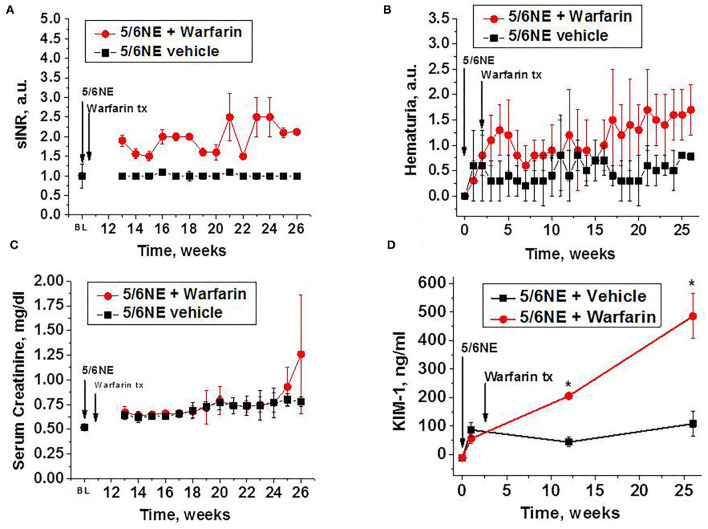
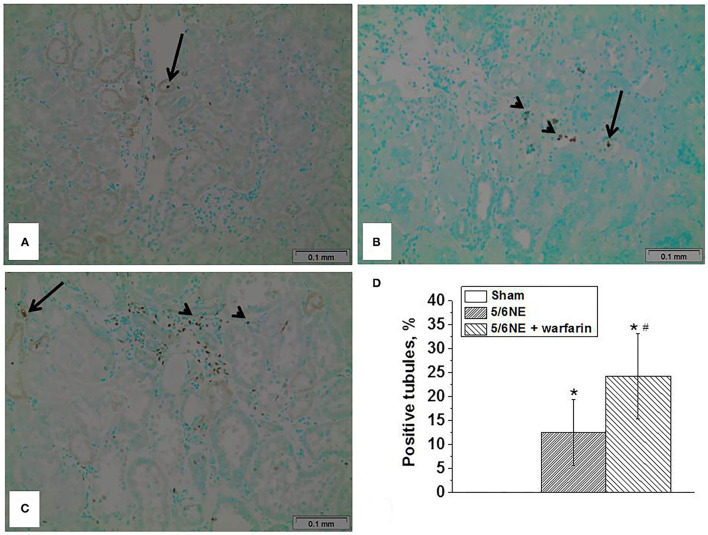
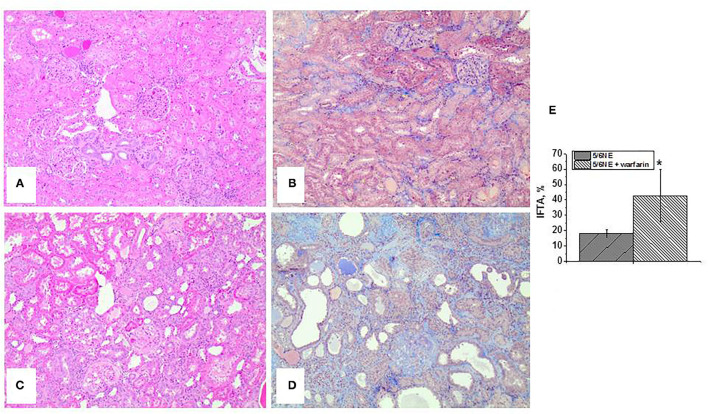
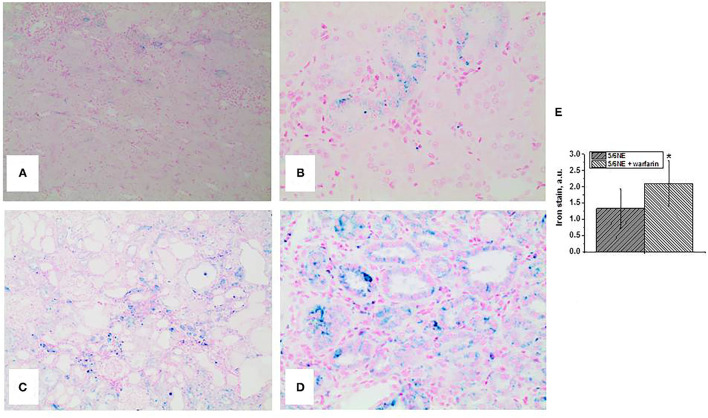
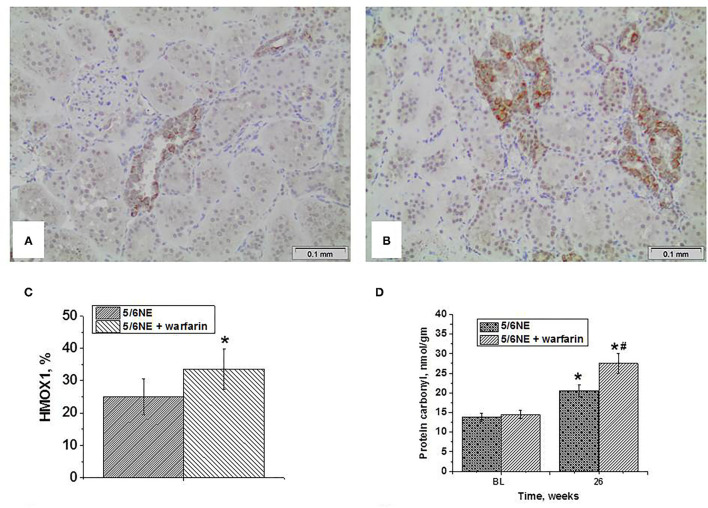
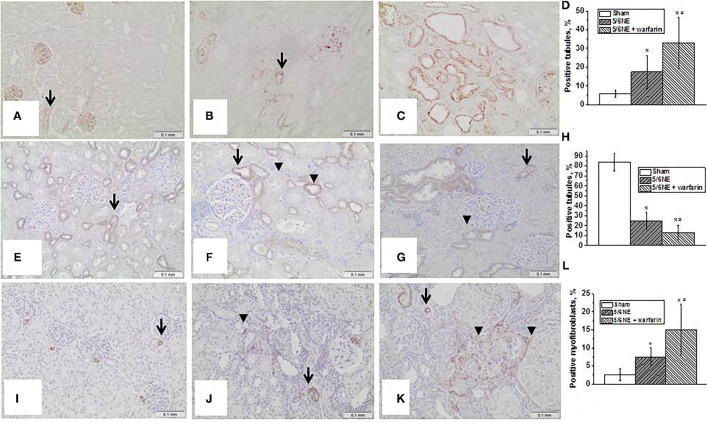
Chronic kidney disease (CKD) is a common outcome of many kidney diseases. Interstitial fibrosis and tubular atrophy (IFTA) is a histologic hallmark of CKD. Hematuria is a common symptom in many human kidney diseases. Free hemoglobin may affect tubular epithelial cells by generating reactive oxygen species (ROS). Epithelial-mesenchymal transition (EMT) of the tubular epithelial cells has been shown to play an important role in the IFTA development. The aim of this study was to determine the effects of chronic hematuria on the CKD progression in 5/6 nephrectomy (5/6NE) rat model of CKD. 5/6 NE rats were treated with oral warfarin (0.5 mg/kg/day) or vehicle (control). The animals were monitored for 26 weeks, while prothrombin time (PT), serum creatinine (SCr), and hematuria were measured weekly. Staining for iron, trichrome, and EMT (vimentin, E-cadherin, smooth muscle actin) markers was performed on the remnant kidneys. ROS were detected in the kidneys by protein carbonyl assay and immunohistochemistry for heme oxygenase 1 (HMOX1), at the end of the study. Apoptosis was detected by TUNEL assay. Warfarin treatment resulted in a PT increase 1.5-2.5 times from control and an increase in hematuria and SCr. Histologically, warfarin-treated animals had more iron-positive tubular epithelial cells and increased IFTA as compared to control (42.9 ± 17% vs. 18.3 ± 2.6%). ROS were increased in the kidney in warfarin-treated rats. The number of tubules that show evidence of EMT was significantly higher in warfarin-treated 5/6NE as compared to control 5/6NE rats. The number of apoptotic tubular epithelial cells was higher in warfarin-treated 5/6 NE rats. Chronic hematuria results in increased iron-positive tubular epithelial cells, EMT, apoptosis, and more prominent IFTA in CKD rats. Our data suggest an important role of chronic hematuria in the progression of CKD.
慢性肾脏病(CKD)是许多肾脏疾病的常见结局。间质纤维化和肾小管萎缩(IFTA)是CKD的组织学特征。血尿是许多人类肾脏疾病的常见症状。游离血红蛋白可能通过产生活性氧(ROS)影响肾小管上皮细胞。肾小管上皮细胞的上皮-间质转化(EMT)已被证明在IFTA发展中起重要作用。本研究的目的是确定慢性血尿对CKD的5/6肾切除(5/6NE)大鼠模型中CKD进展的影响。5/6NE大鼠口服华法林(0.5mg/kg/天)或赋形剂(对照)进行治疗。对动物监测26周,同时每周测量凝血酶原时间(PT)、血清肌酐(SCr)和血尿情况。对残余肾脏进行铁染色、三色染色以及EMT(波形蛋白、E-钙黏蛋白、平滑肌肌动蛋白)标志物染色。在研究结束时,通过蛋白质羰基测定法和血红素加氧酶1(HMOX1)免疫组织化学检测肾脏中的ROS。通过TUNEL检测法检测细胞凋亡。华法林治疗导致PT比对照增加1.5 - 2.5倍,血尿和SCr增加。组织学上,与对照相比,华法林治疗的动物有更多铁阳性肾小管上皮细胞且IFTA增加(42.9±17%对18.3±2.6%)。华法林治疗的大鼠肾脏中ROS增加。与对照5/6NE大鼠相比,华法林治疗的5/6NE中显示EMT证据的肾小管数量显著更高。华法林治疗的5/6NE大鼠中凋亡肾小管上皮细胞数量更高。慢性血尿导致CKD大鼠中铁阳性肾小管上皮细胞增加、EMT、细胞凋亡以及更明显的IFTA。我们的数据表明慢性血尿在CKD进展中起重要作用。