Chevallier Lugon Chloé, Kharat Aileen, Soccal Paola M, Guessous Idris, Spechbach Hervé, Salamun Julien
Department of Primary Care Medicine, Geneva University Hospitals, Geneva, Switzerland.
Department of Pulmonary Medicine, Geneva University Hospitals, Geneva, Switzerland.
Front Med (Lausanne). 2021 Nov 26;8:774035. doi: 10.3389/fmed.2021.774035. eCollection 2021.
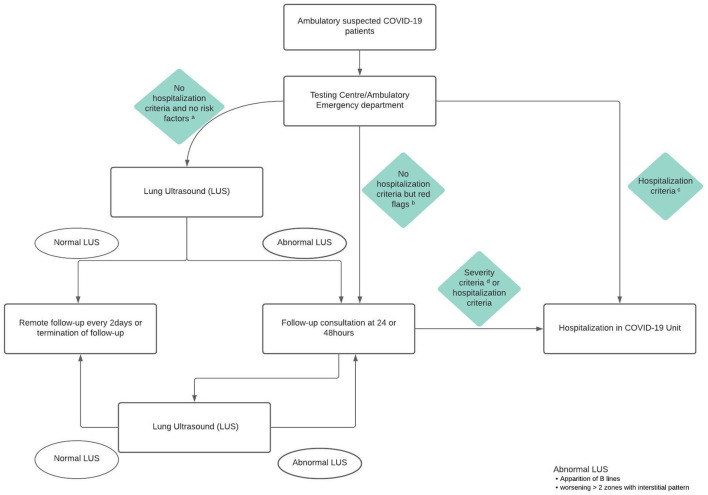
Lung ultrasound (LUS) has a good performance with a high sensitivity and specificity for the diagnosis of pneumonia compared with chest X-ray, and it has been extensively used to assess patients during the COVID-19 pandemic. This study aims to evaluate the potential advantages of the regular use of LUS for the assessment of the severity and prognosis of COVID-19 pneumonia and to propose an adapted protocol with its inclusion in current local validated and published guidelines. This is a single-center prospective study conducted during the first (April-May 2020) and second (October 2020-January 2021) waves of the SARS-CoV2 pandemic in Switzerland. All adult patients presenting to dedicated test centers with a suspicion of mild-to-moderate COVID-19 pneumonia and not requiring hospitalization at the time of diagnosis were included. Patients with confirmed COVID-19 pneumonia were referred to an ambulatory follow-up unit at our institution for reassessment, with the inclusion of the use of LUS in a random selection. Descriptive statistics were calculated for demographics using percentages, means, and standard deviations according to the distribution of variables. Eighty-eight ambulatory patients with a confirmed COVID-19 pneumonia were included (men = 57 [59%]; mean age, 52.1 ± 13.5 years). Among these, 19 (21%) were hospitalized and none died. Twenty-five lung assessments by ultrasound were performed during the follow-up consultation. All were consistent with the clinical examination and confirmed the clinician's opinion. The use of a standardized pleuro-pulmonary ultrasound protocol for ambulatory patients with COVID-19 could help to reduce the use of chest X-rays and improve overall management at the time of referral and eventual follow-up. However, a specific study including LUS in a systematic approach should be performed to evaluate the outcome of patients according to findings.
与胸部X光相比,肺部超声(LUS)在诊断肺炎方面具有良好的性能,灵敏度和特异性较高,并且在新冠疫情期间已被广泛用于评估患者。本研究旨在评估定期使用LUS评估新冠肺炎严重程度和预后的潜在优势,并提出一个适用方案,将其纳入当前本地经过验证并已发表的指南中。这是一项单中心前瞻性研究,在瑞士SARS-CoV2疫情的第一波(2020年4月至5月)和第二波(2020年10月至2021年1月)期间进行。所有因疑似轻至中度新冠肺炎而到专门检测中心就诊、诊断时无需住院的成年患者均被纳入。确诊为新冠肺炎的患者被转介到我们机构的门诊随访单元进行重新评估,随机选择部分患者使用LUS。根据变量分布,使用百分比、均值和标准差对人口统计学数据进行描述性统计。纳入了88例确诊为新冠肺炎的门诊患者(男性57例[59%];平均年龄52.1±13.5岁)。其中19例(21%)住院,无死亡病例。随访会诊期间进行了25次肺部超声评估。所有评估结果均与临床检查一致,证实了临床医生的判断。对新冠门诊患者使用标准化的胸膜-肺部超声方案有助于减少胸部X光的使用,并改善转诊和最终随访时的整体管理。然而,应进行一项将LUS纳入系统方法的具体研究,以根据检查结果评估患者的预后。