Dong Jiayi, Yang Song, Zhuang Qian, Sun Junxiang, Wei Pengfei, Zhao Xianghai, Chen Yanchun, Chen Xiaotian, Li Mengxia, Wei Lai, Chen Changying, Fan Yao, Shen Chong
Department of Epidemiology, School of Public Health, Nanjing Medical University, Nanjing, China.
Department of Cardiology, Affiliated Yixing People's Hospital of Jiangsu University, People's Hospital of Yixing City, Yixing, China.
Front Cardiovasc Med. 2021 Nov 25;8:745539. doi: 10.3389/fcvm.2021.745539. eCollection 2021.
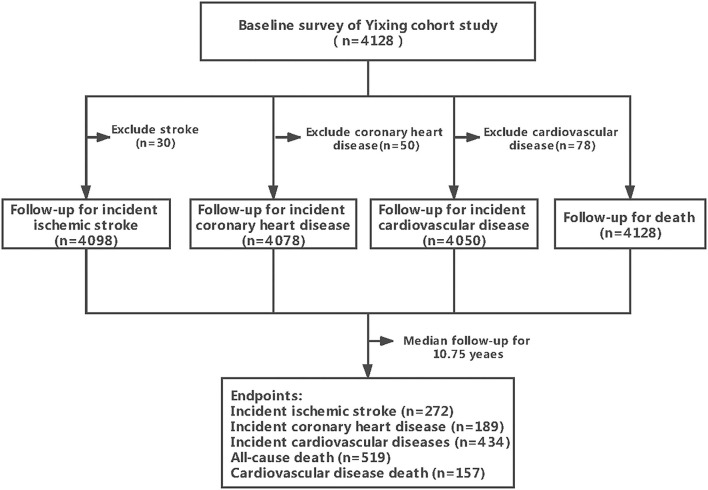
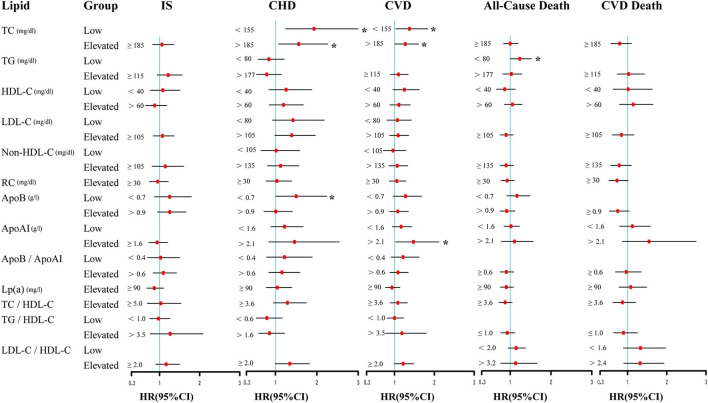
Dyslipidemia is one of the modifiable risk factors for cardiovascular diseases (CVD). Identifying subjects with lipid abnormality facilitates preventative interventions. To evaluate the effects of lipid indices on the risks of ischemic stroke (IS), coronary heart disease (CHD), CVD, all-cause death, and CVD death. The cohort study of 4,128 subjects started in May 2009 and followed up to July 2020. Restricted cubic spline (RCS) regression analysis was used to explore the dose-response relationship between lipid indices with outcomes. Cox proportional hazard regression analysis was used to estimate the association with a hazard ratio (HR) and 95% CI. RCS analysis showed that there were significant linear associations of TG with IS, non-high-density lipoprotein cholesterol (HDL-C), apolipoprotein B (ApoB), and total cholesterol (TC)/HDL-C ratio with all-cause death, non-HDL-C and RC with CVD death, and significant non-linear associations of ApoB with IS and CVD, TC, LDL-C, ApoAI, and TC/HDL-C ratio with CHD, and TC with all-cause death (all <0.1). Cox regression analysis revealed that subjects with TC <155 mg/dl (vs. 155-184 mg/dl), > 185 mg/dl (vs. 155-184 mg/dl), and ApoB <0.7 g/l (vs. ≥0.7 g/l) had higher risks of CHD ( < 0.05), the adjusted HRs (95% CIs) were 1.933 (1.248-2.993), 1.561 (1.077-2.261), and 1.502 (1.01-2.234), respectively. Subjects with ApoAI > 2.1 g/l (vs. 1.6-2.1 g/l) and TG <80 mg/dl (vs. 80-177 mg/dl) had higher risks of CVD and all-cause death ( < 0.05), the adjusted HRs (95% CIs) were 1.476 (1.031-2.115) and 1.234 (1.002-1.519), respectively. Lower or higher levels of TC, higher level of ApoAI, and lower level of ApoB were associated with increased risks of CVD, and lower level of TG was associated with increased all-cause death. Maintaining optimal lipid levels would help to prevent CVD and reduce mortality.
血脂异常是心血管疾病(CVD)的可改变风险因素之一。识别脂质异常的个体有助于进行预防性干预。为了评估脂质指标对缺血性中风(IS)、冠心病(CHD)、CVD、全因死亡和CVD死亡风险的影响。对4128名受试者的队列研究始于2009年5月,随访至2020年7月。采用限制立方样条(RCS)回归分析来探讨脂质指标与结局之间的剂量反应关系。采用Cox比例风险回归分析来估计与风险比(HR)和95%置信区间的关联。RCS分析表明,甘油三酯(TG)与IS、非高密度脂蛋白胆固醇(HDL-C)、载脂蛋白B(ApoB)以及总胆固醇(TC)/HDL-C比值与全因死亡之间存在显著线性关联,非HDL-C和残粒胆固醇(RC)与CVD死亡之间存在显著线性关联,ApoB与IS和CVD、TC、低密度脂蛋白胆固醇(LDL-C)、载脂蛋白A-I(ApoAI)以及TC/HDL-C比值与CHD之间存在显著非线性关联,TC与全因死亡之间存在显著非线性关联(均P<0.1)。Cox回归分析显示,TC<155mg/dl(vs.155 - 184mg/dl)、>185mg/dl(vs.155 - 184mg/dl)以及ApoB<0.7g/l(vs.≥0.7g/l)的受试者患CHD的风险更高(P<0.05),调整后的HR(95%CI)分别为1.933(1.248 - 2.993)、1.561(1.077 - 2.261)和1.502(1.01 - 2.234)。ApoAI>2.1g/l(vs.1.6 - 2.1g/l)和TG<80mg/dl(vs.80 - 177mg/dl)的受试者患CVD和全因死亡的风险更高(P<0.05),调整后的HR(95%CI)分别为1.476(1.031 - 2.115)和1.234(1.002 - 1.519)。TC水平过低或过高、ApoAI水平过高以及ApoB水平过低与CVD风险增加相关,TG水平过低与全因死亡风险增加相关。维持最佳脂质水平有助于预防CVD并降低死亡率。