Emerg Infect Dis. 2022 Feb;28(2):338-346. doi: 10.3201/eid2802.211834. Epub 2021 Dec 14.
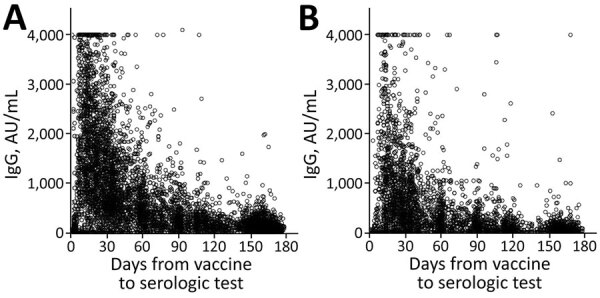
Israel experienced a new wave of coronavirus disease during June 2021, six months after implementing a national vaccination campaign. We conducted 3 discrete analyses using data from a large health maintenance organization in Israel to determine whether IgG levels of fully vaccinated persons decrease over time, describe the relationship between IgG titer and subsequent PCR-confirmed infection, and compare PCR-confirmed infection rates by period of vaccination. Mean IgG levels steadily decreased over the 6-month period in the total tested population and in all age groups. An inverse relationship was found between IgG titer and subsequent PCR-positive infection. Persons vaccinated during the first 2 months of the campaign were more likely to become infected than those subsequently vaccinated. The vaccinated group >60 years of age had lower initial IgG levels and were at greater risk for infection. The findings support the decision to add a booster vaccine for persons >60 years of age.
2021 年 6 月,以色列在开展全国性疫苗接种运动六个月后,迎来了新一轮的冠状病毒疾病。我们使用以色列一家大型健康维护组织的数据进行了 3 项独立分析,以确定完全接种疫苗的人的 IgG 水平是否会随时间下降,描述 IgG 滴度与随后 PCR 确诊感染之间的关系,并比较按接种时间划分的 PCR 确诊感染率。在整个检测人群和所有年龄组中,IgG 水平在 6 个月的时间里呈稳步下降趋势。发现 IgG 滴度与随后的 PCR 阳性感染呈负相关。在疫苗接种运动的前两个月接种疫苗的人比随后接种疫苗的人更容易感染。60 岁以上的接种组初始 IgG 水平较低,感染风险更高。这些发现支持为 60 岁以上人群接种加强疫苗的决定。