Scott Brian L, Anderson Yvette, Loyo Myriam, Kim Michael M
Department of Otolaryngology-Head & Neck Surgery, Oregon Health & Science University, Portland, Oregon, USA.
Private Practice, Portland, Oregon, USA.
J Cutan Aesthet Surg. 2021 Jul-Sep;14(3):351-356. doi: 10.4103/JCAS.JCAS_116_20.
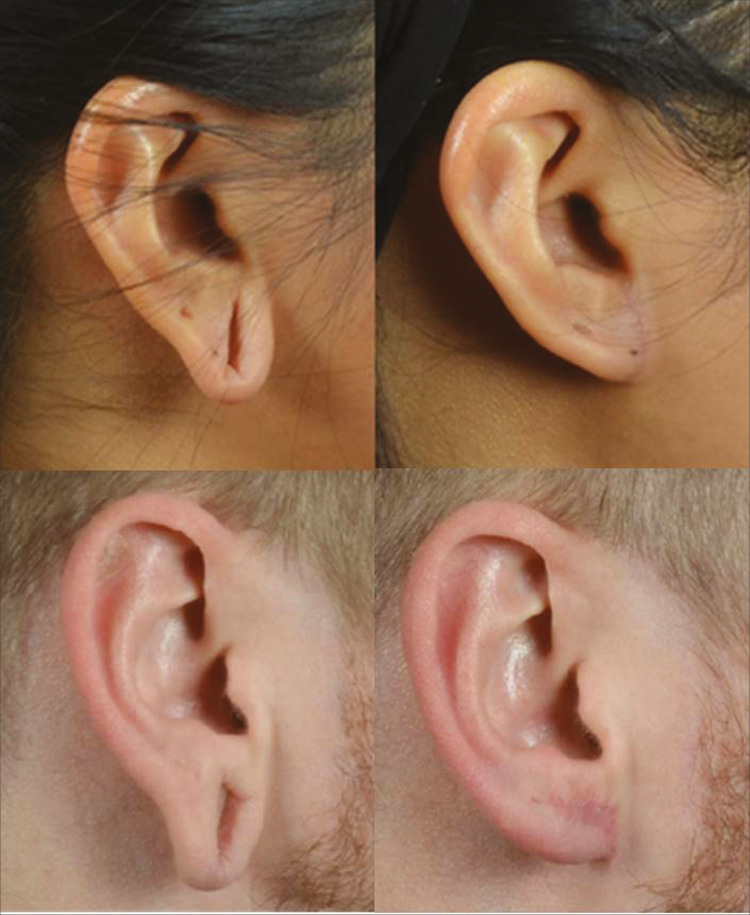
Earlobe stretching is a common body modification typically performed in individuals under 30 years old. Individuals may later desire restoration of a natural earlobe contour. There is a paucity of literature regarding technique and outcomes for repair of the gauged earlobe defect.
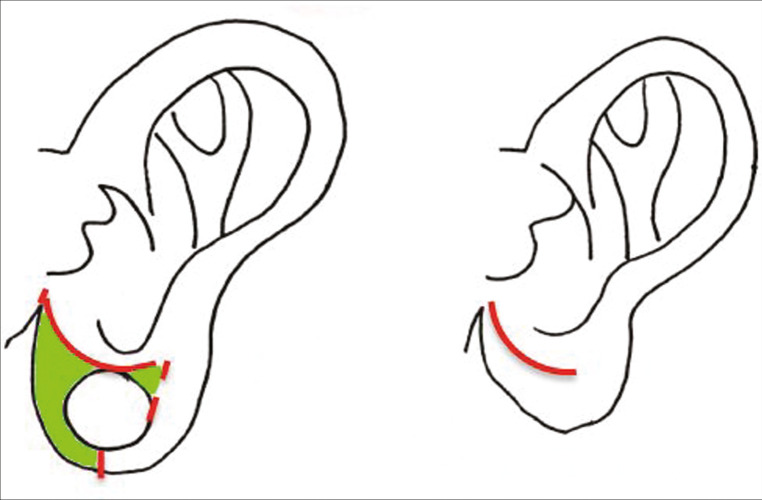
The primary aim of this study was to provide a strategy to assess stretched earlobe defects and choose between the repair techniques of de-epithelialization and closure or excision and rotation. The secondary aim of this study was to evaluate complication rates of the two techniques.
Retrospective review of all patients who underwent repair of stretched (gauged) earlobes at a single institution from 2012 to 2019. Patient demographics, maximum earlobe size, motivation for seeking repair, surgical technique, and complication rate were recorded.
Fifty-three patients underwent stretched earlobe repair. The average age was 25.9 years old; 60.0% of the patients were male. Defects repaired with de-epithelialization and closure had been stretched to an average of 12.4 (SD = 3.2) mm compared to 29.3 (SD = 10.9) mm for excision and rotation. The minor complication rate was 12.5% with de-epithelialization and 10.8% for excision and rotation. Motivations for seeking repair included a desire to look more professional for work (34.0%), personal preference (30.0%), and joining the military (23.0%).
Smaller earlobe defects (<15 mm) with nonptotic lobules can be repaired with de-epithelialization and primary closure, whereas larger earlobes (>15.0 mm) with ptotic lobules require excision and rotation. Stretched earlobe repair is a well-tolerated procedure, although a significant number of patients will require minor revisions.
耳垂拉伸是一种常见的身体改造方式,通常在30岁以下的人群中进行。个体后来可能希望恢复自然的耳垂轮廓。关于修复扩张耳垂缺损的技术和效果的文献较少。
本研究的主要目的是提供一种评估拉伸耳垂缺损的策略,并在去上皮化闭合或切除旋转修复技术之间做出选择。本研究的次要目的是评估这两种技术的并发症发生率。
回顾性分析2012年至2019年在单一机构接受拉伸(扩张)耳垂修复的所有患者。记录患者的人口统计学资料、最大耳垂尺寸、寻求修复的动机、手术技术和并发症发生率。
53例患者接受了拉伸耳垂修复。平均年龄为25.9岁;60.0%的患者为男性。采用去上皮化闭合修复的缺损平均拉伸至12.4(标准差 = 3.2)mm,而切除旋转修复的缺损平均拉伸至29.3(标准差 = 10.9)mm。去上皮化修复的轻微并发症发生率为12.5%,切除旋转修复的为10.8%。寻求修复的动机包括希望在工作中看起来更专业(34.0%)、个人喜好(30.0%)和参军(23.0%)。
耳垂小叶无下垂的较小耳垂缺损(<15 mm)可采用去上皮化和一期闭合修复,而耳垂小叶下垂的较大耳垂(>15.0 mm)则需要切除和旋转修复。拉伸耳垂修复是一种耐受性良好的手术,尽管相当数量的患者需要进行小的修复。