Gastroenterology Unit, University Hospitals Birmingham NHS Foundation Trust, Birmingham B15 2TH, United Kingdom.
Liver Unit, University Hospitals Birmingham NHS Foundation Trust, Birmingham B15 2TH, United Kingdom.
World J Gastroenterol. 2021 Nov 28;27(44):7612-7624. doi: 10.3748/wjg.v27.i44.7612.
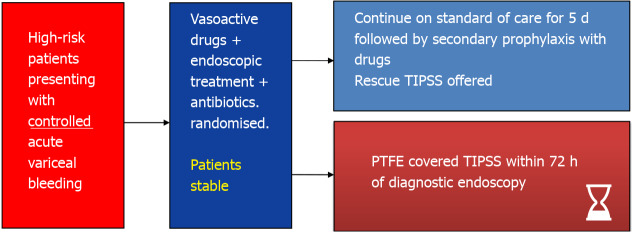
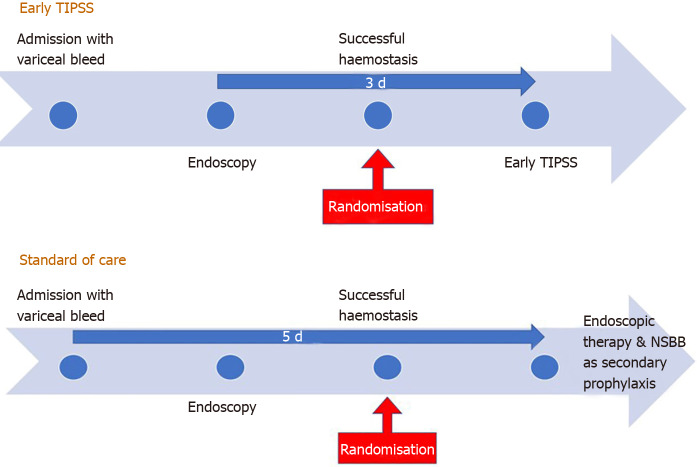
Variceal bleeding is a serious complication of cirrhosis and portal hypertension. Despite the improvement in management of acute variceal bleed (AVB), it still carries significant mortality. Portal pressure is the main driver of variceal bleeding and also a main predictor of decompensation. Reduction in portal pressure has been the mainstay of management of variceal bleeding. Transjugular intrahepatic porto-systemic stent shunt (TIPSS) is a very effective modality in reducing the portal hypertension and thereby, controlling portal hypertensive bleeding. However, its use in refractory bleeding (rescue/salvage TIPSS) is still associated with high mortality. "Early" use of TIPSS as a "pre-emptive strategy" in patients with AVB at high risk of failure of treatment has shown to be superior to standard treatment in several studies. While patients with Child C cirrhosis (up to 13 points) clearly benefit from early-TIPSS strategy, it's role in less severe liver disease (Child B) and more severe disease (Child C > 13 points) remains less clear. Moreover, standard of care has improved in the last decade leading to improved 1-year survival in high-risk patients with AVB as compared to earlier "early" TIPSS studies. Lastly in the real world, only a minority of patients with AVB fulfil the stringent criteria for early TIPSS. Therefore, there is unmet need to explore role of early TIPSS in management of AVB in well-designed prospective studies. In this review, we have appraised the role of early TIPSS, patient selection and discussed future directions in the management of patients with AVB.
静脉曲张出血是肝硬化和门静脉高压的严重并发症。尽管急性静脉曲张出血 (AVB) 的治疗有所改善,但仍存在较高的死亡率。门静脉压力是静脉曲张出血的主要驱动因素,也是失代偿的主要预测因素。降低门静脉压力一直是静脉曲张出血管理的主要方法。经颈静脉肝内门体分流术 (TIPSS) 是一种非常有效的降低门静脉高压的方法,从而控制门静脉高压性出血。然而,其在难治性出血(救援/挽救性 TIPSS)中的应用仍与高死亡率相关。在 AVB 高治疗失败风险的患者中“早期”使用 TIPSS 作为“预防性策略”,已在多项研究中显示优于标准治疗。虽然 Child C 肝硬化(高达 13 分)的患者明显受益于早期 TIPSS 策略,但它在较轻的肝病(Child B)和更严重的肝病(Child C > 13 分)中的作用仍不明确。此外,过去十年中,标准治疗方法有所改进,导致高危 AVB 患者的 1 年生存率提高,与早期“早期”TIPSS 研究相比。最后,在现实世界中,只有少数 AVB 患者符合早期 TIPSS 的严格标准。因此,需要在设计良好的前瞻性研究中探索早期 TIPSS 在 AVB 管理中的作用。在这篇综述中,我们评估了早期 TIPSS 的作用、患者选择,并讨论了 AVB 患者管理的未来方向。