Cele Sandile, Karim Farina, Lustig Gila, San James Emmanuel, Hermanus Tandile, Tegally Houriiyah, Snyman Jumari, Moyo-Gwete Thandeka, Wilkinson Eduan, Bernstein Mallory, Khan Khadija, Hwa Shi-Hsia, Tilles Sasha W, Singh Lavanya, Giandhari Jennifer, Mthabela Ntombifuthi, Mazibuko Matilda, Ganga Yashica, Gosnell Bernadett I, Karim Salim Abdool, Hanekom Willem, Van Voorhis Wesley C, Ndung'u Thumbi, Lessells Richard J, Moore Penny L, Moosa Mahomed-Yunus S, de Oliveira Tulio, Sigal Alex
Africa Health Research Institute, Durban, South Africa.
School of Laboratory Medicine and Medical Sciences, University of KwaZulu-Natal, Durban, South Africa.
medRxiv. 2021 Dec 7:2021.09.14.21263564. doi: 10.1101/2021.09.14.21263564.
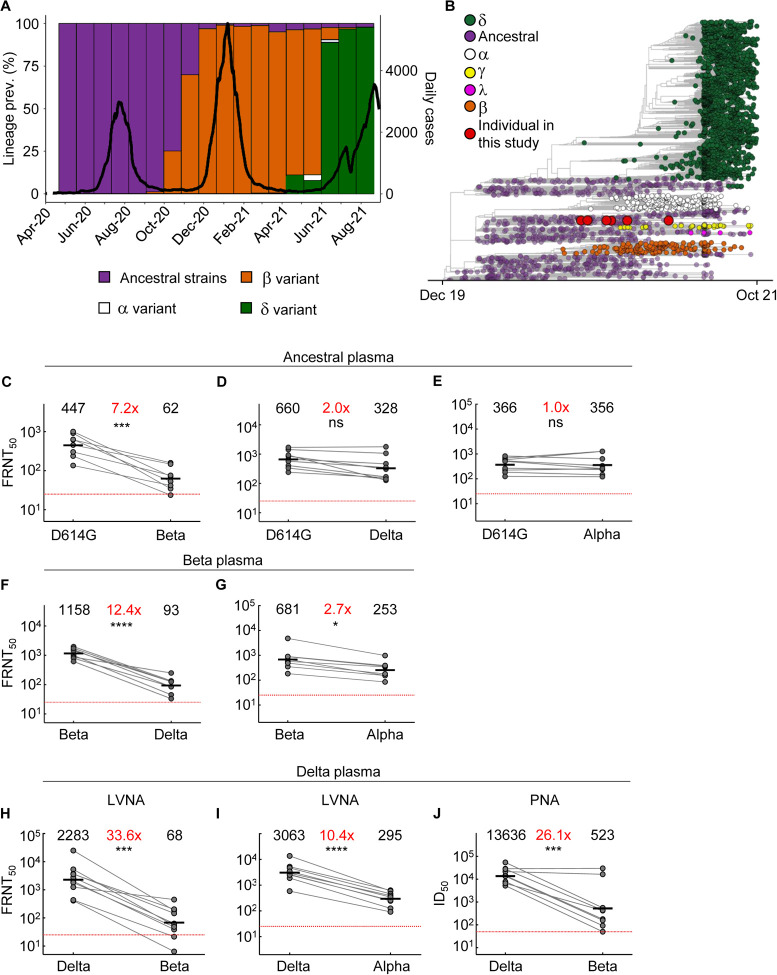
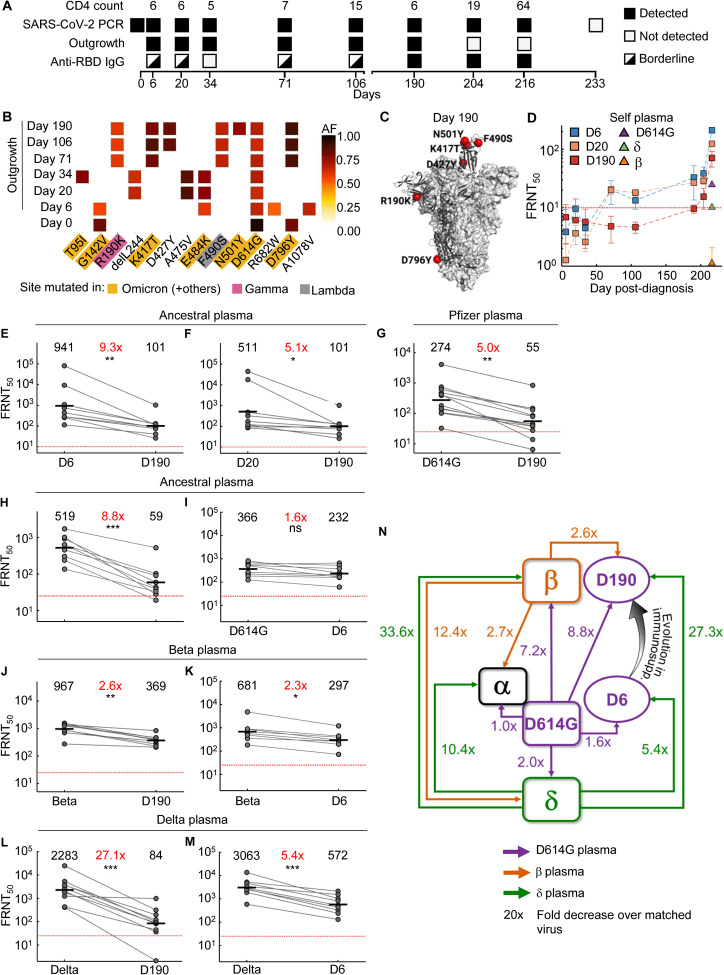
Characterizing SARS-CoV-2 evolution in specific geographies may help predict the properties of variants coming from these regions. We mapped neutralization of a SARS-CoV-2 strain that evolved over 6 months from the ancestral virus in a person with advanced HIV disease. Infection was before the emergence of the Beta variant first identified in South Africa, and the Delta variant. We compared early and late evolved virus to the ancestral, Beta, Alpha, and Delta viruses and tested against convalescent plasma from ancestral, Beta, and Delta infections. Early virus was similar to ancestral, whereas late virus was similar to Beta, exhibiting vaccine escape and, despite pre-dating Delta, strong escape of Delta-elicited neutralization. This example is consistent with the notion that variants arising in immune-compromised hosts, including those with advanced HIV disease, may evolve immune escape of vaccines and enhanced escape of Delta immunity, with implications for vaccine breakthrough and reinfections.
A prolonged ancestral SARS-CoV-2 infection pre-dating the emergence of Beta and Delta resulted in evolution of a Beta-like serological phenotypeSerological phenotype includes strong escape from Delta infection elicited immunity, intermediate escape from ancestral virus immunity, and weak escape from Beta immunityEvolved virus showed substantial but incomplete escape from antibodies elicited by BNT162b2 vaccination.
描绘严重急性呼吸综合征冠状病毒2(SARS-CoV-2)在特定地区的进化情况,可能有助于预测来自这些地区的病毒变体的特性。我们对一名晚期艾滋病患者体内从原始病毒进化了6个月的一种SARS-CoV-2毒株的中和作用进行了分析。感染发生在首次在南非发现的贝塔变体和德尔塔变体出现之前。我们将早期和晚期进化的病毒与原始病毒、贝塔病毒、阿尔法病毒和德尔塔病毒进行了比较,并使用来自原始感染、贝塔感染和德尔塔感染的康复期血浆进行了检测。早期病毒与原始病毒相似,而晚期病毒与贝塔病毒相似,表现出疫苗逃逸,并且尽管早于德尔塔变体出现,但对德尔塔变体诱导的中和作用有很强的逃逸能力。这个例子与以下观点一致,即在免疫功能低下的宿主(包括晚期艾滋病患者)中出现的变体可能会进化出对疫苗的免疫逃逸以及对德尔塔免疫的增强逃逸,这对疫苗突破和再次感染有影响。
在贝塔和德尔塔变体出现之前,一次长时间的原始SARS-CoV-2感染导致了一种类似贝塔的血清学表型的进化
血清学表型包括对德尔塔感染诱导的免疫有强烈逃逸、对原始病毒免疫有中等逃逸以及对贝塔免疫有微弱逃逸
进化后的病毒对BNT162b2疫苗诱导的抗体表现出显著但不完全的逃逸。