• 文献检索
  • 文档翻译
  • 深度研究
  • 学术资讯
  • Suppr Zotero 插件Zotero 插件
  • 邀请有礼
  • 套餐&价格
  • 历史记录
应用&插件
Suppr Zotero 插件Zotero 插件浏览器插件Mac 客户端Windows 客户端微信小程序
定价
高级版会员购买积分包购买API积分包
服务
文献检索文档翻译深度研究API 文档MCP 服务
关于我们
关于 Suppr公司介绍联系我们用户协议隐私条款
关注我们

Suppr 超能文献

核心技术专利:CN118964589B侵权必究
粤ICP备2023148730 号-1Suppr @ 2026

文献检索

告别复杂PubMed语法,用中文像聊天一样搜索,搜遍4000万医学文献。AI智能推荐,让科研检索更轻松。

立即免费搜索

文件翻译

保留排版,准确专业,支持PDF/Word/PPT等文件格式,支持 12+语言互译。

免费翻译文档

深度研究

AI帮你快速写综述,25分钟生成高质量综述,智能提取关键信息,辅助科研写作。

立即免费体验

瑞典辅助生殖技术受孕的儿童和青少年的精神障碍长期随访。

Long-term Follow-up of Psychiatric Disorders in Children and Adolescents Conceived by Assisted Reproductive Techniques in Sweden.

机构信息

Department of Medical Epidemiology and Biostatistics, Karolinska Institutet, Stockholm, Sweden.

Department of Oncology-Pathology, Karolinska Institutet, Stockholm, Sweden.

出版信息

JAMA Psychiatry. 2022 Feb 1;79(2):133-142. doi: 10.1001/jamapsychiatry.2021.3647.

DOI:10.1001/jamapsychiatry.2021.3647
PMID:34910092
原文链接:https://pmc.ncbi.nlm.nih.gov/articles/PMC8674804/
Abstract

IMPORTANCE

Individuals conceived with assisted reproductive techniques (ARTs) could be at elevated risk of psychiatric disorders owing to potential adverse effects of the procedures themselves, or because such traits or their risk factors may be more common in couples with infertility.

OBJECTIVE

To investigate the risk of psychiatric disorders in adolescents and young adults conceived with ARTs and to evaluate the role of treatment-related parental characteristics.

DESIGN, SETTING, AND PARTICIPANTS: This prospective follow-up of a nationwide birth cohort used linkage of Swedish population registers with coverage through 2018. All children born in Sweden from January 1, 1994, to December 31, 2006, were included in the analysis. Follow-up was completed on December 31, 2018, when participants were 12 to 25 years of age, and data was analyzed from March 17, 2020, to September 10, 2021.

EXPOSURES

In vitro fertilization with or without intracytoplasmic sperm injection and transfer of fresh or frozen-thawed embryos.

MAIN OUTCOMES AND MEASURES

Clinical diagnoses of mood disorder, including major depression, anxiety, obsessive-compulsive disorder (OCD), or suicidal behavior, were identified from hospital records and outpatient specialist care. Suicide was additionally identified from death certificates. Antidepressant use was identified from dispensations of prescribed medications.

RESULTS

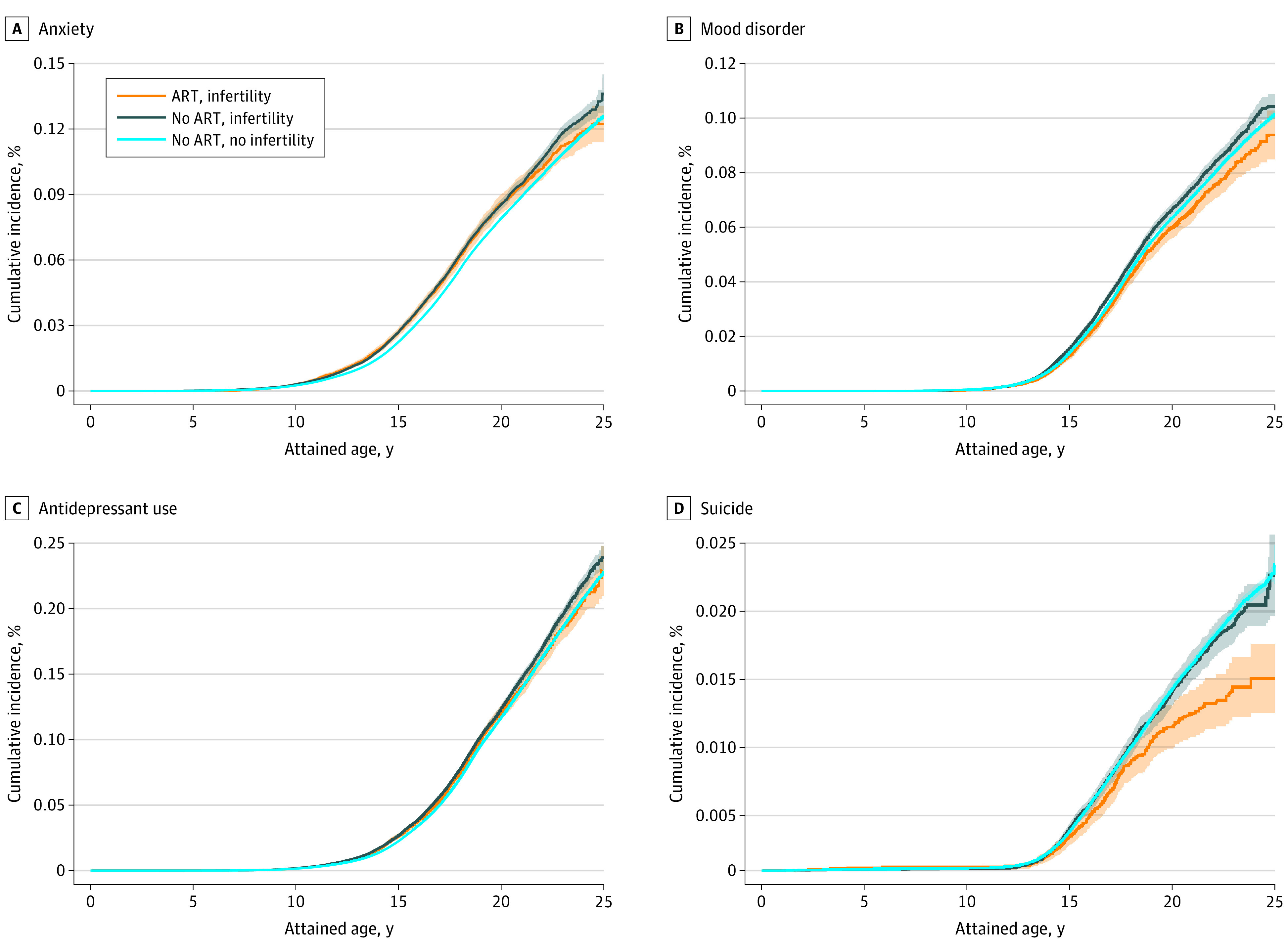
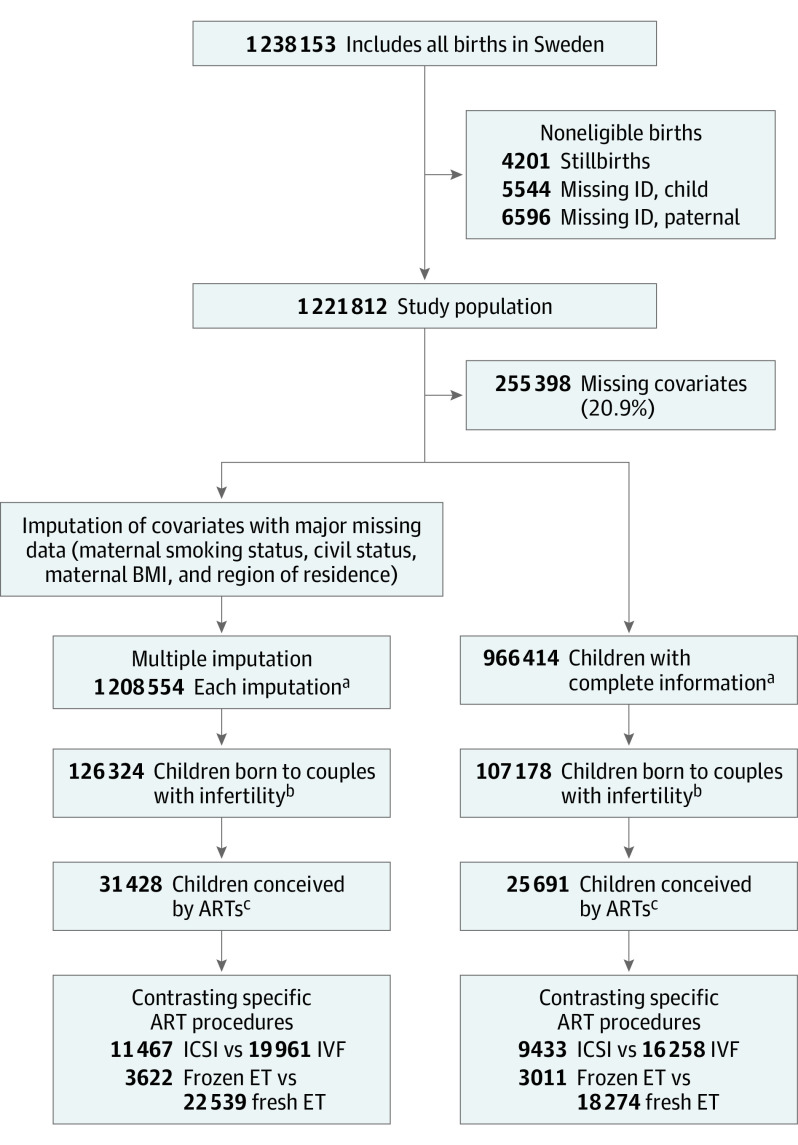
A total of 1 221 812 children (48.6% female, 51.4% male) born between 1994 and 2006 were followed up to a median age of 18 (IQR, 15-21) years. Among these participants, 31 565 (2.6%) were conceived with ART. Compared with all others, adolescents conceived with ART had an elevated risk of OCD (hazard ratio [HR], 1.35 [95% CI, 1.20-1.51]), but the association was attenuated and no longer statistically significant after adjustment for parental characteristics (adjusted HR [aHR], 1.10 [95% CI, 0.98-1.24]) and was no longer present when restricted to individuals born to couples with known infertility (aHR, 1.02 [95% CI, 0.89-1.17]). Adolescents conceived with ARTs were not at elevated risk of depression or suicidal behavior compared with other adolescents (irrespective of parental infertility). Type of fertilization (standard in vitro fertilization or intracytoplasmic sperm injection) had no association with outcomes. Compared with non-ART-conceived children of couples with infertility, fresh, but not frozen, embryo transfer was associated with a lower risk of mood disorders (aHR, 0.90 [95% CI, 0.83-0.97]), making frozen embryo transfer appear less advantageous when directly contrasted with fresh embryo transfer.

CONCLUSIONS AND RELEVANCE

These findings suggest that adolescents conceived with ARTs around the millennium are not at risk of poor psychiatric health compared with the general population, except for an elevated risk of OCD that may be explained by differences in parental characteristics.
https://cdn.ncbi.nlm.nih.gov/pmc/blobs/a020/8674804/52fbd04964ce/jamapsychiatry-e213647-g002.jpg
https://cdn.ncbi.nlm.nih.gov/pmc/blobs/a020/8674804/92e725992a3a/jamapsychiatry-e213647-g001.jpg
https://cdn.ncbi.nlm.nih.gov/pmc/blobs/a020/8674804/52fbd04964ce/jamapsychiatry-e213647-g002.jpg
https://cdn.ncbi.nlm.nih.gov/pmc/blobs/a020/8674804/92e725992a3a/jamapsychiatry-e213647-g001.jpg
https://cdn.ncbi.nlm.nih.gov/pmc/blobs/a020/8674804/52fbd04964ce/jamapsychiatry-e213647-g002.jpg
摘要

重要性

由于程序本身的潜在不良影响,或者由于不孕夫妇的这些特征或其风险因素可能更为常见,因此通过辅助生殖技术(ART)受孕的个体可能面临更高的精神障碍风险。

目的

调查通过辅助生殖技术受孕的青少年和年轻人患精神障碍的风险,并评估与治疗相关的父母特征的作用。

设计、环境和参与者:这是一项全国性出生队列的前瞻性随访研究,利用瑞典人口登记处的链接进行分析,覆盖范围截至 2018 年。所有于 1994 年 1 月 1 日至 2006 年 12 月 31 日期间在瑞典出生的儿童均纳入分析。2018 年 12 月 31 日完成随访,此时参与者年龄为 12 至 25 岁,数据分析于 2020 年 3 月 17 日至 2021 年 9 月 10 日进行。

暴露因素

体外受精(包括或不包括胞浆内精子注射)和新鲜或冷冻解冻胚胎的移植。

主要结果和测量

通过医院记录和专科门诊专家护理来识别心境障碍的临床诊断,包括重度抑郁症、焦虑症、强迫症(OCD)或自杀行为。通过死亡证明来识别自杀。通过处方药物的配药来识别抗抑郁药物的使用情况。

结果

共有 1221812 名(48.6%女性,51.4%男性)于 1994 年至 2006 年期间出生的儿童接受了中位年龄为 18 岁(IQR,15-21)年的随访。其中,31565 名(2.6%)是通过辅助生殖技术受孕的。与其他所有人相比,通过辅助生殖技术受孕的青少年患 OCD 的风险更高(风险比[HR],1.35[95%CI,1.20-1.51]),但在调整父母特征后,这种关联减弱且不再具有统计学意义(调整后的 HR[aHR],1.10[95%CI,0.98-1.24]),并且当限制为已知不孕夫妇所生的个体时,这种关联不再存在(aHR,1.02[95%CI,0.89-1.17])。与其他青少年相比,通过辅助生殖技术受孕的青少年在抑郁或自杀行为方面没有更高的风险(无论父母是否存在不孕不育)。受精类型(标准体外受精或胞浆内精子注射)与结果无关。与不孕夫妇非辅助生殖受孕的儿童相比,新鲜而非冷冻胚胎移植与较低的情绪障碍风险相关(aHR,0.90[95%CI,0.83-0.97]),这表明与新鲜胚胎移植相比,冷冻胚胎移植似乎没有优势。

结论和相关性

这些发现表明,与一般人群相比,在千禧年左右通过辅助生殖技术受孕的青少年在精神健康方面没有风险,除了 OCD 风险升高,这可能与父母特征的差异有关。

相似文献

1
Long-term Follow-up of Psychiatric Disorders in Children and Adolescents Conceived by Assisted Reproductive Techniques in Sweden.瑞典辅助生殖技术受孕的儿童和青少年的精神障碍长期随访。
JAMA Psychiatry. 2022 Feb 1;79(2):133-142. doi: 10.1001/jamapsychiatry.2021.3647.
2
Type 1 diabetes in children born after assisted reproductive technology: a register-based national cohort study.辅助生殖技术出生儿童的 1 型糖尿病:基于登记的全国队列研究。
Hum Reprod. 2020 Jan 1;35(1):221-231. doi: 10.1093/humrep/dez227.
3
Pregnancy outcomes after assisted human reproduction.人类辅助生殖后的妊娠结局
J Obstet Gynaecol Can. 2014 Jan;36(1):64-83. doi: 10.1016/S1701-2163(15)30685-X.
4
Imprinting disorders in children conceived with assisted reproductive technology in Sweden.瑞典辅助生殖技术受孕儿童的印迹障碍。
Fertil Steril. 2024 Oct;122(4):706-714. doi: 10.1016/j.fertnstert.2024.05.168. Epub 2024 Jun 1.
5
Mortality from infancy to adolescence in singleton children conceived from assisted reproductive techniques versus naturally conceived singletons in Sweden.在瑞典,通过辅助生殖技术受孕的单胎婴儿与自然受孕的单胎婴儿在婴儿期至青春期的死亡率。
Fertil Steril. 2020 Mar;113(3):524-532. doi: 10.1016/j.fertnstert.2019.10.018. Epub 2020 Feb 18.
6
Assisted Reproductive Techniques, ADHD, and School Performance.辅助生殖技术、注意缺陷多动障碍与学业成绩。
Pediatrics. 2021 Jul;148(1). doi: 10.1542/peds.2020-033183. Epub 2021 Jun 25.
7
Association of assisted reproductive technology (ART) treatment and parental infertility diagnosis with autism in ART-conceived children.辅助生殖技术(ART)治疗及父母不育诊断与ART受孕儿童自闭症的关联。
Hum Reprod. 2015 Feb;30(2):454-65. doi: 10.1093/humrep/deu338. Epub 2014 Dec 17.
8
Autism and mental retardation among offspring born after in vitro fertilization.体外受精后出生的子女中的自闭症和智力迟钝。
JAMA. 2013 Jul 3;310(1):75-84. doi: 10.1001/jama.2013.7222.
9
Risk of cancer in children and young adults conceived by assisted reproductive technology.辅助生殖技术受孕儿童和青少年的癌症风险。
Hum Reprod. 2019 Apr 1;34(4):740-750. doi: 10.1093/humrep/dey394.
10
The risk of birth defects with conception by ART.ART 受孕的出生缺陷风险。
Hum Reprod. 2021 Jan 1;36(1):116-129. doi: 10.1093/humrep/deaa272.

引用本文的文献

1
Association between imprinting disorders and assisted reproductive technologies.印记障碍与辅助生殖技术之间的关联。
Epigenomics. 2025 Apr;17(6):397-410. doi: 10.1080/17501911.2025.2471269. Epub 2025 Mar 3.
2
Children born to subfertile couples, how are they doing? Evidence from research.不孕夫妇所生子女的情况如何?研究证据。
Arch Dis Child. 2024 Dec 13;110(1):12-17. doi: 10.1136/archdischild-2023-326023.
3
Long-term health risk of offspring born from assisted reproductive technologies.辅助生殖技术出生子代的长期健康风险。
J Assist Reprod Genet. 2024 Mar;41(3):527-550. doi: 10.1007/s10815-023-02988-5. Epub 2023 Dec 26.
4
Health of singletons born after frozen embryo transfer until early adulthood: a Finnish register study.冻融胚胎移植后出生的单胎婴儿至成年早期的健康:一项芬兰登记研究。
Hum Reprod. 2022 Nov 24;37(12):2899-2907. doi: 10.1093/humrep/deac211.