Khan Memoona, Nisar Haider, Mushahid Nuzhat
Dr. Memoona Khan, MBBS, FCPS Haematology, Consultant Haematologist, Combined Military Hospital Khuzdar, Khuzdar District Balochistan, Pakistan.
Dr. Haider Nisar, MBBS, FCPS Paediatrics Consultant Paediatrician, Combined Military Hospital Khuzdar, Khuzdar District Balochistan, Pakistan.
Pak J Med Sci. 2021 Nov-Dec;37(7):1918-1923. doi: 10.12669/pjms.37.7.4210.
Khuzdar, the largest city of Southern Balochistan, is endemic for malaria with API of 6. The study was aimed at comparing the clinico-lab profile of severe and uncomplicated malaria in the region and to determine any association with age. No such study is reported in the region so far.
A prospective clinical observational study was conducted in Combined Military Hospital, Khuzdar between 2018 and 2020. A total of 210 Malaria patients, irrespective of age and gender were included. Cases were categorized into severe and uncomplicated according to WHO criteria. The clinical parameters and lab profile of severe and uncomplicated cases were compared and data was analyzed using SPSS 23.0. Categorical variables were analyzed for association of clinical features with severe malaria using Fisher exact test. Continuous variables were compared between uncomplicated and severe malaria using Mann-Whitney U -test. Statistical significance of lab parameters with type of malaria was derived using Kruskal Wallis.
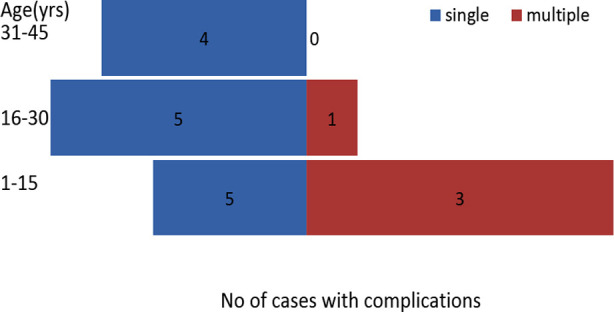
Uncomplicated and severe cases were 191 (91%) and 19 (9%) respectively. Severe malaria was significantly associated with jaundice, bleeding from gums, epistaxis, pallor, vomiting, respiratory distress, thrombocytopenia, low Hb, raised serum bilirubin and raised PT (p value<0.05). In children, frequency of multiple complications was significantly higher than adult patients. (75% vs 25%, p-value 0.002).Overall case fatality of severe malaria was 5.2% (1/19). However, case fatality rate was 100% in cerebral malaria.
Certain clinical and lab parameters can be used to predict prognosis and thus avoid adverse outcome in malaria patients.
胡兹达尔是俾路支省南部最大的城市,疟疾流行,年度发病率为6。本研究旨在比较该地区重症和非重症疟疾的临床实验室特征,并确定与年龄的任何关联。迄今为止,该地区尚未报道过此类研究。
2018年至2020年期间,在胡兹达尔联合军事医院进行了一项前瞻性临床观察研究。共纳入210例疟疾患者,不分年龄和性别。根据世界卫生组织标准将病例分为重症和非重症。比较重症和非重症病例的临床参数和实验室特征,并使用SPSS 23.0分析数据。使用Fisher精确检验分析分类变量,以确定临床特征与重症疟疾的关联。使用Mann-Whitney U检验比较非重症和重症疟疾之间的连续变量。使用Kruskal Wallis检验得出实验室参数与疟疾类型的统计学意义。
非重症和重症病例分别为191例(91%)和19例(9%)。重症疟疾与黄疸、牙龈出血、鼻出血、面色苍白、呕吐、呼吸窘迫、血小板减少、血红蛋白降低、血清胆红素升高和凝血酶原时间延长显著相关(p值<0.05)。儿童出现多种并发症的频率显著高于成年患者(75%对25%,p值0.002)。重症疟疾的总体病死率为5.2%(1/19)。然而,脑型疟疾的病死率为100%。
某些临床和实验室参数可用于预测预后,从而避免疟疾患者出现不良后果。