Department of Neurology, Xinqiao Hospital and the Second Affiliated Hospital, Army Medical University (Third Military Medical University), Chongqing, China.
Department of Neurology, Zhongnan Hospital, Wuhan University, Wuhan, China.
JAMA Netw Open. 2021 Dec 1;4(12):e2139550. doi: 10.1001/jamanetworkopen.2021.39550.
Endovascular therapy (EVT) has been reported to be safe and effective in improving clinical outcomes among patients with acute basilar artery occlusion (ABAO). The benefits associated with EVT remain uncertain for patients with ABAO with severe symptoms (ie, National Institutes of Health Stroke Scale [NIHSS] score ≥ 21).
To assess the outcomes associated with EVT and identify factors associated with outcomes among patients with ABAO and severe symptoms.
DESIGN, SETTING, AND PARTICIPANTS: This prospective, nationwide cohort study was conducted using data from January 2014 to May 2019 in China from the Endovascular Treatment for Acute Basilar Artery Occlusion Study Registry (BASILAR). Included patients had ABAO and underwent EVT or standard medical treatment (SMT) alone in routine clinical practice. Patients were dichotomized into severe symptoms (ie, NIHSS score ≥ 21) and minor to moderate symptoms (NIHSS score < 21) groups. Patients were followed up for 90 days. Data were analyzed from December 2020 through June 2021.
EVT with SMT vs SMT alone.
The primary outcome was improvement in modified Rankin Scale (mRS) score at 90 days, defined as a decrease by 1 grade in mRS score. Secondary outcomes included favorable functional outcome (ie, mRS score, 0-3) and mortality.
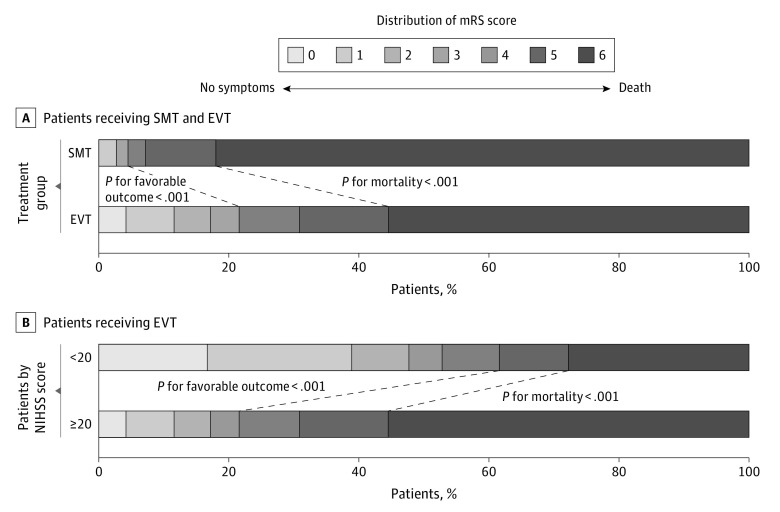
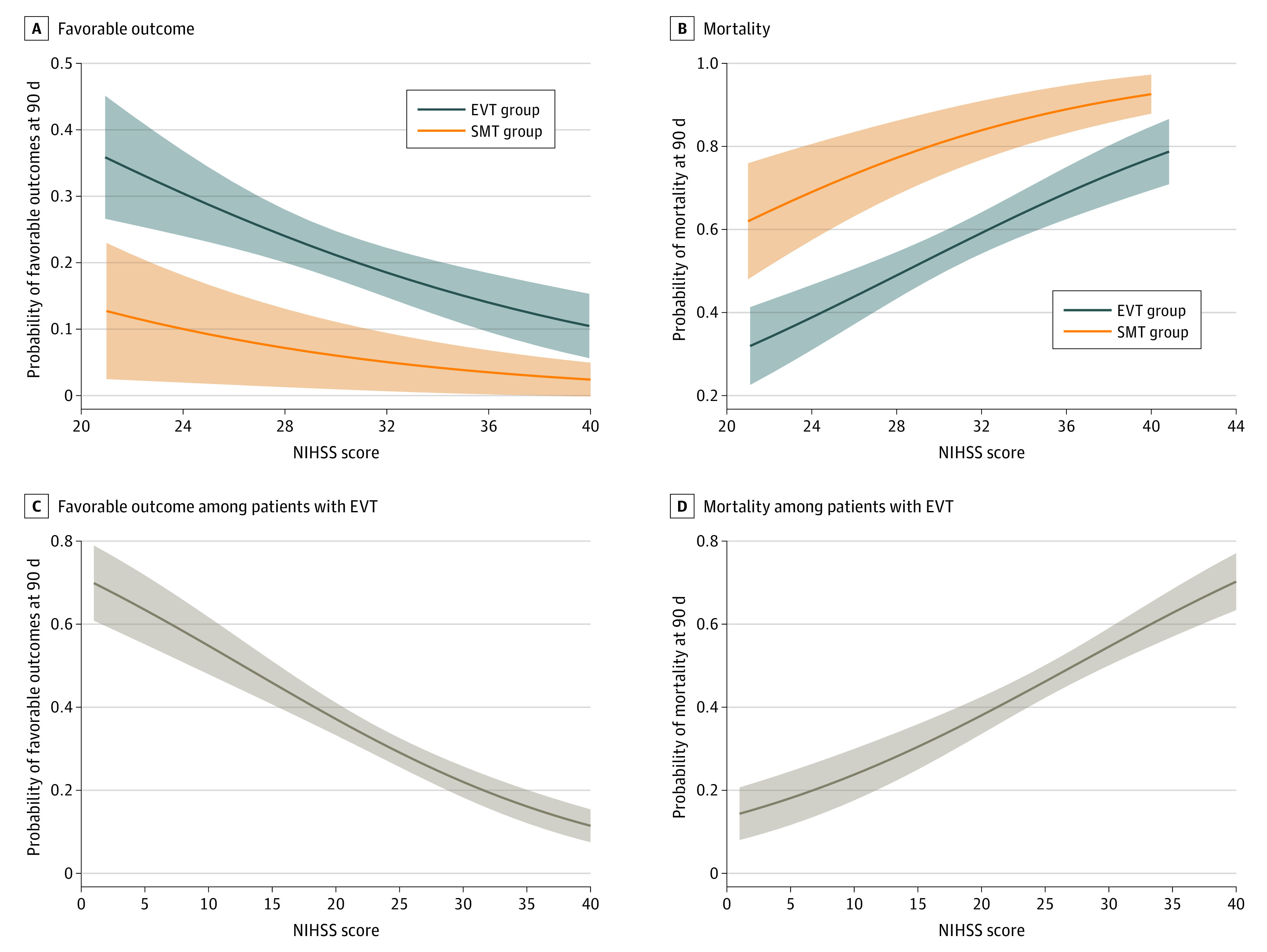
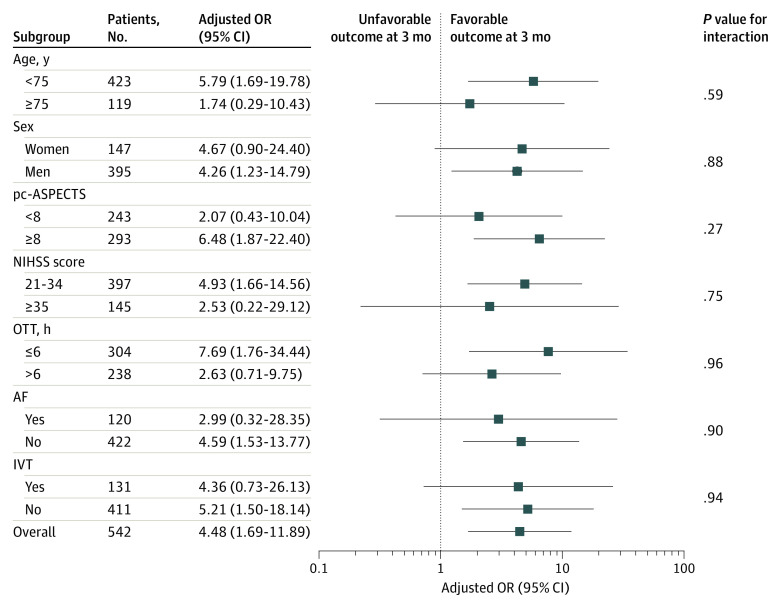
Among 542 patients with ABAO and severe symptoms (median [IQR] age, 65 [57-74] years; 147 [27.1%] women), 431 patients (79.5%) received EVT and 111 patients (20.5%) received SMT. Compared with SMT, EVT was associated with increased odds of improved mRS score (adjusted common odds ratio [OR], 3.44 [95% CI, 2.05-5.78]; P < .001), with increased odds of a favorable functional outcome (ie, mRS score, 0-3; adjusted OR, 4.52 [95% CI, 1.64-12.43]; P = .004) and decreased odds of mortality (adjusted OR, 0.27 [95% CI, 0.15-0.50]; P < .001). Among patients receiving EVT, baseline NIHSS score was associated with decreased odds of a favorable functional outcome (adjusted OR per 1-point increase in score, 0.90 [95% CI, 0.85-0.95]; P < .001) and increased odds of mortality (adjusted OR per 1-point increase in score, 1.13 [95% CI, 1.07-1.19]; P < .001), while posterior circulation Acute Stroke Prognosis Early Computed Tomography Score (pc-ASPECTS) was associated with increased odds of a favorable functional outcome (adjusted OR per 1-point increase in score, 1.71 [95% CI, 1.41-2.07]; P < .001) and decreased odds of mortality (adjusted OR per 1-point increase in score, 0.74 [95% CI, 0.64-0.85]; P < .001). Different occlusion sites, compared with distal basilar artery, were associated with decreased odds of favorable functional outcome (eg, middle basilar artery: adjusted OR vs distal basilar artery, 0.36 [95% CI, 0.17-0.80]; P = .01).
This study found that EVT was associated with increased odds of functional favorable outcomes among patients with ABAO and severe symptoms. Baseline NIHSS score, pc-ASPECTS, and occlusion site were independent factors associated with clinical outcomes.
血管内治疗(EVT)已被报道可改善急性基底动脉闭塞(ABAO)患者的临床预后。对于症状严重的 ABAO 患者(即美国国立卫生研究院卒中量表[NIHSS]评分≥21),EVT 带来的益处尚不确定。
评估 EVT 相关结局,并确定与 ABAO 且症状严重的患者结局相关的因素。
设计、地点和参与者:本前瞻性全国性队列研究于 2014 年 1 月至 2019 年 5 月期间在中国进行,数据来自急性基底动脉闭塞血管内治疗研究登记处(BASILAR)。纳入患者均患有 ABAO,并在常规临床实践中接受 EVT 或标准药物治疗(SMT)。将患者分为症状严重(即 NIHSS 评分≥21)和症状轻微至中度(NIHSS 评分<21)两组。对患者进行 90 天随访。数据分析于 2020 年 12 月至 2021 年 6 月进行。
EVT 联合 SMT 与 SMT 单药治疗。
主要结局为 90 天时改良 Rankin 量表(mRS)评分改善,定义为 mRS 评分降低 1 级。次要结局包括功能结局良好(即 mRS 评分 0-3)和死亡率。
在 542 例 ABAO 且症状严重的患者中(中位数[IQR]年龄,65[57-74]岁;147[27.1%]为女性),431 例(79.5%)患者接受 EVT,111 例(20.5%)患者接受 SMT。与 SMT 相比,EVT 可增加 mRS 评分改善的可能性(校正后的常见比值比[OR],3.44[95%CI,2.05-5.78];P<0.001),增加功能结局良好的可能性(即 mRS 评分 0-3;校正后的 OR,4.52[95%CI,1.64-12.43];P=0.004),并降低死亡率的可能性(校正后的 OR,0.27[95%CI,0.15-0.50];P<0.001)。在接受 EVT 的患者中,基线 NIHSS 评分与功能结局良好的可能性降低相关(每增加 1 分的校正 OR,0.90[95%CI,0.85-0.95];P<0.001),与死亡率增加相关(每增加 1 分的校正 OR,1.13[95%CI,1.07-1.19];P<0.001),而后部循环急性卒中预后早期计算机断层扫描评分(pc-ASPECTS)与功能结局良好的可能性增加相关(每增加 1 分的校正 OR,1.71[95%CI,1.41-2.07];P<0.001),与死亡率降低相关(每增加 1 分的校正 OR,0.74[95%CI,0.64-0.85];P<0.001)。与远端基底动脉相比,不同的闭塞部位(如中脑动脉)与功能结局良好的可能性降低相关(例如,中脑动脉:与远端基底动脉相比的校正 OR,0.36[95%CI,0.17-0.80];P=0.01)。
本研究发现 EVT 可增加症状严重的 ABAO 患者功能结局良好的可能性。基线 NIHSS 评分、pc-ASPECTS 和闭塞部位是与临床结局相关的独立因素。