From the Delaware Limb Loss Studies, University of Delaware, Department of Physical Therapy (MS, EHB, JMS); University of Delaware, Biostatistics Core Facility (RTP); Independence Prosthetics-Orthotics, Inc (JRH); and Christiana Spine Center, Newark, Delaware (FBS).
Am J Phys Med Rehabil. 2022 Jan 1;101(1):32-39. doi: 10.1097/PHM.0000000000001736.
The aim of this study was to evaluate associations between time since amputation (TSAmp) and mobility outcomes of adults with lower-limb amputation.
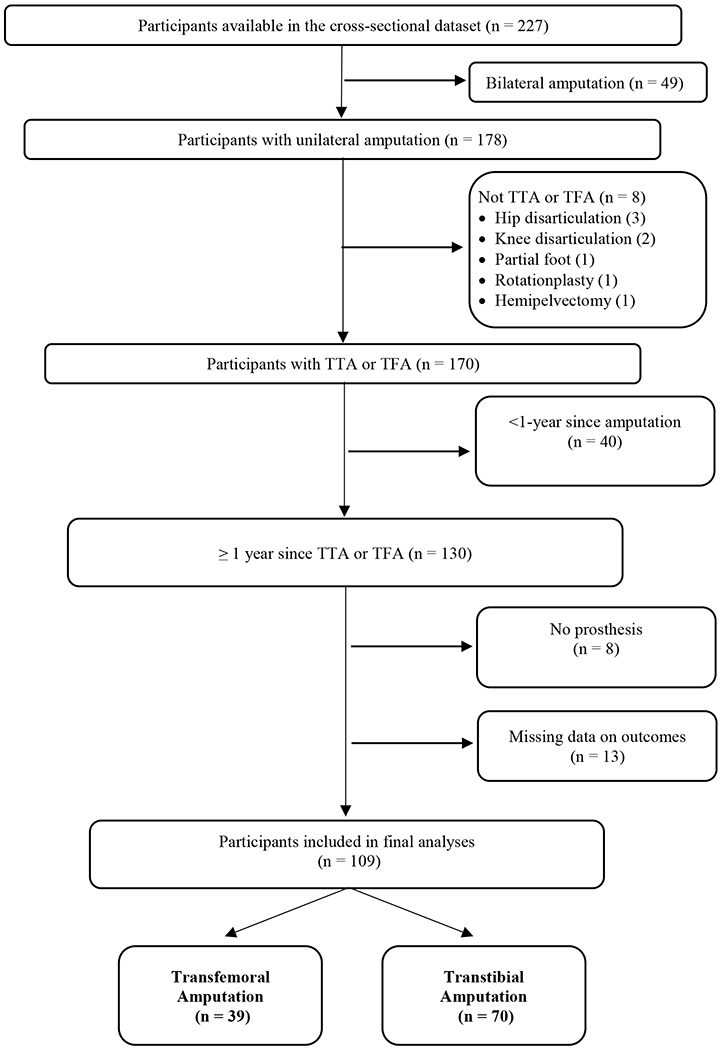
A secondary analysis of a cross-sectional dataset, including 109 community-dwelling adults, 1 yr or more after unilateral transfemoral (n = 39; mean age, 54 ± 15 yrs) or transtibial (n = 70; mean age = 58 ± 14 yrs) amputation, was conducted. Participants attended standardized clinical evaluations and completed mobility-related outcome measures: Prosthesis Evaluation Questionnaire-Mobility Subscale, timed up and go, 10-m walk test, and 6-min walk test.
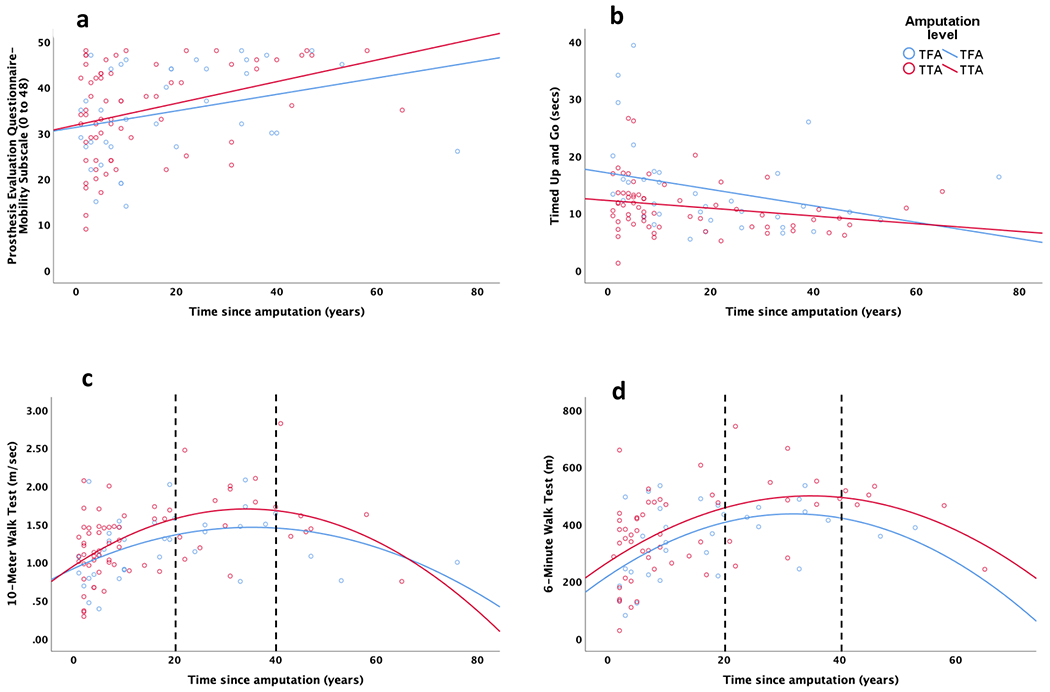
After controlling for age, sex, amputation level, and etiology, TSAmp was significantly associated with each mobility outcome. Prosthesis Evaluation Questionnaire-Mobility Subscale and TSAmp were linearly associated, with TSAmp explaining 10.6% of the overall variance. Timed up and go test time and TSAmp were linearly associated, with TSAmp and an interaction term (LevelxTSAmp) explaining 8.4% of the overall variance; 10-m walk test speed and 6-min walk test distance had nonlinear associations with TSAmp, with TSAmp and nonlinear terms (TSAmp2) explaining 12.1% and 13.2% of the overall variance, respectively.
Based on the findings, longer TSAmp may be associated with better Prosthesis Evaluation Questionnaire-Mobility Subscale score and timed up and go test time, whereas longer TSAmp may be associated with better or worse 10-m walk test speed and 6-min walk test distance depending upon time elapsed since lower-limb amputation. Estimations of postamputation mobility among adults with lower-limb amputation should consider TSAmp.
本研究旨在评估下肢截肢成年人截肢后时间(TSAmp)与移动能力结果之间的关系。
对横断面数据集进行二次分析,包括 109 名居住在社区的成年人,单侧股骨(n = 39;平均年龄 54 ± 15 岁)或胫骨(n = 70;平均年龄 58 ± 14 岁)截肢后 1 年或以上。参与者接受了标准化的临床评估,并完成了与移动能力相关的结果测量:假肢评估问卷-移动子量表、计时起立行走测试、10 米步行测试和 6 分钟步行测试。
在控制年龄、性别、截肢水平和病因后,TSAmp 与每个移动能力结果显著相关。假肢评估问卷-移动子量表和 TSAmp 呈线性相关,TSAmp 解释了总方差的 10.6%。计时起立行走测试时间和 TSAmp 呈线性相关,TSAmp 和交互项(LevelxTSAmp)解释了总方差的 8.4%;10 米步行测试速度和 6 分钟步行测试距离与 TSAmp 呈非线性相关,TSAmp 和非线性项(TSAmp2)分别解释了总方差的 12.1%和 13.2%。
根据研究结果,较长的 TSAmp 可能与更好的假肢评估问卷-移动子量表评分和计时起立行走测试时间相关,而较长的 TSAmp 可能与更好或更差的 10 米步行测试速度和 6 分钟步行测试距离相关,具体取决于下肢截肢后时间的流逝。估计下肢截肢成年人的截肢后移动能力应考虑 TSAmp。