Public Health Ontario, Toronto, Ontario, Canada.
Dalla Lana School of Public Health, University of Toronto, Toronto, Ontario, Canada.
Euro Surveill. 2021 Dec;26(50). doi: 10.2807/1560-7917.ES.2021.26.50.2001559.
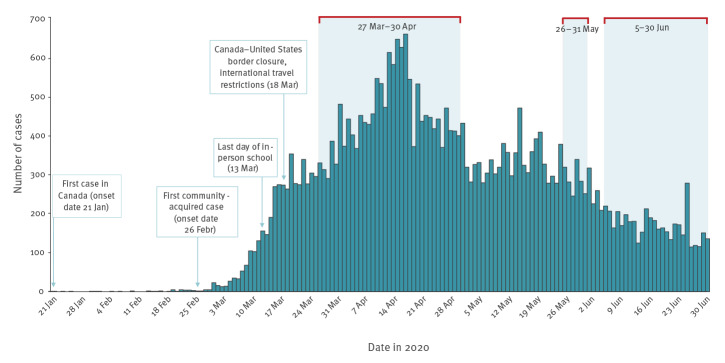
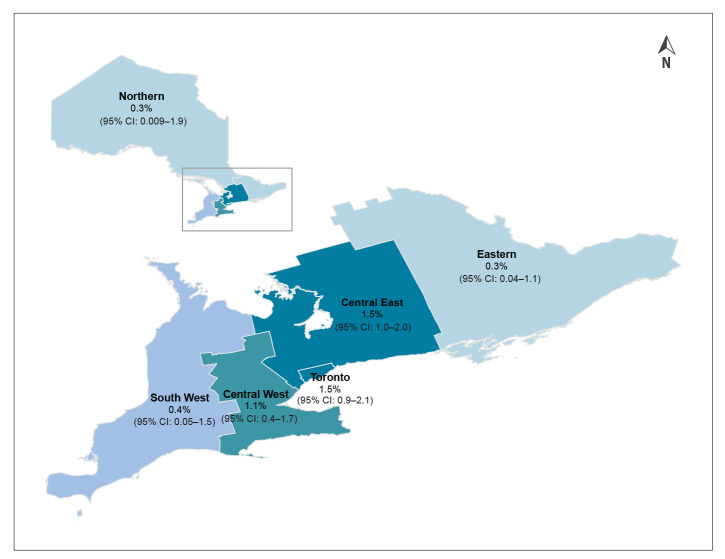
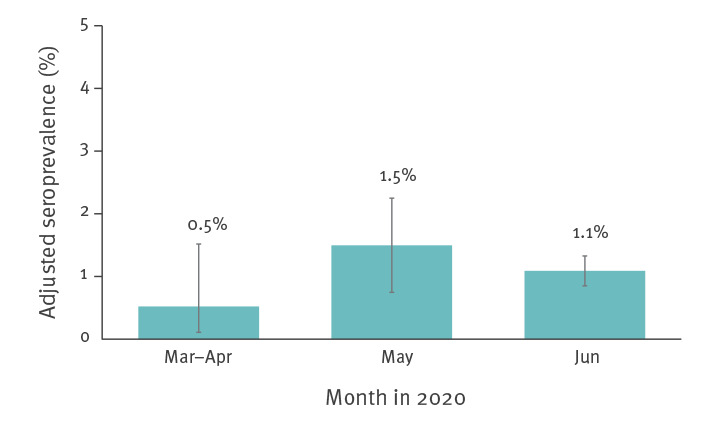
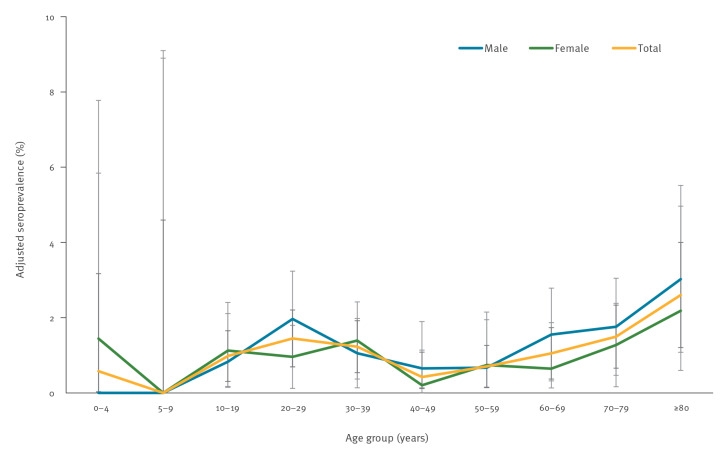
BackgroundSerosurveys for SARS-CoV-2 aim to estimate the proportion of the population that has been infected.AimThis observational study assesses the seroprevalence of SARS-CoV-2 antibodies in Ontario, Canada during the first pandemic wave.MethodsUsing an orthogonal approach, we tested 8,902 residual specimens from the Public Health Ontario laboratory over three time periods during March-June 2020 and stratified results by age group, sex and region. We adjusted for antibody test sensitivity/specificity and compared with reported PCR-confirmed COVID-19 cases.ResultsAdjusted seroprevalence was 0.5% (95% confidence interval (CI): 0.1-1.5) from 27 March-30 April, 1.5% (95% CI: 0.7-2.2) from 26-31 May, and 1.1% (95% CI: 0.8-1.3) from 5-30 June 2020. Adjusted estimates were highest in individuals aged ≥ 60 years in March-April (1.3%; 95% CI: 0.2-4.6), in those aged 20-59 years in May (2.1%; 95% CI: 0.8-3.4) and in those aged ≥ 60 years in June (1.6%; 95% CI: 1.1-2.1). Regional seroprevalence varied, and was highest for Toronto in March-April (0.9%; 95% CI: 0.1-3.1), for Toronto in May (3.2%; 95% CI: 1.0-5.3) and for Toronto (1.5%; 95% CI: 0.9-2.1) and Central East in June (1.5%; 95% CI: 1.0-2.0). We estimate that COVID-19 cases detected by PCR in Ontario underestimated SARS-CoV-2 infections by a factor of 4.9.ConclusionsOur results indicate low population seroprevalence in Ontario, suggesting that public health measures were effective at limiting the spread of SARS-CoV-2 during the first pandemic wave.
背景
SARS-CoV-2 的血清学调查旨在估计人群中已感染的比例。
目的
本观察性研究评估了加拿大安大略省在第一次大流行期间 SARS-CoV-2 抗体的血清流行率。
方法
使用正交方法,我们在 2020 年 3 月至 6 月期间的三个时间段测试了来自安大略省公共卫生局实验室的 8902 份剩余标本,并按年龄组、性别和地区对结果进行分层。我们对抗体检测的敏感性/特异性进行了调整,并与报告的 PCR 确诊 COVID-19 病例进行了比较。
结果
调整后的血清流行率为 3 月 27 日至 4 月 30 日为 0.5%(95%置信区间[CI]:0.1-1.5),5 月 26 日至 31 日为 1.5%(95%CI:0.7-2.2),6 月 5 日至 30 日为 1.1%(95%CI:0.8-1.3)。3 月至 4 月年龄≥60 岁的个体调整后的估计值最高(1.3%;95%CI:0.2-4.6),5 月 20-59 岁的个体为 2.1%(95%CI:0.8-3.4),6 月年龄≥60 岁的个体为 1.6%(95%CI:1.1-2.1)。区域血清流行率不同,3 月至 4 月多伦多最高(0.9%;95%CI:0.1-3.1),5 月多伦多最高(3.2%;95%CI:1.0-5.3),6 月多伦多(1.5%;95%CI:0.9-2.1)和中东部最高(1.5%;95%CI:1.0-2.0)。我们估计安大略省通过 PCR 检测到的 COVID-19 病例低估了 SARS-CoV-2 感染的比例为 4.9 倍。
结论
我们的结果表明安大略省人群的血清流行率较低,这表明公共卫生措施在第一次大流行期间有效限制了 SARS-CoV-2 的传播。