Digestive Diseases Research Center, Digestive Diseases Research Institute, Shariati Hospital, Tehran University of Medical Sciences, Tehran, 14117-13135, Iran.
Liver and Pancreatobiliary Diseases Research Center, Digestive Diseases Research Institute, Shariati Hospital, Tehran University of Medical Sciences, Tehran, Iran.
BMC Public Health. 2022 May 23;22(1):1031. doi: 10.1186/s12889-022-13464-7.
The first large serosurvey in Iran found a SARS-CoV-2 antibody seroprevalence of 17.1% among the general population in the first wave of the epidemic by April, 2020. The purpose of the current study was to assess the seroprevalence of COVID-19 infection among Iranian general population after the third wave of the disease.
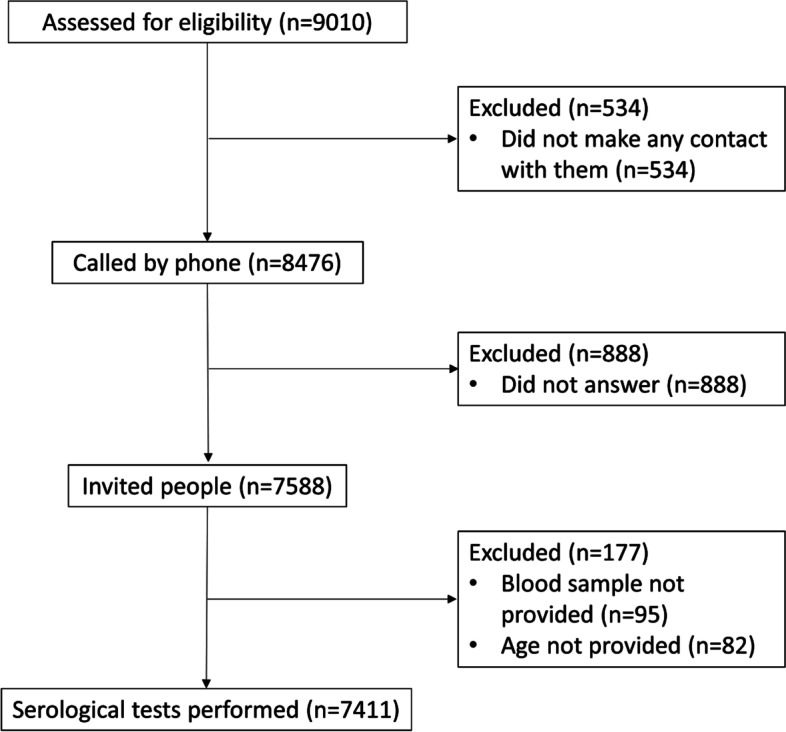
This population-based cross-sectional study was conducted on 7411 individuals aged ≥10 years old in 16 cities across 15 provinces in Iran between January and March, 2021. We randomly sampled individuals registered in the Iranian electronic health record system based on their national identification numbers and invited them by telephone to a healthcare center for data collection. Presence of SARS-CoV-2-specific IgG and IgM antibodies was assessed using the SARS-CoV-2 ELISA kits. The participants were also asked about their recent COVID-19-related symptoms, including cough, fever, chills, sore throat, headache, dyspnea, diarrhea, anosmia, conjunctivitis, weakness, myalgia, arthralgia, altered level of consciousness, and chest pain. The seroprevalence was estimated after adjustment for population weighting and test performance.
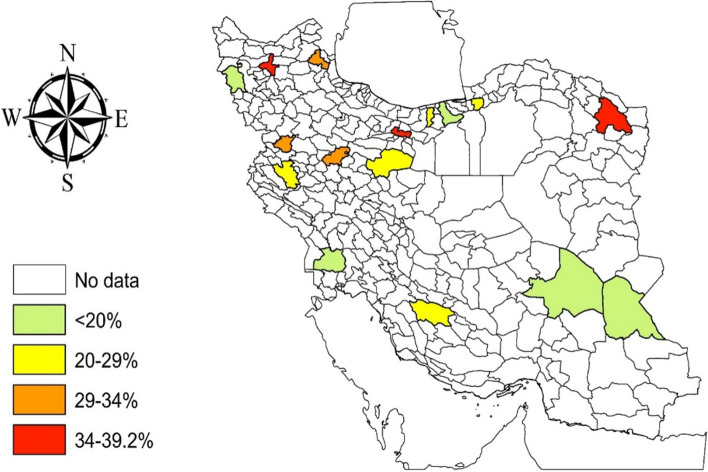
The overall population-weighted seroprevalence adjusted for test performance was 34.2% (95% CI 31.0-37.3), with an estimated 7,667,874 (95% CI 6,950,412-8,362,915) infected individuals from the 16 cities. The seroprevalence varied between the cities, from the highest estimate in Tabriz (39.2% [95% CI 33.0-45.5]) to the lowest estimate in Kerman (16.0% [95% CI 10.7-21.4]). In the 16 cities studied, 50.9% of the seropositive individuals did not report a history of symptoms suggestive of COVID-19, implying an estimation of 3,902,948 (95% CI 3,537,760-4,256,724) asymptomatic infected individuals.
Nearly one in three individuals were exposed to SARS-CoV-2 in the studied cities by March 2021. The seroprevalence increased about two-fold between April, 2020, and March, 2021.
2020 年 4 月,伊朗首次大规模血清学调查发现,在疫情第一波期间,普通人群中 SARS-CoV-2 抗体血清阳性率为 17.1%。本研究的目的是评估伊朗普通人群在第三次疾病浪潮后 COVID-19 感染的血清阳性率。
这项基于人群的横断面研究于 2021 年 1 月至 3 月在伊朗 15 个省份的 16 个城市中对 7411 名年龄≥10 岁的个体进行。我们根据国家身份证号码从伊朗电子健康记录系统中随机抽取个体,并通过电话邀请他们到医疗中心进行数据收集。使用 SARS-CoV-2 ELISA 试剂盒评估 SARS-CoV-2 特异性 IgG 和 IgM 抗体的存在。还询问了参与者最近与 COVID-19 相关的症状,包括咳嗽、发热、寒战、喉咙痛、头痛、呼吸困难、腹泻、嗅觉丧失、结膜炎、乏力、肌痛、关节痛、意识水平改变和胸痛。在调整人群加权和测试性能后,估计了血清阳性率。
经过测试性能调整的总体人群加权血清阳性率为 34.2%(95%CI 31.0-37.3),估计有 16 个城市的 7667874 名(95%CI 6950412-8362915)感染个体。血清阳性率在城市之间存在差异,从最高的大不里士(39.2%[95%CI 33.0-45.5])到最低的克尔曼(16.0%[95%CI 10.7-21.4])。在所研究的 16 个城市中,50.9%的血清阳性个体没有报告有 COVID-19 症状的病史,这意味着估计有 3902948 名(95%CI 3537760-4256724)无症状感染个体。
到 2021 年 3 月,研究城市中近三分之一的个体接触过 SARS-CoV-2。血清阳性率在 2020 年 4 月至 2021 年 3 月期间增加了一倍多。