Developmental Therapeutics Branch, National Cancer Institute, National Institutes of Health, Bethesda, Maryland.
Curr Protoc. 2021 Dec;1(12):e316. doi: 10.1002/cpz1.316.
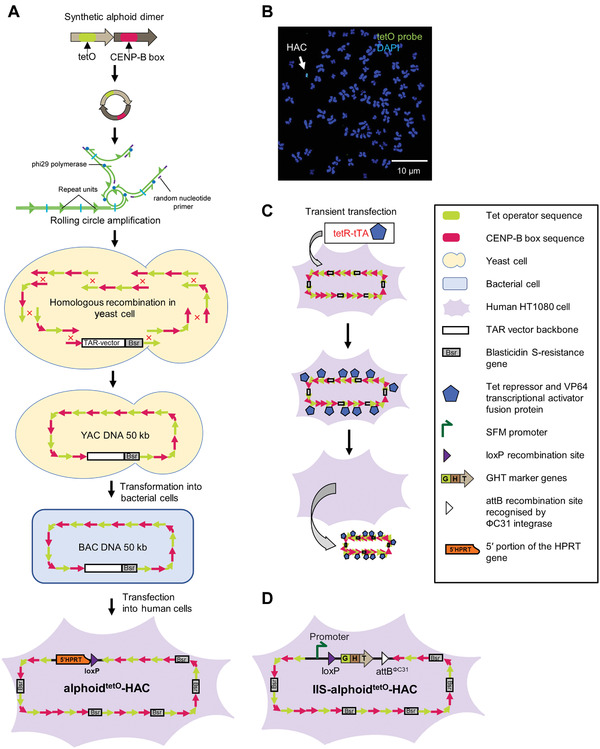
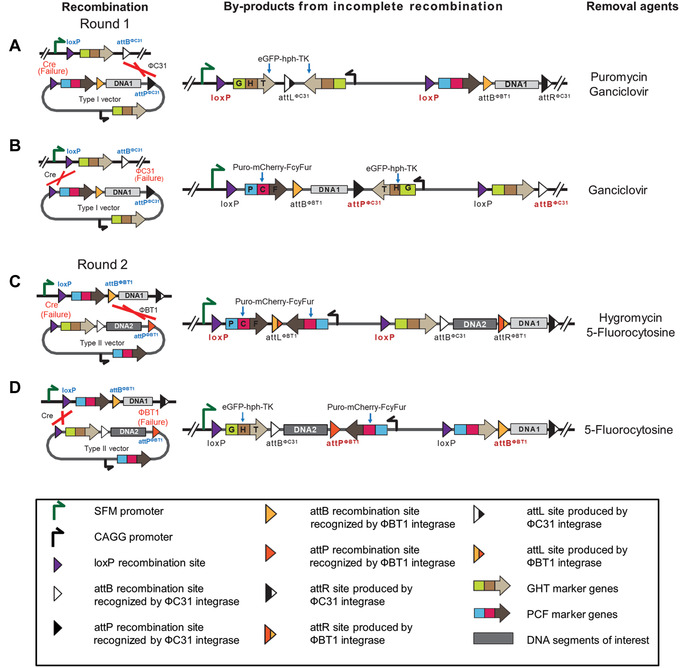
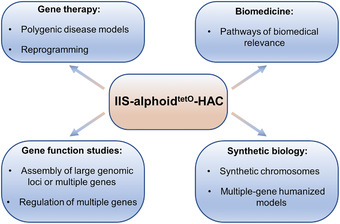
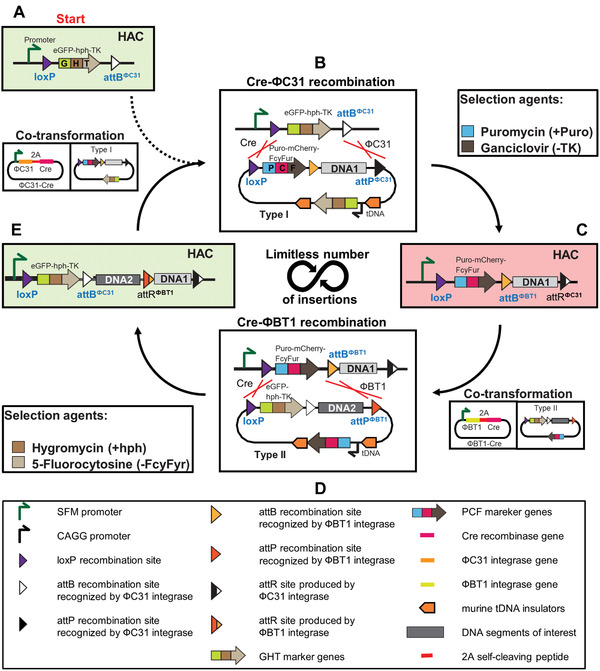
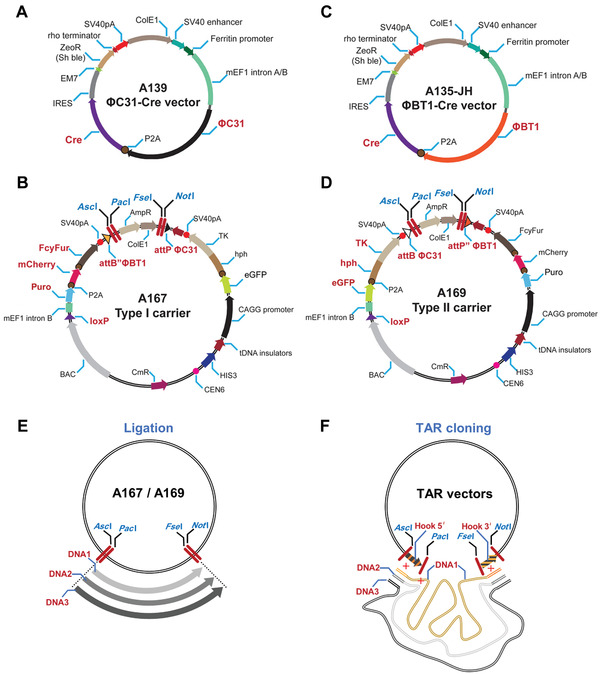
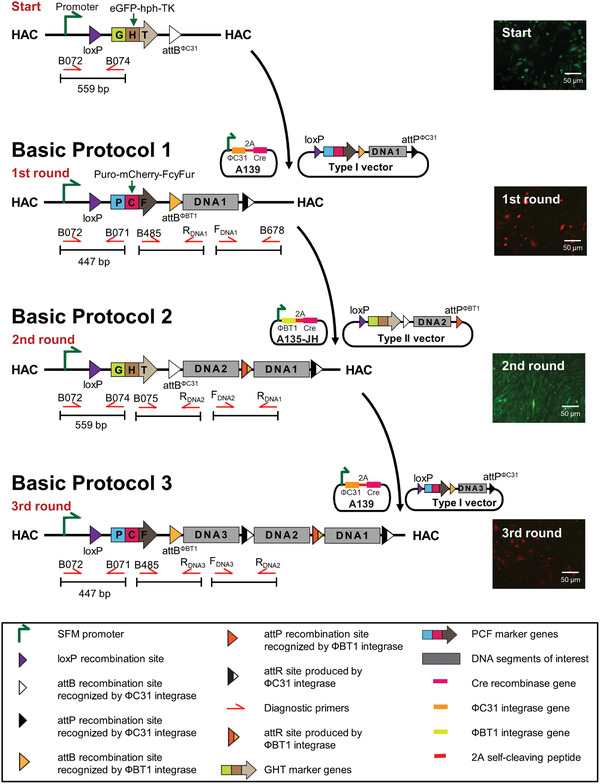
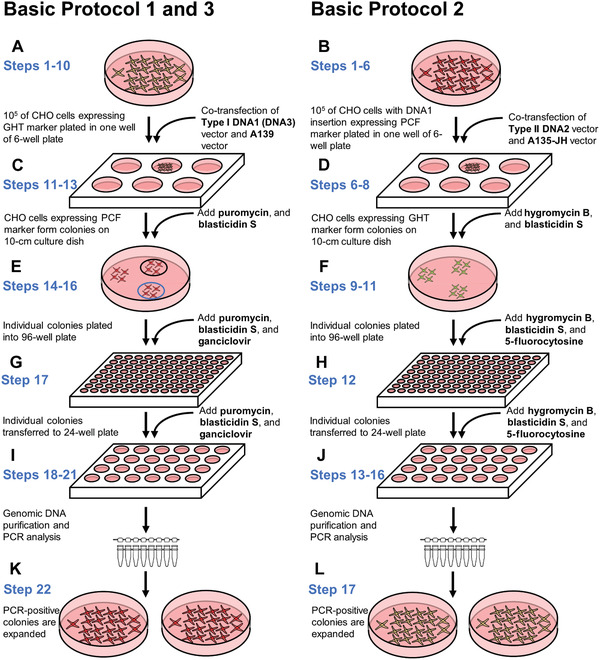
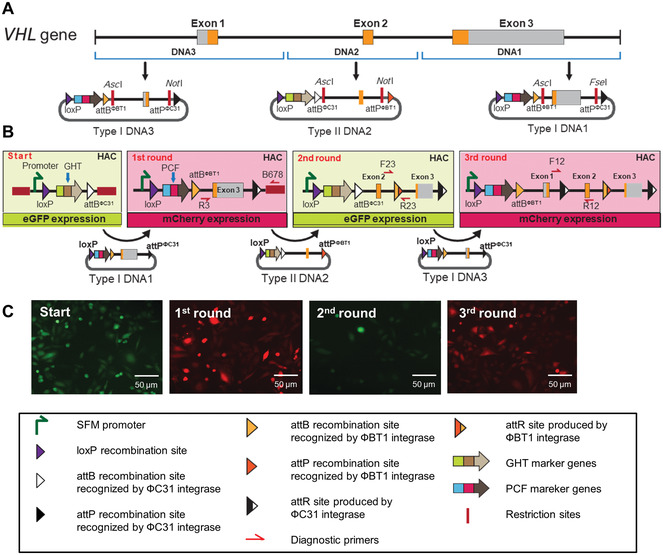
Human artificial chromosomes (HACs) are gene delivery vectors that have been used for decades for gene functional studies. HACs have several advantages over viral-based gene transfer systems, including stable episomal maintenance in a single copy in the cell and the ability to carry up to megabase-sized genomic DNA segments. We have previously developed the alphoid -HAC, which has a single gene acceptor loxP site that allows insertion of an individual gene of interest using Chinese hamster ovary (CHO) hybrid cells. The HAC, along with a DNA segment of interest, can then be transferred from donor CHO cells to various recipient cells of interest via microcell-mediated chromosome transfer (MMCT). Here, we detail a protocol for loading multiple genomic DNA segments or genes into the alphoid -HAC vector using an iterative integration system (IIS) that utilizes recombinases Cre, ΦC31, and ΦBT. This IIS-alphoid -HAC can be used for either serially assembling genomic loci or fragments of a large gene, or for inserting multiple genes into the same artificial chromosome. The insertions are executed iteratively, whereby each round results in the insertion of a new DNA segment of interest. This is accompanied by changes of expression of marker fluorescent proteins, which simplifies screening of correct clones, and changes of selection and counterselection markers, which constitutes an error-proofing mechanism that removes mis-incorporated DNA segments. In addition, the IIS-alphoid -HAC carrying the genes can be eliminated from the cells, offering the possibility to compare the phenotypes of human cells with and without functional copies of the genes of interest. The resulting HAC molecules may be used to investigate biomedically relevant pathways or the regulation of multiple genes, and to potentially engineer synthetic chromosomes with a specific set of genes of interest. The IIS-alphoid -HAC system is expected to be beneficial in creating multiple-gene humanized models with the purpose of understanding complex multi-gene genetic disorders. Published 2021. This article is a U.S. Government work and is in the public domain in the USA. Current Protocols published by Wiley Periodicals LLC. Basic Protocol 1: Integration of the first DNA segment of interest into the IIS-alphoid -HAC Basic Protocol 2: Integration of a second DNA segment of interest into the IIS-alphoid -HAC Basic Protocol 3: Integration of a third DNA segment of interest into the IIS-alphoid -HAC Support Protocol: Fluorescence in situ hybridization analysis for the circular IIS-alphoid -HAC.
人类人工染色体(HAC)是一种基因传递载体,已被用于基因功能研究数十年。HAC 具有优于病毒基因转移系统的几个优点,包括在细胞中单拷贝稳定的附加体维持,以及携带高达兆碱基大小的基因组 DNA 片段的能力。我们之前开发了α-人工染色体(alphoid -HAC),它具有一个单个基因接受者 loxP 位点,允许使用中国仓鼠卵巢(CHO)杂种细胞插入感兴趣的单个基因。然后,HAC 连同感兴趣的 DNA 片段,可以通过微细胞介导的染色体转移(MMCT)从供体 CHO 细胞转移到各种感兴趣的受体细胞。在这里,我们详细描述了一种使用迭代整合系统(IIS)将多个基因组 DNA 片段或基因加载到α-人工染色体(alphoid -HAC)载体中的方案,该系统利用重组酶 Cre、ΦC31 和 ΦBT。这种 IIS-α-人工染色体(alphoid -HAC)可用于串联组装基因组基因座或大片段基因,或用于将多个基因插入同一人工染色体中。插入是迭代执行的,每一轮都会插入一个新的感兴趣的 DNA 片段。这伴随着标记荧光蛋白表达的变化,这简化了正确克隆的筛选,以及选择和反选择标记的变化,这构成了一种纠错机制,可以去除错误整合的 DNA 片段。此外,携带基因的 IIS-α-人工染色体(alphoid -HAC)可以从细胞中消除,从而可以比较具有和不具有感兴趣基因功能副本的人类细胞的表型。由此产生的 HAC 分子可用于研究与生物医学相关的途径或多个基因的调节,并有可能用一组特定的感兴趣基因工程合成染色体。IIS-α-人工染色体(alphoid -HAC)系统有望用于创建具有目的理解复杂多基因遗传疾病的多个基因人类化模型。发表于 2021 年。本文是美国政府的工作,在美国属于公有领域。Wiley Periodicals LLC 出版的《当代协议》。基本方案 1:将第一个感兴趣的 DNA 片段整合到 IIS-α-人工染色体(alphoid -HAC)中基本方案 2:将第二个感兴趣的 DNA 片段整合到 IIS-α-人工染色体(alphoid -HAC)中基本方案 3:将第三个感兴趣的 DNA 片段整合到 IIS-α-人工染色体(alphoid -HAC)中支持方案:用于圆形 IIS-α-人工染色体(alphoid -HAC)的荧光原位杂交分析。