Graduate Institute of Clinical Medicine, College of Medicine, National Taiwan University, Taipei, Taiwan.
Department of Family and Community Medicine, Chung Shan Medical University Hospital, Taichung, Taiwan.
Sci Rep. 2021 Dec 17;11(1):24181. doi: 10.1038/s41598-021-03279-8.
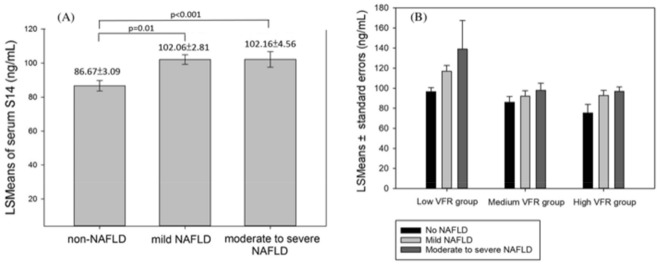
S14 has been identified as a potent stimulator of de novo hepatic lipogenesis (DNL) in rodents. However, it is unclear how S14 is regulated in humans with non-alcoholic fatty liver disease (NAFLD). The aim of this study was to investigate the relationship between serum S14 and liver steatosis in humans with NAFLD. A total of 614 participants were recruited from community. Liver steatosis were evaluated according to the Ultrasonographic Fatty Liver Indicator (US-FLI), which is a semi-quantitative liver ultrasound score. Anthropometric and biochemical indices were collected for further analysis. The risk of liver steatosis severity was estimated by a cumulative logistic regression model. NAFLD was found in 52.2% of the participants. The subjects with NAFLD showed higher levels of waist circumference, body mass index, insulin resistance, aspartate aminotransferase, dyslipidemia, visceral fat, serum S14 and risk of metabolic syndrome (MetS) than those of controls. Compared with the first tertile of serum S14, the odds ratios for the risk of more severe liver steatosis were 1.22 (95% confidence interval [CI]: 0.78-1.92) for those of the second tertile and 2.08 (95% CI: 1.28-3.39) for the third tertile (P for trend < 0.05) after adjusting for confounding factors. Higher serum S14 level was not only found in NAFLD subjects but also was positively correlated with the severity of liver steatosis. S14 may play an important role in the mechanism of DNL for NAFLD in humans.
S14 被鉴定为啮齿动物中新生肝脂肪生成(DNL)的有效刺激物。然而,S14 在非酒精性脂肪性肝病(NAFLD)患者中是如何被调控的尚不清楚。本研究旨在探讨血清 S14 与 NAFLD 患者肝脂肪变性之间的关系。共招募了 614 名来自社区的参与者。根据超声脂肪肝指标(US-FLI)评估肝脂肪变性,US-FLI 是一种半定量肝脏超声评分。收集人体测量学和生化指标进行进一步分析。采用累积逻辑回归模型估计肝脂肪变性严重程度的风险。52.2%的参与者患有 NAFLD。与对照组相比,患有 NAFLD 的受试者腰围、体重指数、胰岛素抵抗、天门冬氨酸转氨酶、血脂异常、内脏脂肪、血清 S14 和代谢综合征(MetS)风险更高。与血清 S14 的第一三分位数相比,第二三分位数的肝脂肪变性严重风险比值比为 1.22(95%置信区间[CI]:0.78-1.92),第三三分位数为 2.08(95%CI:1.28-3.39)(趋势 P<0.05),校正混杂因素后。血清 S14 水平升高不仅在 NAFLD 患者中发现,而且与肝脂肪变性的严重程度呈正相关。S14 可能在人类非酒精性脂肪性肝病 DNL 的机制中发挥重要作用。