Department of Endocrinology, 424 General Military Hospital, 564 29 N Efkarpia Thessaloniki, Greece.
Department of Clinical, Internal, Anesthesiology and Cardiovascular Sciences, "Sapienza" University of Rome, 00185 Rome, Italy.
J Clin Endocrinol Metab. 2022 Apr 19;107(5):1441-1460. doi: 10.1210/clinem/dgab888.
Antiresorptive therapy significantly reduces fracture risk in patients with benign bone disease and skeletal-related events (SREs) in patients with bone metastases (BM). Osteonecrosis of the jaw (ONJ) is a rare but severe condition manifested as necrotic bone lesion or lesions of the jaws. ONJ has been linked to the use of potent antiresorptive agents, termed medication-related ONJ (MRONJ).
We aimed to identify the differences various aspects of MRONJ among distinct patient categories and provide recommendations on how to mitigate the risk and optimally manage MRONJ in each of them.
A working group of the European Calcified Tissue Society (ECTS) and 2 experts performed an updated detailed review of existing literature on MRONJ incidence, characteristics, and treatment applied in bone diseases with variable severity of skeletal insult, ranging from osteoporosis to prevention of cancer treatment-induced bone loss and SREs in cancer patients with BM.
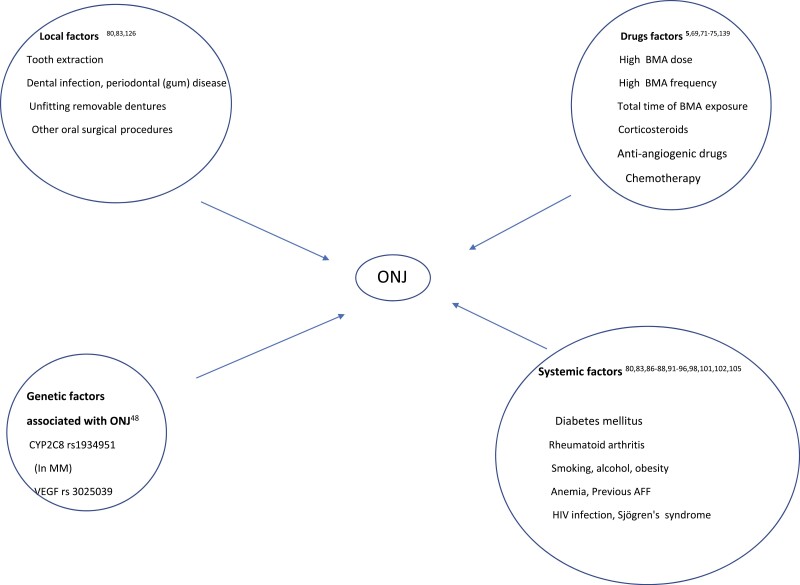
The risk for MRONJ is much higher in patients with advanced malignancies compared to those with benign bone diseases because of the higher doses and more frequent administration of antiresorptive agents in individuals with compromised general health, along with coadministration of other medications that predispose to MRONJ. The overall risk for MRONJ is considerably lower than the benefits in all categories of patients.
The risk for MRONJ largely depends on the underlying bone disease and the relevant antiresorptive regimen applied. Physicians and dentists should keep in mind that the benefits of antiresorptive therapy far outweigh the risk for MRONJ development.
抗吸收治疗可显著降低良性骨病患者的骨折风险和伴有骨转移(BM)的骨骼相关事件(SREs)患者的 SREs。颌骨坏死(ONJ)是一种罕见但严重的疾病,表现为颌骨的坏死性骨病变或病变。ONJ 与使用强效抗吸收剂有关,称为药物相关 ONJ(MRONJ)。
我们旨在确定不同患者群体中各种 MRONJ 方面的差异,并就如何降低风险以及如何在每个群体中最佳管理 MRONJ 提供建议。
欧洲钙化组织学会(ECTS)的一个工作组和 2 名专家对现有的关于 MRONJ 发生率、特征和治疗的文献进行了详细的更新,这些文献应用于骨骼损伤程度不同的各种骨疾病,从骨质疏松症到预防癌症治疗引起的骨质流失,再到伴有 BM 的癌症患者的 SREs。
与患有良性骨病的患者相比,晚期恶性肿瘤患者的 MRONJ 风险更高,因为在一般健康状况较差的患者中,抗吸收剂的剂量更高、给药频率更高,同时还合并使用了其他易引发 MRONJ 的药物。在所有患者群体中,MRONJ 的总体风险明显低于获益。
MRONJ 的风险在很大程度上取决于潜在的骨病和应用的相关抗吸收方案。医生和牙医应牢记,抗吸收治疗的益处远远超过发生 MRONJ 的风险。