Fusco V, Cabras M, Erovigni F, Dell'Acqua A, Arduino P-G, Pentenero M, Appendino P, Basano L-, Ferrera F-D, Fasciolo A, Caka M, Migliario M
Department of Surgical Sciences CIR-Dental School, University of Turin Via Nizza 230, 10126 Turin, Italy
Med Oral Patol Oral Cir Bucal. 2021 Jul 1;26(4):e466-e473. doi: 10.4317/medoral.24318.
Incidence of Medication-Related Osteonecrosis of the Jaw (MRONJ) related to cancer and myeloma treatments is undetermined, with scarce data varying from 2 to 7.8/million/year in limited investigated populations. A 9-years [2009-2018] regional-wide survey was conducted, deploying the North-Western Italy Cancer Network ("Rete Oncologica Piemonte e Valle d'Aosta"), to assess number and main characteristics of MRONJ cases among myeloma/cancer patients, within a population of 4.5 million inhabitants.
MRONJ cases were collected retrospectively from January 2009 to June 2015; from July 2015 to December 2018, data were collected prospectively. Number of new MRONJ cases per year, underlying disorder, drug(s) administered, treatment duration, site and onset timing of MRONJ were detailed.
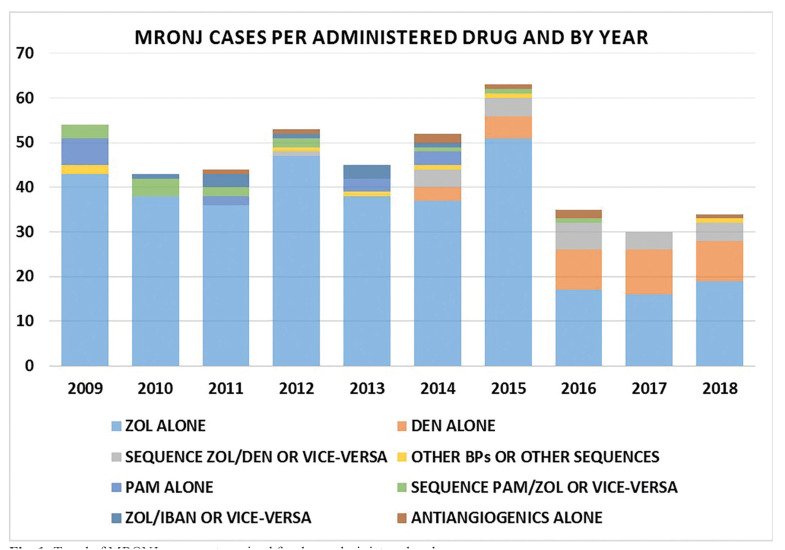
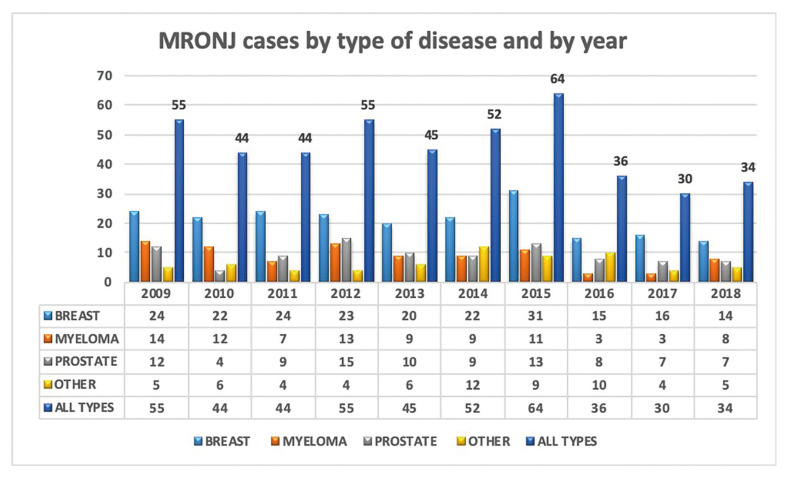
459 MRONJ cases were identified. Primary diseases were breast cancer (46%), prostate cancer (21%), myeloma (19%), and other types of carcinoma (14%). Patients received antiresorptive treatment either alone (399; 88.47%) or in combination with biological agents (52; 11.53%); 8 patients (1.7%) received only antiangiogenic drugs. Zoledronic acid [388] and denosumab [59] were the most frequently administered drugs. Mandible was involved in 296 (64,5%) cases. Number of new MRONJ cases was stable from 2009 to 2015, with a mean of 51.3 cases per year (raw incidence: 11.6/million/year), declining in the 2016-2018 years to 33.3 cases per year (raw incidence: 7.5/million/year).
With such discrepancy of cases overtime being partially explicable, number of new MRONJ cases per year are consistent with those observed in a previous study [2003-2008] in the same region, being instead higher than those reported in other populations.
与癌症和骨髓瘤治疗相关的颌骨药物性骨坏死(MRONJ)的发病率尚未确定,在有限的调查人群中,稀少的数据显示每年每百万人口中有2至7.8例。在意大利西北部一个拥有450万居民的地区,开展了一项为期9年(2009 - 2018年)的区域范围调查,通过意大利西北部癌症网络(“皮埃蒙特和瓦莱达奥斯塔肿瘤网络”)来评估骨髓瘤/癌症患者中MRONJ病例的数量和主要特征。
回顾性收集2009年1月至2015年6月的MRONJ病例;2015年7月至2018年12月的数据则进行前瞻性收集。详细记录每年新的MRONJ病例数、基础疾病、使用的药物、治疗持续时间、MRONJ的部位和发病时间。
共识别出4**59例MRONJ病例。主要疾病为乳腺癌(46%)、前列腺癌(21%)、骨髓瘤(19%)和其他类型的癌症(14%)。患者单独接受抗吸收治疗(399例;88.47%)或与生物制剂联合使用(52例;11.53%);8例患者(1.7%)仅接受抗血管生成药物治疗。唑来膦酸[388例]和地诺单抗[59例]是最常使用的药物。下颌骨受累296例(64.5%)。2009年至2015年新的MRONJ病例数稳定,平均每年51.3例(粗发病率:每年每百万人口11.6例),2016 - 2018年降至每年33.3例(粗发病率:每年每百万人口7.5例)。
虽然病例数量随时间的差异部分可以解释,但每年新的MRONJ病例数与该地区先前一项研究[2003 - 2008年]中观察到的一致,不过高于其他人群报告的病例数。