Liu Yuanhui, Ma Bin, Chen Wenfeng, Schlaeppi Klaus, Erb Matthias, Stirling Erinne, Hu Lingfei, Wang Entao, Zhang Yunzeng, Zhao Kankan, Lu Zhijiang, Ye Shudi, Xu Jianming
Institute of Soil and Water Resources and Environmental Science, College of Environmental and Resource Sciences, Zhejiang University, Hangzhou, China.
Zhejiang Provincial Key Laboratory of Agricultural Resources and Environment, Zhejiang University, Hangzhou, China.
Front Microbiol. 2021 Dec 2;12:709012. doi: 10.3389/fmicb.2021.709012. eCollection 2021.
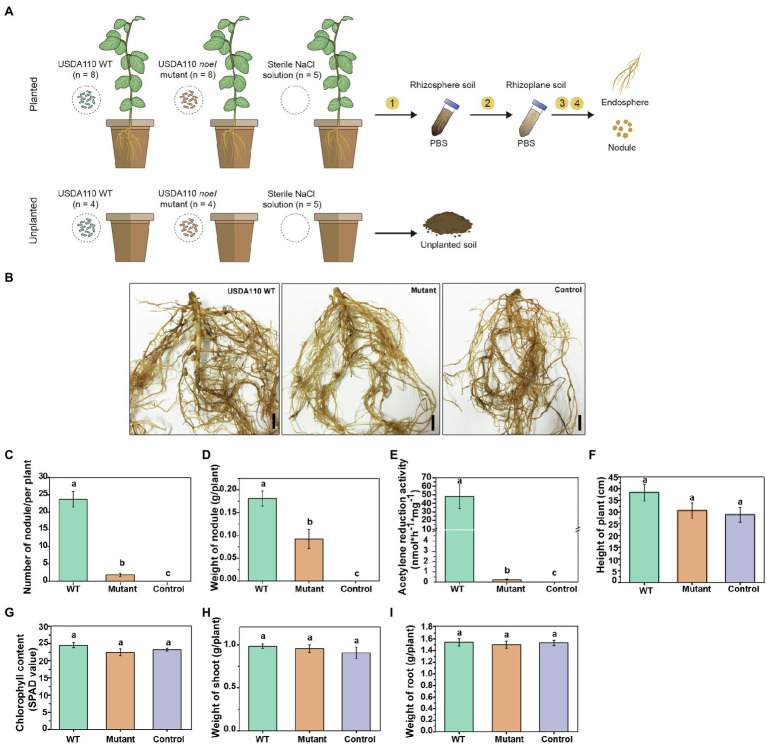
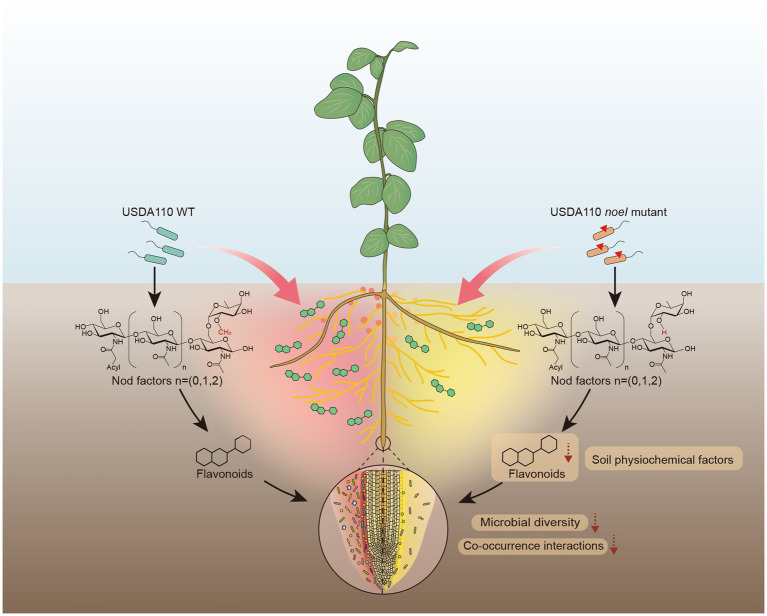
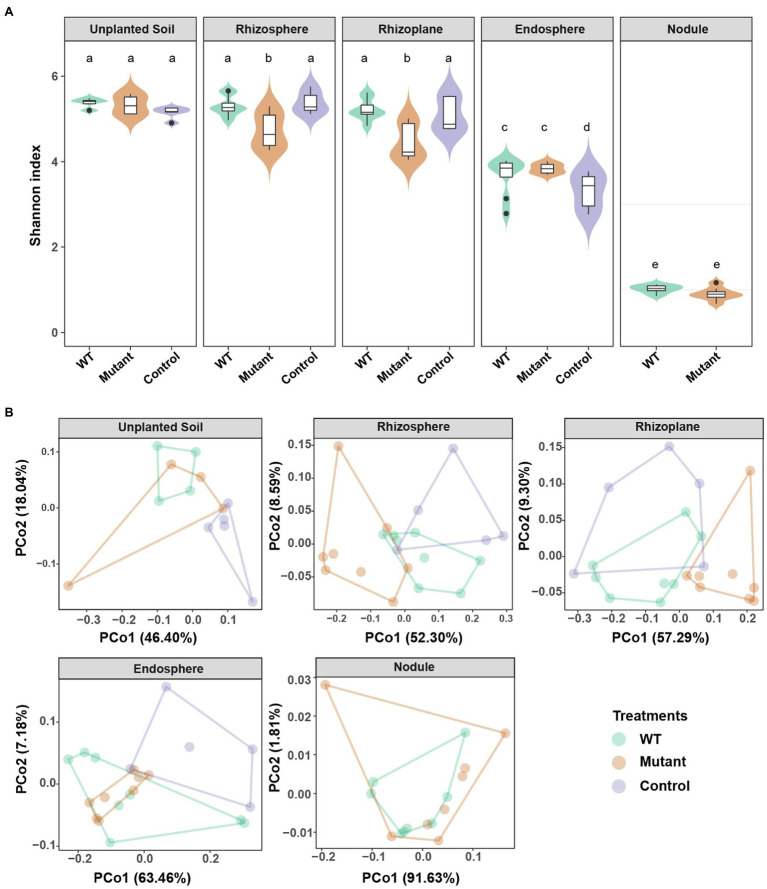
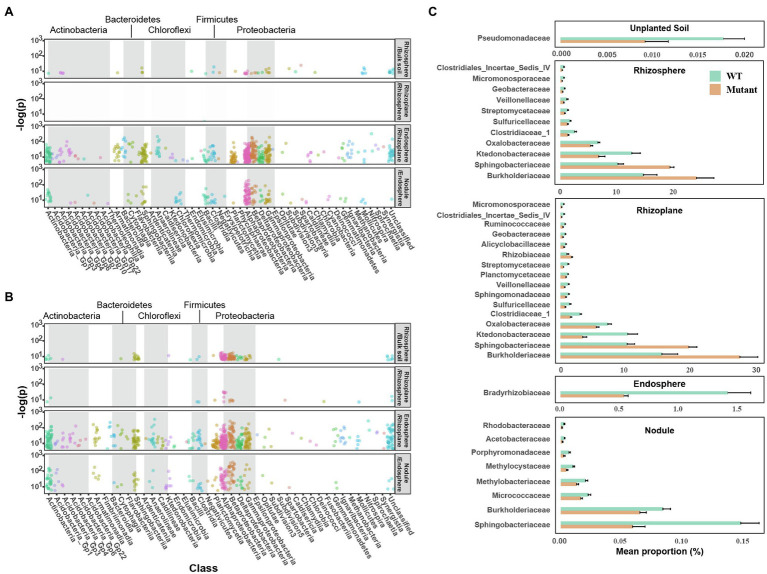
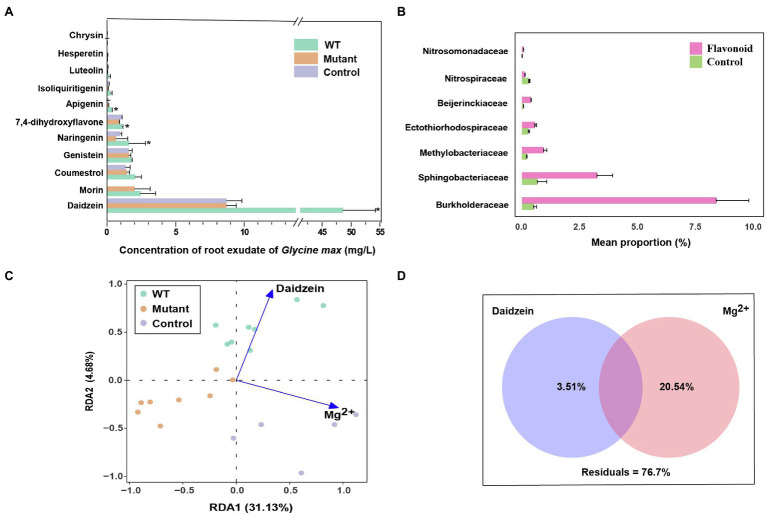
Root-microbiome interactions are of central importance for plant performance and yield. A distinctive feature of legumes is that they engage in symbiosis with N-fixing rhizobia. If and how the rhizobial symbiotic capacity modulates root-associated microbiomes are still not yet well understood. We determined root-associated microbiomes of soybean inoculated with wild type (WT) or a mutant of USDA 110 by amplicon sequencing. UPLC-MS/MS was used to analyze root exudates. The gene is responsible for fucose-methylation of Nod factor secreted by USDA 110 WT strain. Soybean roots inoculated with the mutant showed a significant decrease in nodulation and root-flavonoid exudation compared to roots inoculated with WT strain. The mutant-inoculated roots exhibited strong changes in microbiome assembly in the rhizosphere and rhizoplane, including reduced diversity, changed co-occurrence interactions and a substantial depletion of root microbes. Root exudates and soil physiochemical properties were significantly correlated with microbial community shift in the rhizosphere between different rhizobial treatments. These results illustrate that rhizobial symbiotic capacity dramatically alters root-associated microbiomes, in which root exudation and edaphic patterns play a vital role. This study has important implications for understanding the evolution of plant-microbiome interactions.
根际微生物相互作用对植物生长性能和产量至关重要。豆科植物的一个显著特征是它们与固氮根瘤菌形成共生关系。根瘤菌的共生能力是否以及如何调节根际微生物群落,目前仍未得到充分了解。我们通过扩增子测序确定了接种野生型(WT)或美国农业部110突变体的大豆根际微生物群落。采用超高效液相色谱-串联质谱法(UPLC-MS/MS)分析根分泌物。该基因负责美国农业部110野生型菌株分泌的结瘤因子的岩藻糖甲基化。与接种野生型菌株的根相比,接种突变体的大豆根瘤形成和根黄酮分泌显著减少。接种突变体的根在根际和根表微生物群落组装方面表现出强烈变化,包括多样性降低、共现相互作用改变以及根际微生物大量减少。根分泌物和土壤理化性质与不同根瘤菌处理的根际微生物群落变化显著相关。这些结果表明,根瘤菌的共生能力显著改变了根际微生物群落,其中根分泌物和土壤性质起着至关重要的作用。本研究对理解植物-微生物群落相互作用的进化具有重要意义。