Shaheen Magda, Schrode Katrina M, Pan Deyu, Kermah Dulcie, Puri Vishwajeet, Zarrinpar Ali, Elisha David, Najjar Sonia M, Friedman Theodore C
College of Medicine, Charles R Drew University, Los Angeles, CA, United States.
Heritage College of Osteopathic Medicine, Ohio University, Athens, OH, United States.
Front Med (Lausanne). 2021 Dec 2;8:795421. doi: 10.3389/fmed.2021.795421. eCollection 2021.
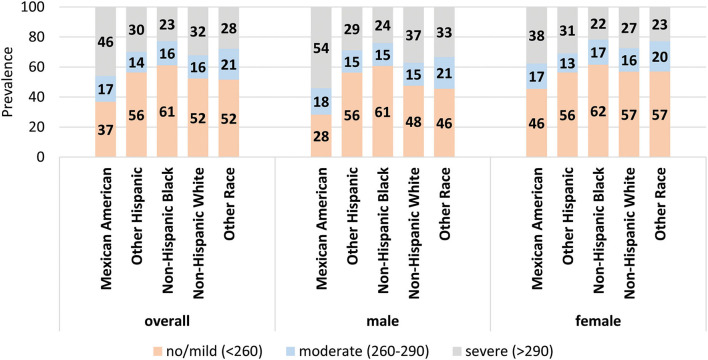
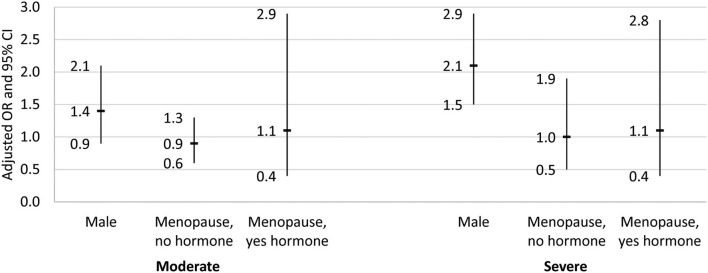
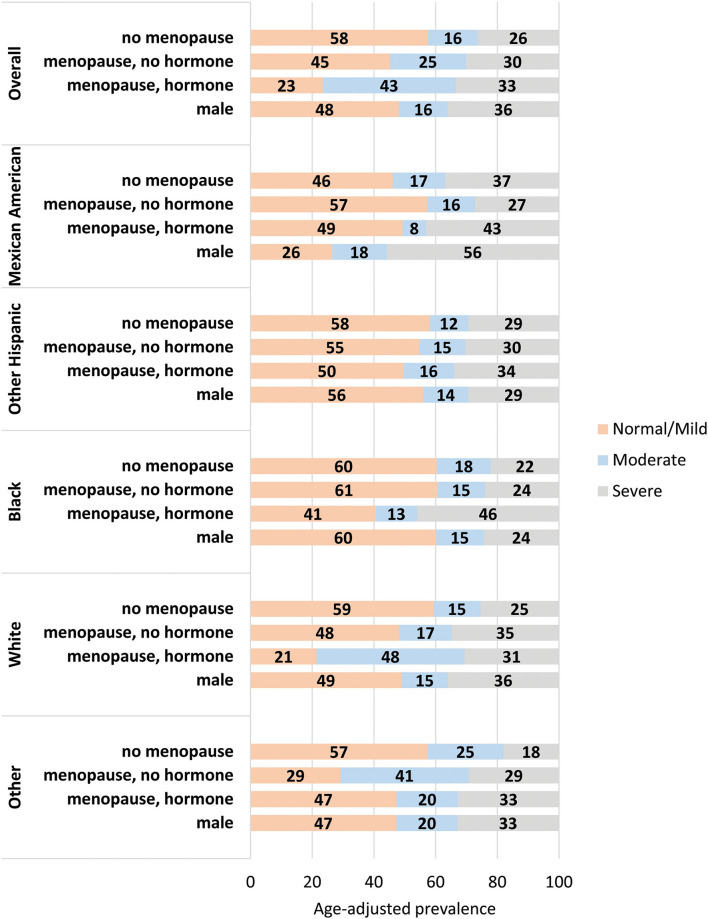
Non-alcoholic fatty liver disease (NAFLD) is spreading worldwide, with a racial/ethnic disparity. We examined the gender role in the racial/ethnic difference in NAFLD in the US population. We analyzed data for 3,292 individuals ≥18 years old from NHANES 2017-2018, a representative sample of the non-institutionalized adult population in the US. Exclusions were subjects with elevated transferrin level, chronic hepatitis B or C, excessive alcohol use, or prescription medications that might cause hepatic steatosis. NAFLD was diagnosed by FibroScan using controlled attenuation parameter (CAP) values: S0 <238, S1 = 238-259, S2 = 260-290, S3 >290. Data were analyzed using Chi square and multinomial regression. The overall prevalence of NAFLD was 47.9% [S2 = 16.1%, and S3 = 31.8%]. The prevalence of S3 was highest among Mexican Americans (46%), lowest among Blacks (22.7%), 29.9% in other Hispanics and 32.1% in Whites ( < 0.05). It was higher among Mexican American males (54.1%) compared to Mexican American females (37.7%) ( < 0.05). In the adjusted model, Mexican Americans were two times more likely than Whites to have S2 and S3 ( < 0.05). Only male Mexican Americans had higher odds of S2 and S3 relative to male White ( < 0.05). Males had higher odds of S3 relative to non-menopausal females ( < 0.05). There was no difference in the odds of S2 or S3 NAFLD among the menopausal females with or without hormone therapy relative to non-menopausal females ( > 0.05). While Mexican Americans had the highest prevalence of severe NAFLD relative to the other racial/ethnic groups, only male Mexican Americans, but not females, had higher likelihood of both moderate and severe NAFLD relative to Whites. Interventions that specifically target Mexican American males are needed to increase awareness about NAFLD and its prevention.
非酒精性脂肪性肝病(NAFLD)正在全球范围内蔓延,存在种族/民族差异。我们研究了美国人群中NAFLD种族/民族差异中的性别角色。我们分析了来自2017 - 2018年美国国家健康与营养检查调查(NHANES)的3292名18岁及以上个体的数据,这是美国非机构化成年人口的代表性样本。排除标准为转铁蛋白水平升高、慢性乙型或丙型肝炎、过度饮酒或可能导致肝脂肪变性的处方药使用者。通过FibroScan使用受控衰减参数(CAP)值诊断NAFLD:S0 <238,S1 = 238 - 259,S2 = 260 - 290,S3 >290。使用卡方检验和多项回归分析数据。NAFLD的总体患病率为47.9%[S2 = 16.1%,S3 = 31.8%]。S3的患病率在墨西哥裔美国人中最高(46%),在黑人中最低(22.7%),其他西班牙裔为29.9%,白人为32.1%(P<0.05)。与墨西哥裔美国女性(37.7%)相比,墨西哥裔美国男性中S3的患病率更高(54.1%)(P<0.05)。在调整模型中,墨西哥裔美国人患S2和S3的可能性是白人的两倍(P<0.05)。仅墨西哥裔美国男性患S2和S3的几率相对于白人男性更高(P<0.05)。男性患S3的几率相对于未绝经女性更高(P<0.05)。在接受或未接受激素治疗的绝经后女性中,S2或S3 NAFLD的几率与未绝经女性相比无差异(P>0.05)。虽然相对于其他种族/民族群体,墨西哥裔美国人中重度NAFLD的患病率最高,但只有墨西哥裔美国男性,而非女性,相对于白人,患中度和重度NAFLD的可能性更高。需要针对墨西哥裔美国男性的专门干预措施,以提高对NAFLD及其预防的认识。