Cancer Research UK Cambridge Institute, University of Cambridge, Li Ka Shing Centre, Cambridge CB2 0RE, United Kingdom.
Cancer Research UK Cambridge Centre, Cancer Research UK Cambridge Institute, Li Ka Shing Centre, Cambridge CB2 0RE, United Kingdom.
Genome Res. 2022 Feb;32(2):215-227. doi: 10.1101/gr.275691.121. Epub 2021 Dec 20.
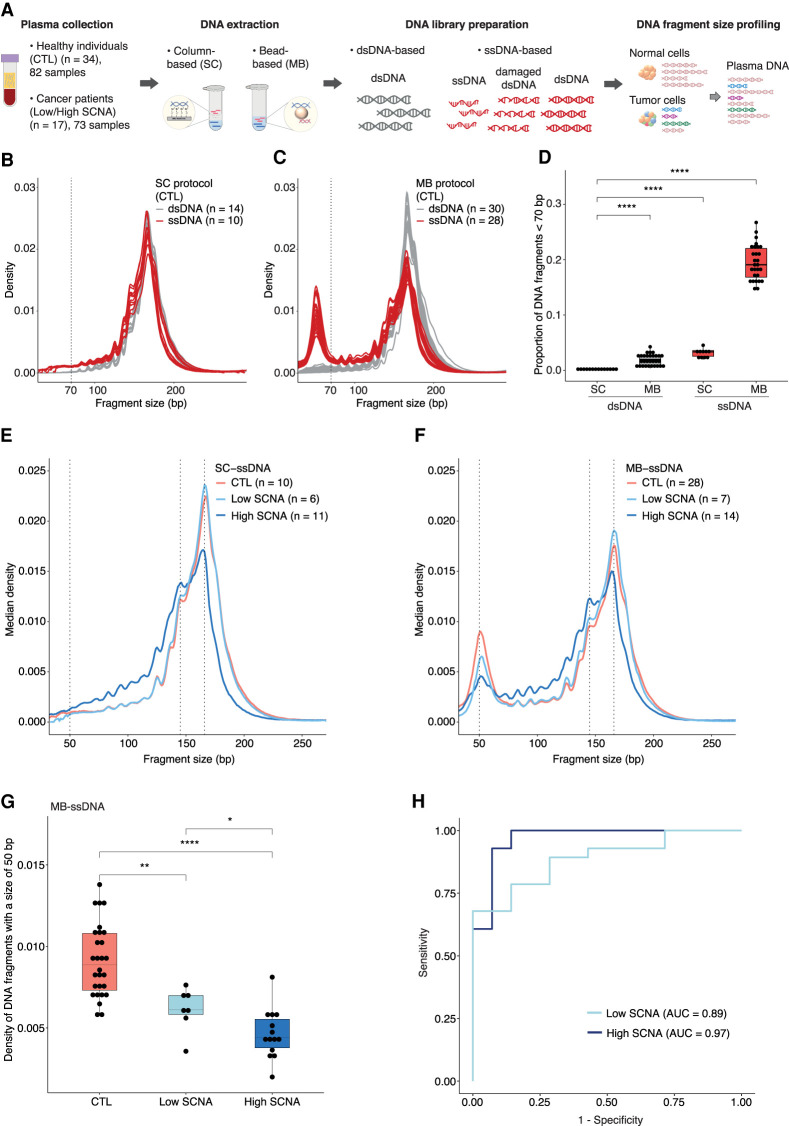
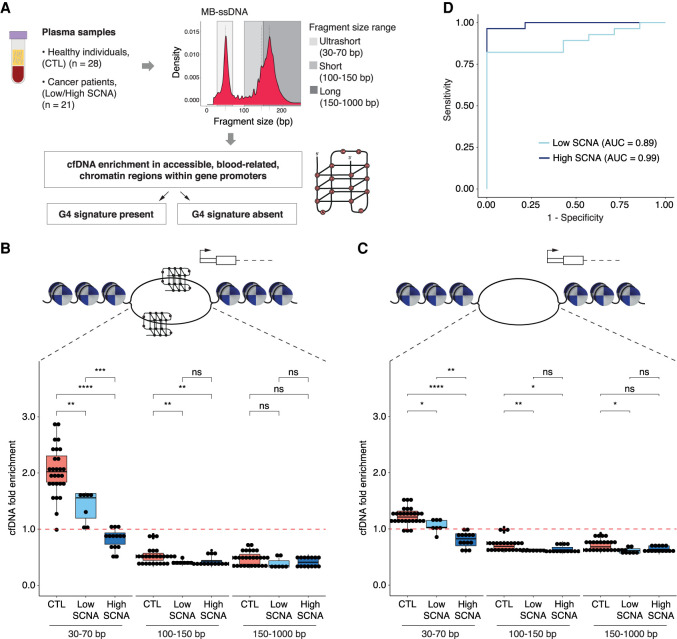
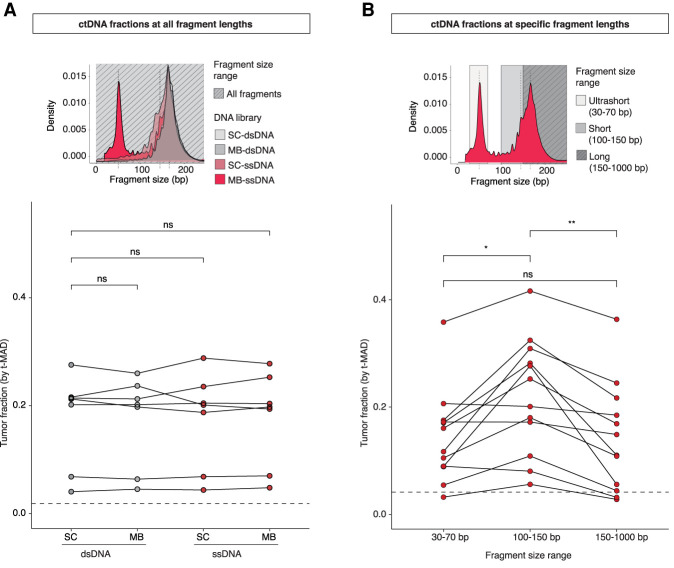
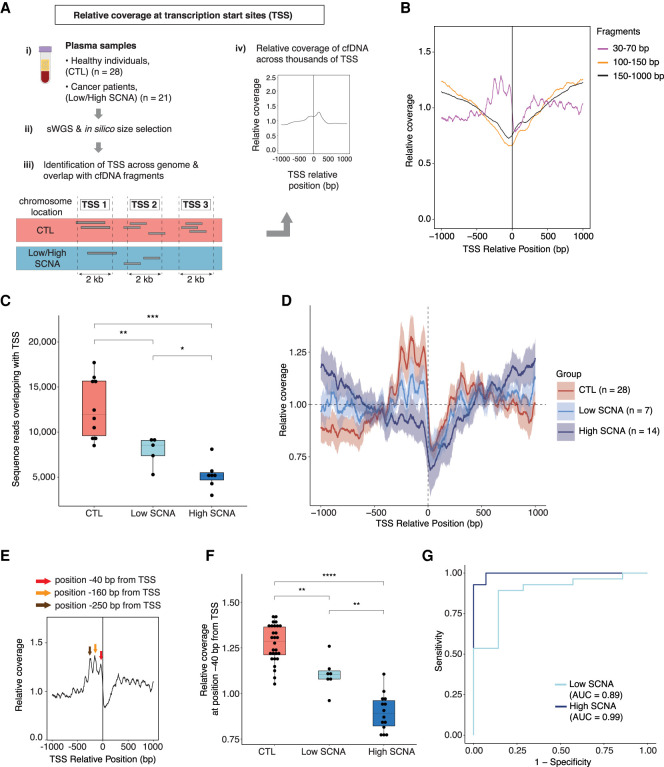
Current evidence suggests that plasma cell-free DNA (cfDNA) is fragmented around a mode of 166 bp. Data supporting this view has been mainly acquired through the analysis of double-stranded cfDNA. The characteristics and diagnostic potential of single-stranded and damaged double-stranded cfDNA in healthy individuals and cancer patients remain unclear. Here, through a combination of high-affinity magnetic bead-based DNA extraction and single-stranded DNA sequencing library preparation (MB-ssDNA), we report the discovery of a large proportion of cfDNA fragments centered at ∼50 bp. We show that these "ultrashort" cfDNA fragments have a greater relative abundance in plasma of healthy individuals (median = 19.1% of all sequenced cfDNA fragments, = 28) than in plasma of patients with cancer (median = 14.2%, = 21, < 0.0001). The ultrashort cfDNA fragments map to accessible chromatin regions of blood cells, particularly in promoter regions with the potential to adopt G-quadruplex (G4) DNA secondary structures. G4-positive promoter chromatin accessibility is significantly enriched in ultrashort plasma cfDNA fragments from healthy individuals relative to patients with cancers ( < 0.0001), in whom G4-cfDNA enrichment is inversely associated with copy number aberration-inferred tumor fractions. Our findings redraw the landscape of cfDNA fragmentation by identifying and characterizing a novel population of ultrashort plasma cfDNA fragments. Sequencing of MB-ssDNA libraries could facilitate the characterization of gene regulatory regions and DNA secondary structures via liquid biopsy. Our data underline the diagnostic potential of ultrashort cfDNA through classification for cancer patients.
目前的证据表明,无细胞血浆游离 DNA(cfDNA)的片段化模式约为 166bp。支持这一观点的数据主要是通过对双链 cfDNA 的分析获得的。在健康个体和癌症患者中,单链和双链 cfDNA 的特征和诊断潜力尚不清楚。在这里,我们通过结合高亲和力磁珠 DNA 提取和单链 DNA 测序文库制备(MB-ssDNA),报告了大量约 50bp 的 cfDNA 片段的发现。我们表明,这些“超短”cfDNA 片段在健康个体的血浆中具有更高的相对丰度(中位数=所有测序 cfDNA 片段的 19.1%, =28),而在癌症患者的血浆中相对丰度较低(中位数=14.2%, =21,<0.0001)。超短 cfDNA 片段定位在血细胞的可及染色质区域,特别是在具有形成 G-四链体(G4)DNA 二级结构潜力的启动子区域。与癌症患者相比,健康个体的超短血浆 cfDNA 片段中 G4 阳性启动子染色质的可及性显著富集(<0.0001),在癌症患者中,G4-cfDNA 的富集与拷贝数异常推断的肿瘤分数呈负相关。我们的研究结果通过鉴定和描述一种新型的超短血浆 cfDNA 片段,重新绘制了 cfDNA 片段化的图谱。通过 MB-ssDNA 文库的测序,可以通过液体活检来促进基因调控区域和 DNA 二级结构的特征描述。我们的数据通过对癌症患者的分类强调了超短 cfDNA 的诊断潜力。