Department of Surgery, University of California San Francisco, San Francisco, CA, USA.
Department of Biomedical Engineering, University of Wisconsin, Madison, WI, USA.
Integr Biol (Camb). 2021 Dec 30;13(11):259-268. doi: 10.1093/intbio/zyab018.
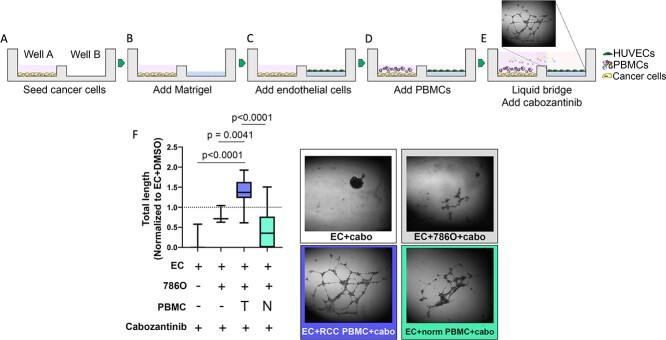
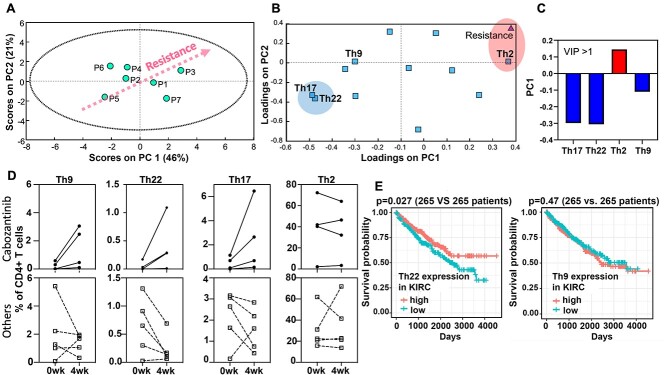
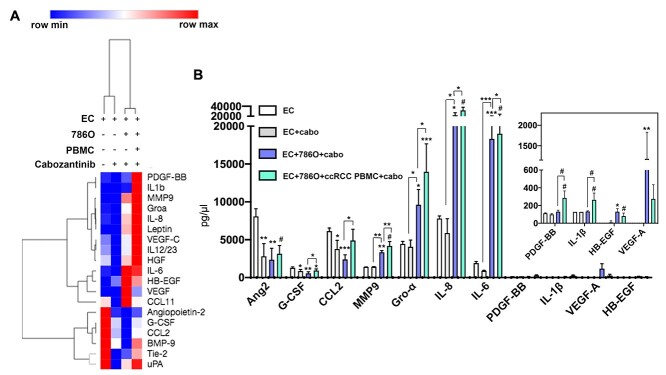
Renal cell carcinoma (RCC) is the third most common genitourinary cancer in the USA. Despite recent advances in the treatment for advanced and metastatic clear cell RCC (ccRCC), the 5-year relative survival rate for the distant disease remains at 12%. Cabozantinib, a tyrosine kinase inhibitor (TKI), which is one of the first-line therapies approved to treat advanced ccRCC as a single agent, is now being investigated as a combination therapy with newer immunotherapeutic agents. However, not much is known about how cabozantinib modulates the immune system. Here, we present a high throughput tri-culture model that incorporates cancer cells, endothelial cells, and patient-derived immune cells to study the effect of immune cells from patients with ccRCC on angiogenesis and cabozantinib resistance. We show that circulating immune cells from patients with ccRCC induce cabozantinib resistance via increased secretion of a set of pro-angiogenic factors. Using multivariate partial least square regression modeling, we identified CD4+ T cell subsets that are correlated with cabozantinib resistance and report the changes in the frequency of these populations in ccRCC patients who are undergoing cabozantinib therapy. These findings provide a potential set of biomarkers that should be further investigated in the current TKI-immunotherapy combination clinical trials to improve personalized treatments for patients with ccRCC.
肾细胞癌(RCC)是美国第三大常见的泌尿生殖系统癌症。尽管在治疗晚期和转移性透明细胞 RCC(ccRCC)方面最近取得了进展,但远处疾病的 5 年相对生存率仍为 12%。卡博替尼是一种酪氨酸激酶抑制剂(TKI),是作为单一药物治疗晚期 ccRCC 的一线治疗药物之一,目前正在作为联合治疗与新型免疫治疗药物一起进行研究。然而,对于卡博替尼如何调节免疫系统,人们知之甚少。在这里,我们提出了一种高通量的三培养模型,该模型结合了癌细胞、内皮细胞和患者来源的免疫细胞,以研究来自 ccRCC 患者的免疫细胞对血管生成和卡博替尼耐药性的影响。我们表明,来自 ccRCC 患者的循环免疫细胞通过增加一组促血管生成因子的分泌诱导卡博替尼耐药性。使用多元偏最小二乘回归建模,我们确定了与卡博替尼耐药性相关的 CD4+T 细胞亚群,并报告了在接受卡博替尼治疗的 ccRCC 患者中这些群体频率的变化。这些发现提供了一组潜在的生物标志物,这些标志物应在当前的 TKI-免疫治疗联合临床试验中进一步研究,以改善 ccRCC 患者的个性化治疗。