• 文献检索
  • 文档翻译
  • 深度研究
  • 学术资讯
  • Suppr Zotero 插件Zotero 插件
  • 邀请有礼
  • 套餐&价格
  • 历史记录
应用&插件
Suppr Zotero 插件Zotero 插件浏览器插件Mac 客户端Windows 客户端微信小程序
定价
高级版会员购买积分包购买API积分包
服务
文献检索文档翻译深度研究API 文档MCP 服务
关于我们
关于 Suppr公司介绍联系我们用户协议隐私条款
关注我们

Suppr 超能文献

核心技术专利:CN118964589B侵权必究
粤ICP备2023148730 号-1Suppr @ 2026

文献检索

告别复杂PubMed语法,用中文像聊天一样搜索,搜遍4000万医学文献。AI智能推荐,让科研检索更轻松。

立即免费搜索

文件翻译

保留排版,准确专业,支持PDF/Word/PPT等文件格式,支持 12+语言互译。

免费翻译文档

深度研究

AI帮你快速写综述,25分钟生成高质量综述,智能提取关键信息,辅助科研写作。

立即免费体验

美国公众对精神疾病污名化的趋势,1996-2018 年。

Trends in Public Stigma of Mental Illness in the US, 1996-2018.

机构信息

Department of Sociology, Indiana University, Bloomington.

Department of Sociology, Pennsylvania State University, University Park.

出版信息

JAMA Netw Open. 2021 Dec 1;4(12):e2140202. doi: 10.1001/jamanetworkopen.2021.40202.

DOI:10.1001/jamanetworkopen.2021.40202
PMID:34932103
原文链接:https://pmc.ncbi.nlm.nih.gov/articles/PMC8693212/
Abstract

IMPORTANCE

Stigma, the prejudice and discrimination attached to mental illness, has been persistent, interfering with help-seeking, recovery, treatment resources, workforce development, and societal productivity in individuals with mental illness. However, studies assessing changes in public perceptions of mental illness have been limited.

OBJECTIVE

To evaluate the nature, direction, and magnitude of population-based changes in US mental illness stigma over 22 years.

DESIGN, SETTING, AND PARTICIPANTS: This survey study used data collected from the US National Stigma Studies, face-to-face interviews conducted as 1996, 2006, and 2018 General Social Survey modules of community-dwelling adults, based on nationally representative, multistage sampling techniques. Individuals aged 18 years or older, including Spanish-speaking respondents, living in noninstitutionalized settings were interviewed in 1996 (n = 1438), 2006 (n = 1520), and 2018 (n = 1171). The present study was conducted from July 2019 to January 2021.

MAIN OUTCOMES AND MEASURES

Respondents reacted to 1 of 3 vignettes (schizophrenia, depression, alcohol dependence) meeting Diagnostic and Statistical Manual of Mental Disorders, Fourth Edition, criteria or a control case (daily troubles). Measures included beliefs about underlying causes (attributions), perceptions of likely violence (danger to others), and rejection (desire for social distance).

RESULTS

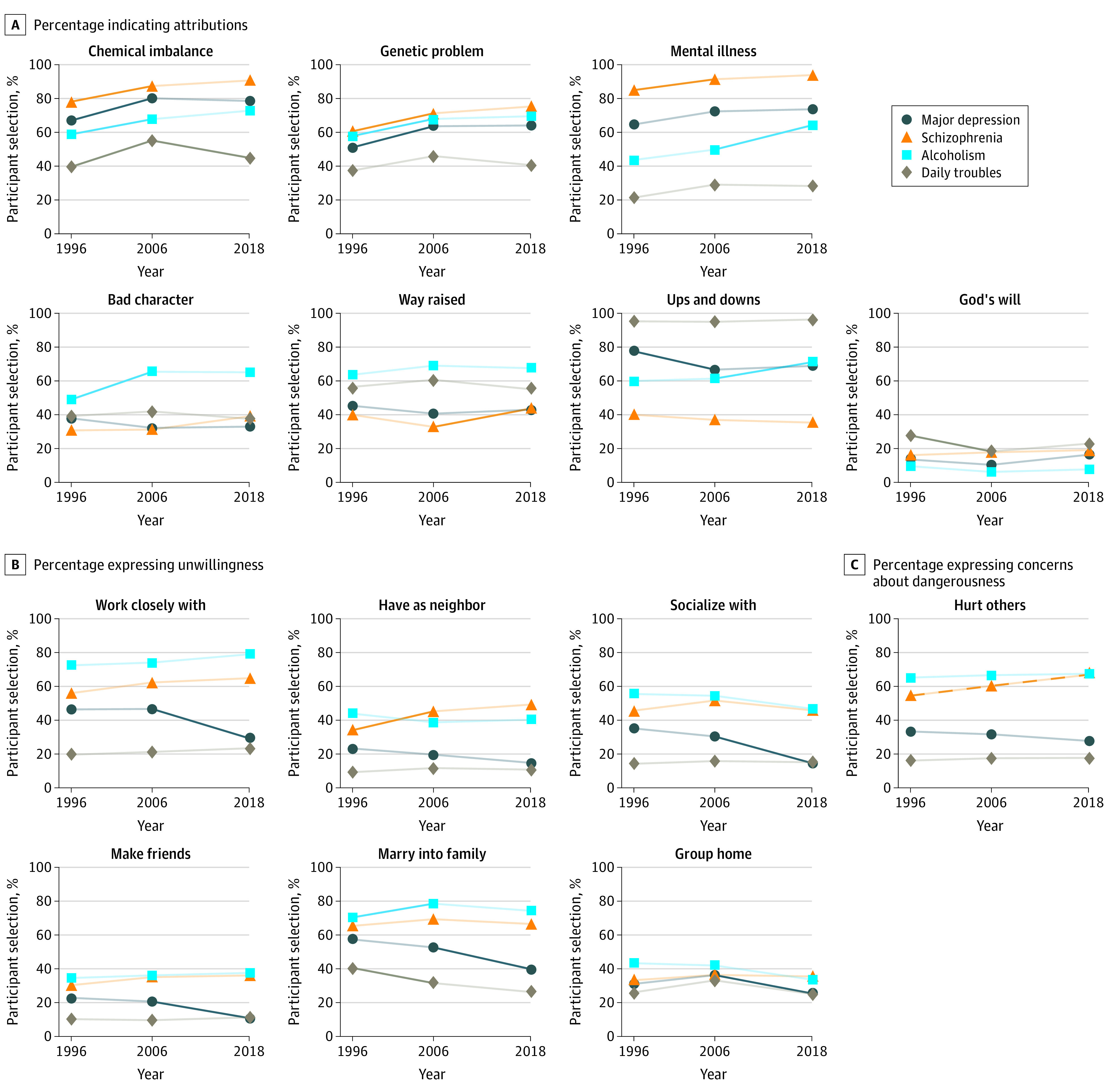
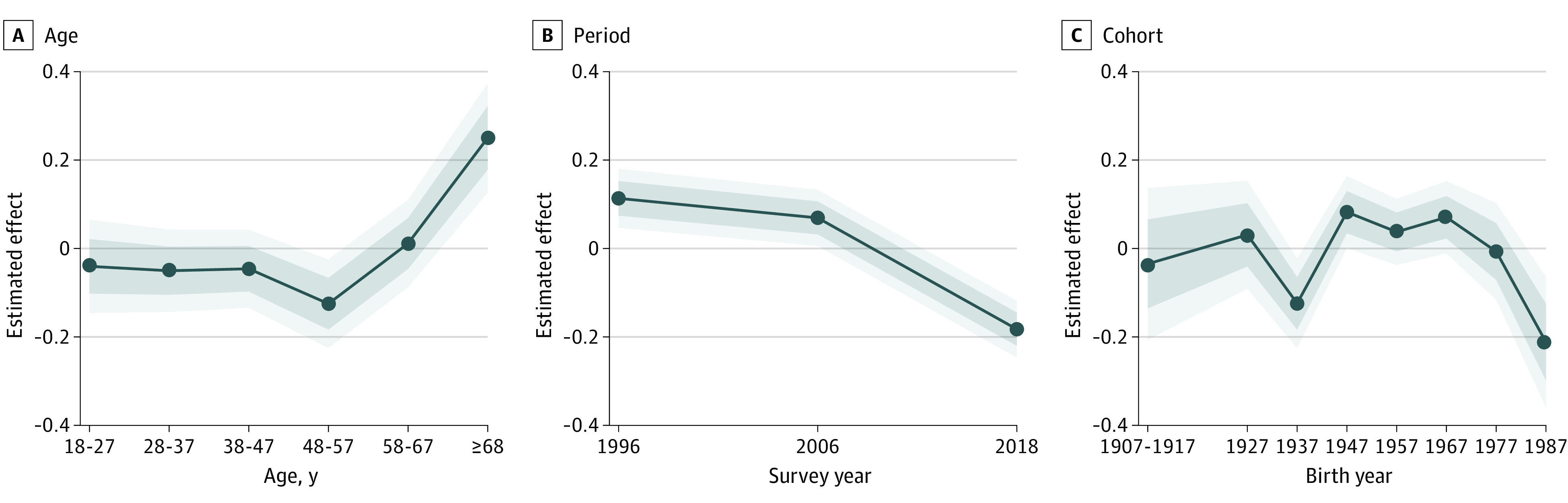
Of the 4129 individuals interviewed in the surveys, 2255 were women (54.6%); mean (SD) age was 44.6 (16.9) years. In the earlier period (1996-2006), respondents endorsing scientific attributions (eg, genetics) for schizophrenia (11.8%), depression (13.0%), and alcohol dependence (10.9%) increased. In the later period (2006-2018), the desire for social distance decreased for depression in work (18.1%), socializing (16.7%), friendship (9.7%), family marriage (14.3%), and group home (10.4%). Inconsistent, sometimes regressive change was observed, particularly regarding dangerousness for schizophrenia (1996-2018: 15.7% increase, P = .001) and bad character for alcohol dependence (1996-2018: 18.2% increase, P = .001). Subgroup differences, defined by race and ethnicity, sex, and educational level, were few and inconsistent. Change appeared to be consistent with age and generational shifts among 2 birth cohorts (1937-1946 and 1987-2000).

CONCLUSIONS AND RELEVANCE

To date, this survey study found the first evidence of significant decreases in public stigma toward depression. The findings of this study suggest that individuals' age was a conservatizing factor whereas being in the pre-World War II or millennial birth cohorts was a progressive factor. However, stagnant stigma levels for other disorders and increasing public perceptions of likely violence among persons with schizophrenia call for rethinking stigma and retooling reduction strategies to increase service use, improve treatment resources, and advance population health.
https://cdn.ncbi.nlm.nih.gov/pmc/blobs/015f/8693212/7ea2626b2925/jamanetwopen-e2140202-g002.jpg
https://cdn.ncbi.nlm.nih.gov/pmc/blobs/015f/8693212/e3d165837406/jamanetwopen-e2140202-g001.jpg
https://cdn.ncbi.nlm.nih.gov/pmc/blobs/015f/8693212/7ea2626b2925/jamanetwopen-e2140202-g002.jpg
https://cdn.ncbi.nlm.nih.gov/pmc/blobs/015f/8693212/e3d165837406/jamanetwopen-e2140202-g001.jpg
https://cdn.ncbi.nlm.nih.gov/pmc/blobs/015f/8693212/7ea2626b2925/jamanetwopen-e2140202-g002.jpg
摘要

重要性

污名化,即附加于精神疾病的偏见和歧视,一直以来都很顽固,干扰了寻求帮助、康复、治疗资源、劳动力发展以及精神疾病患者的社会生产力。然而,评估公众对精神疾病看法变化的研究一直有限。

目的

评估美国精神疾病污名化在 22 年期间的性质、方向和程度上的变化。

设计、地点和参与者:这项调查研究使用了美国国家污名研究的数据,这些数据来自 1996 年、2006 年和 2018 年作为社区居住成年人的一般社会调查模块的面对面访谈,采用了全国代表性的多阶段抽样技术。1996 年(n=1438)、2006 年(n=1520)和 2018 年(n=1171),年龄在 18 岁或以上的包括讲西班牙语的受访者,居住在非机构化环境中,接受了采访。本研究于 2019 年 7 月至 2021 年 1 月进行。

主要结果和措施

受访者对 3 个符合《精神疾病诊断与统计手册》第 4 版标准的案例(精神分裂症、抑郁症、酒精依赖)或对照案例(日常麻烦)之一做出反应。衡量标准包括对潜在原因的信念(归因)、对可能暴力的看法(对他人的危险)和排斥(渴望社会距离)。

结果

在接受调查的 4129 个人中,有 2255 名女性(54.6%);平均(SD)年龄为 44.6(16.9)岁。在早期(1996-2006 年),对精神分裂症(11.8%)、抑郁症(13.0%)和酒精依赖(10.9%)的科学归因(如遗传学)的认同有所增加。在后期(2006-2018 年),对抑郁症在工作(18.1%)、社交(16.7%)、友谊(9.7%)、家庭婚姻(14.3%)和集体之家(10.4%)中产生的社会距离的渴望有所减少。观察到不一致的、有时是倒退的变化,特别是对精神分裂症的危险性(1996-2018 年:增加 15.7%,P=0.001)和对酒精依赖的不良品格(1996-2018 年:增加 18.2%,P=0.001)。按种族和民族、性别和教育程度定义的亚组差异很少且不一致。变化似乎与 2 个出生队列(1937-1946 年和 1987-2000 年)的年龄和代际转变一致。

结论和相关性

到目前为止,这项调查研究发现了第一个有意义的证据,表明公众对抑郁症的污名化程度有所下降。研究结果表明,个体的年龄是一个保守因素,而属于二战前或千禧年出生的人则是一个进步因素。然而,其他疾病的污名化水平停滞不前,以及公众对精神分裂症患者可能暴力的看法增加,这呼吁重新思考污名化问题,并调整减少污名化的策略,以增加服务使用、改善治疗资源和促进人口健康。

相似文献

1
Trends in Public Stigma of Mental Illness in the US, 1996-2018.美国公众对精神疾病污名化的趋势,1996-2018 年。
JAMA Netw Open. 2021 Dec 1;4(12):e2140202. doi: 10.1001/jamanetworkopen.2021.40202.
2
"A disease like any other"? A decade of change in public reactions to schizophrenia, depression, and alcohol dependence.“像其他疾病一样的疾病”?公众对精神分裂症、抑郁症和酒精依赖反应的十年变化。
Am J Psychiatry. 2010 Nov;167(11):1321-30. doi: 10.1176/appi.ajp.2010.09121743. Epub 2010 Sep 15.
3
The unique nature of public stigma toward non-medical prescription opioid use and dependence: a national study.公众对非医疗处方类阿片类药物使用和依赖的污名化具有独特性:一项全国性研究。
Addiction. 2020 Dec;115(12):2317-2326. doi: 10.1111/add.15069. Epub 2020 Apr 20.
4
Mental illness stigma among Pacific Islanders.太平洋岛民中的精神疾病污名。
Psychiatry Res. 2019 Mar;273:578-585. doi: 10.1016/j.psychres.2019.01.077. Epub 2019 Jan 26.
5
Continuum beliefs and stigmatising beliefs about mental illness: results from an Asian community survey.关于精神疾病的连续信念和污名化信念:一项亚洲社区调查的结果。
BMJ Open. 2017 Apr 5;7(4):e014993. doi: 10.1136/bmjopen-2016-014993.
6
Evolving Public Views On The Likelihood Of Violence From People With Mental Illness: Stigma And Its Consequences.公众对精神病患者暴力可能性的看法变化:污名化及其后果。
Health Aff (Millwood). 2019 Oct;38(10):1735-1743. doi: 10.1377/hlthaff.2019.00702.
7
[Dangerous states and mental health disorders: perceptions and reality].[危险状态与精神健康障碍:认知与现实]
Encephale. 2010;36(3 Suppl):21-5. doi: 10.1016/S0013-7006(10)70014-2.
8
Folic acid supplementation and malaria susceptibility and severity among people taking antifolate antimalarial drugs in endemic areas.在流行地区,服用抗叶酸抗疟药物的人群中,叶酸补充剂与疟疾易感性和严重程度的关系。
Cochrane Database Syst Rev. 2022 Feb 1;2(2022):CD014217. doi: 10.1002/14651858.CD014217.
9
Portraying mental illness and drug addiction as treatable health conditions: effects of a randomized experiment on stigma and discrimination.将精神疾病和药物成瘾描述为可治疗的健康状况:一项随机实验对耻辱感和歧视的影响。
Soc Sci Med. 2015 Feb;126:73-85. doi: 10.1016/j.socscimed.2014.12.010. Epub 2014 Dec 5.
10
Social Distance in COVID-19: Drawing the line between protective behavior and stigma manifestation.新冠疫情期间的社交距离:在保护行为和污名表现之间划清界限。
Psychiatriki. 2021 Sep 20;32(3):183-186. doi: 10.22365/jpsych.2021.025. Epub 2021 Aug 5.

引用本文的文献

1
Greater Personal Health Agency Is Associated With Greater Patient Receptiveness to Mindset Exercises.更高的个人健康意识与患者对心态锻炼的更高接受度相关。
J Patient Exp. 2025 Sep 5;12:23743735251376078. doi: 10.1177/23743735251376078. eCollection 2025.
2
Implications of Genetic Attributions for Addiction in Adults Affected by Alcohol Use Disorder and Gambling Disorder.基因归因对受酒精使用障碍和赌博障碍影响的成年人成瘾的影响。
Addict Res Theory. 2025;33(4):350-360. doi: 10.1080/16066359.2025.2468423. Epub 2025 Mar 3.
3
Online mindfulness interventions in the care of people with physical and mental health conditions: a scoping review.

本文引用的文献

1
The Age-Period-Cohort-Interaction Model for Describing and Investigating Inter-cohort Deviations and Intra-cohort Life-course Dynamics.用于描述和研究队列间偏差及队列内生命历程动态的年龄-时期-队列交互模型
Sociol Methods Res. 2022 Aug;51(3):1164-1210. doi: 10.1177/0049124119882451. Epub 2020 Jan 23.
2
Psychiatry's Myopia-Reclaiming the Social, Cultural, and Psychological in the Psychiatric Gaze.精神病学的短视——在精神病学视野中重新找回社会、文化和心理因素
JAMA Psychiatry. 2020 Sep 9. doi: 10.1001/jamapsychiatry.2020.2722.
3
Evolving Public Views On The Likelihood Of Violence From People With Mental Illness: Stigma And Its Consequences.
针对身心健康状况患者的在线正念干预措施:一项范围综述
BMJ Open. 2025 Jul 18;15(7):e086287. doi: 10.1136/bmjopen-2024-086287.
4
A pilot short-term study of feasibility, acceptability and preliminary efficacy of 3-stage 8-session 4-week group therapy-based narrative intervention in 17 improved hospitalized female schizophrenia patients in southern China.对中国南方17名病情有所好转的住院女性精神分裂症患者进行的一项试点短期研究,该研究旨在探讨基于团体治疗的三阶段八节为期四周的叙事干预的可行性、可接受性及初步疗效。
Front Public Health. 2025 Jun 10;13:1594471. doi: 10.3389/fpubh.2025.1594471. eCollection 2025.
5
Race and Gender Differences in the Moderating Relationship of Psychedelics on Stigma and Distress.迷幻剂对污名和痛苦的调节关系中的种族和性别差异
Psychedelic Med (New Rochelle). 2025 May 26;3(2):71-80. doi: 10.1089/psymed.2024.0021. eCollection 2025 Jun.
6
Identifying Themes for an Initial Beta Version of a Mobile Health App for Latino and Native Hawaiian/Pacific Islander Communities: Co-Design and Community-Based Participatory Research in a Code to Community Study.为拉丁裔和夏威夷原住民/太平洋岛民社区确定一款移动健康应用初始测试版的主题:“代码到社区”研究中的协同设计与基于社区的参与式研究
JMIR Form Res. 2025 Jun 12;9:e76178. doi: 10.2196/76178.
7
The Effectiveness of Social Media Campaigns in Improving Knowledge and Attitudes Toward Mental Health and Help-Seeking in High-Income Countries: Scoping Review.社交媒体活动在高收入国家改善心理健康知识和态度以及求助行为方面的有效性:范围综述
J Med Internet Res. 2025 May 23;27:e68124. doi: 10.2196/68124.
8
Is the Treatment Worse than the Disease?: Key Stakeholders' Views about the Use of Psychiatric Electroceutical Interventions for Treatment-Resistant Depression.治疗是否比疾病本身更糟糕?:关键利益相关者对使用精神科电治疗干预措施治疗难治性抑郁症的看法。
Neuroethics. 2025;18(1):1. doi: 10.1007/s12152-024-09573-2. Epub 2024 Oct 16.
9
School-based interventions to prevent anxiety and depression in children and adolescents in low- and middle-income countries: A systematic review.中低收入国家预防儿童和青少年焦虑与抑郁的校本干预措施:一项系统综述。
PLoS One. 2025 Apr 30;20(4):e0316825. doi: 10.1371/journal.pone.0316825. eCollection 2025.
10
Health-related stigma among Indigenous Peoples in Canada: A scoping review.加拿大原住民中与健康相关的污名化:一项范围综述。
PLoS One. 2025 Apr 21;20(4):e0318618. doi: 10.1371/journal.pone.0318618. eCollection 2025.
公众对精神病患者暴力可能性的看法变化:污名化及其后果。
Health Aff (Millwood). 2019 Oct;38(10):1735-1743. doi: 10.1377/hlthaff.2019.00702.
4
Communication Strategies to Counter Stigma and Improve Mental Illness and Substance Use Disorder Policy.应对污名化和改善精神疾病及物质使用障碍政策的沟通策略。
Psychiatr Serv. 2018 Feb 1;69(2):136-146. doi: 10.1176/appi.ps.201700076. Epub 2017 Oct 2.
5
Effect of the Time to Change anti-stigma campaign on trends in mental-illness-related public stigma among the English population in 2003-13: an analysis of survey data.2003 - 2013年改变反污名运动时间对英国人群中与精神疾病相关的公众污名趋势的影响:调查数据分析
Lancet Psychiatry. 2014 Jul;1(2):121-8. doi: 10.1016/S2215-0366(14)70243-3. Epub 2014 Jun 11.
6
The Cultural Turn in Sociology: Can It Help Us Resolve an Age-Old Problem in Understanding Decision Making for Health Care?社会学中的文化转向:它能帮助我们解决理解医疗保健决策这一由来已久的问题吗?
Sociol Forum (Randolph N J). 2010 Dec;25(4):655-676. doi: 10.1111/j.1573-7861.2010.01206.x.
7
"What matters most:" a cultural mechanism moderating structural vulnerability and moral experience of mental illness stigma.“最重要的是”:一种文化机制,调节精神疾病污名的结构脆弱性和道德体验。
Soc Sci Med. 2014 Feb;103:84-93. doi: 10.1016/j.socscimed.2013.09.009.
8
Influence of Time to Change's social marketing interventions on stigma in England 2009-2011.2009 - 2011年变革时机的社会营销干预措施对英国耻辱感的影响
Br J Psychiatry Suppl. 2013 Apr;55:s77-88. doi: 10.1192/bjp.bp.113.126672.
9
The public stigma of mental illness: what do we think; what do we know; what can we prove?公众对精神疾病的污名化:我们怎么想;我们知道什么;我们能证明什么?
J Health Soc Behav. 2013 Mar;54(1):1-21. doi: 10.1177/0022146512471197. Epub 2013 Jan 16.
10
Evolution of public attitudes about mental illness: a systematic review and meta-analysis.公众对精神疾病态度的演变:系统评价和荟萃分析。
Acta Psychiatr Scand. 2012 Jun;125(6):440-52. doi: 10.1111/j.1600-0447.2012.01826.x. Epub 2012 Jan 13.