Institute for International Programs, Johns Hopkins Bloomberg School of Public Health, Baltimore, MD, USA.
Institute for International Programs, Johns Hopkins Bloomberg School of Public Health, Bamako, Mali.
Glob Health Sci Pract. 2021 Dec 21;9(4):869-880. doi: 10.9745/GHSP-D-21-00281. Print 2021 Dec 31.
Countries with scarce resources need timely and high-quality data on coverage of health interventions to make strategic decisions about where to allocate investments in health. Household survey data are generally regarded as "gold standard," high-quality data. This study assessed the comparability of intervention coverage time trends from routine and survey data at national and subnational levels in Mali.
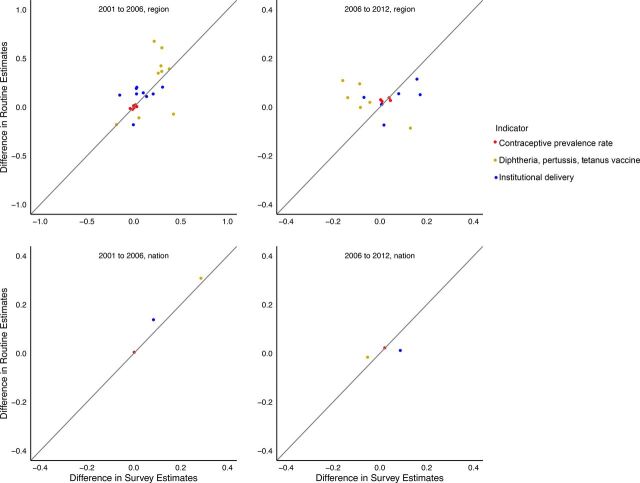
We compared 3 coverage indicators: contraceptive prevalence rate, institutional delivery, and 3 doses of diphtheria, pertussis, and tetanus (DPT3) vaccine, using 3 Mali Demographic and Health Surveys (DHS 2001, 2006, and 2012-2013) and routine health system data covering 2001-2012. For routine data, we used local health information system (HIS) annual reports and an HIS database. To compare time trends between the data sources, we calculated the percentage point change and 95% confidence interval from 2001-2006 and 2006-2012. We then computed the absolute and relative differences between the 2 data sources for each indicator over time at national and regional levels and assessed their level of significance.
The direction and magnitude of the time trends of contraceptive prevalence rate, institutional delivery, and DPT3 vaccine from 2001 to 2012 were similar at the national level between data sources. At the regional level, there were significant differences in the magnitude and direction of time trends for institutional delivery and the DPT3 vaccine; contraceptive prevalence trends were more consistent. Routine data tended to overestimate DPT3 coverage, and underestimate institutional delivery and contraceptive prevalence relative to survey data.
Routine data in Mali-particularly at the national level-appear to be appropriate for use to inform program planning and prioritization, but routine time trends should be interpreted with caution at the subnational level. For program evaluations, routine data may not be appropriate to draw accurate inferences about program impact.
资源匮乏的国家需要及时获得高质量的卫生干预措施覆盖数据,以便就如何在卫生领域进行投资做出战略性决策。家庭调查数据通常被视为“黄金标准”的高质量数据。本研究评估了马里国家和次国家层面常规数据和调查数据在干预措施覆盖时间趋势方面的可比性。
我们使用 3 项覆盖指标进行比较:避孕普及率、机构分娩率和 3 剂白喉、百日咳和破伤风(DPT3)疫苗,比较了 3 项马里人口与健康调查(2001 年、2006 年和 2012-2013 年)和 2001-2012 年的常规卫生系统数据。对于常规数据,我们使用了当地卫生信息系统(HIS)年度报告和 HIS 数据库。为了比较数据来源之间的时间趋势,我们计算了 2001-2006 年和 2006-2012 年之间的百分点变化和 95%置信区间。然后,我们计算了每个指标在国家和地区层面上随时间推移,2 个数据源之间的绝对和相对差异,并评估了它们的显著性水平。
在国家层面上,2001 年至 2012 年期间,常规数据和调查数据来源之间的避孕普及率、机构分娩率和 DPT3 疫苗的时间趋势方向和幅度相似。在区域层面上,机构分娩率和 DPT3 疫苗的时间趋势幅度和方向存在显著差异;而避孕普及率趋势则更为一致。常规数据往往高估了 DPT3 的覆盖率,而相对于调查数据则低估了机构分娩率和避孕普及率。
马里的常规数据——特别是在国家层面上——似乎适合用于为规划和优先事项提供信息,但在次国家层面上,应谨慎解读常规数据的时间趋势。对于方案评估,常规数据可能不适用于准确推断方案的影响。