Morita Akihiro, Omoya Yuta, Ito Rie, Ishibashi Yuya, Hiramoto Keiichi, Ohnishi Shiho, Yoshikawa Nobuji, Kawanishi Shosuke
Department of Pharmaceutical Sciences, Suzuka University of Medical Science, Suzuka, Mie, 513-8670, Japan.
Matsusaka R&D Center, Cokey Co., Ltd., Matsusaka, Mie, 515-0041, Japan.
Biochem Biophys Rep. 2021 Dec 4;28:101181. doi: 10.1016/j.bbrep.2021.101181. eCollection 2021 Dec.
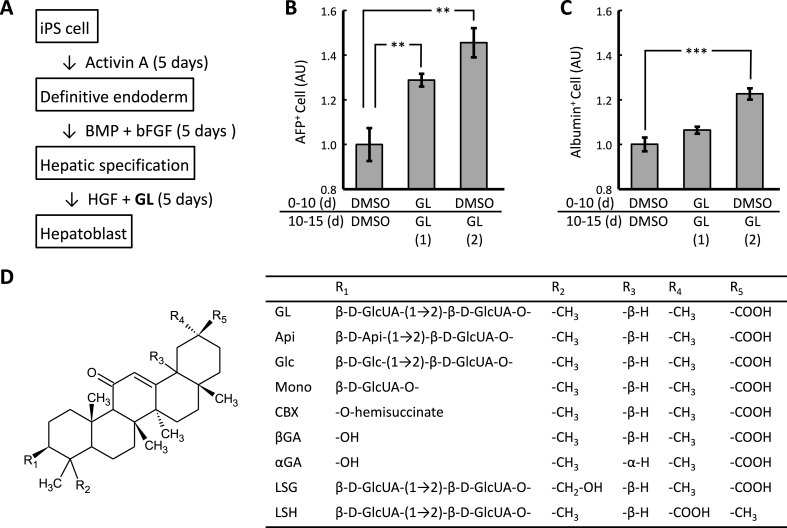
The acute liver disease is involved in aberrant release of high-mobility group box 1 (HMGB1). Glycyrrhizin (GL), a traditional Chinese medicine for liver disease, binds to HMGB1, thereby inhibits tissue injury. However the mode of action of GL for chronic liver disease remains unclear. We investigated the effects of glycyrrhizin (GL) and its derivatives on liver differentiation using human iPS cells by using a flow cytometric analysis. GL promoted hepatic differentiation at the hepatoblast formation stage. The GL derivatives, 3--mono-glucuronyl 18β-glycyrrhetinic acid (Mono) and 3--[glucosyl (1 → 2)-glucuronyl] 18β-glycyrrhetinic acid increased AFP cell counts and albumin cell counts. Glucuronate conjugation seemed to be a requirement for hepatic differentiation. Mono exhibited the most significant hepatic differentiation effect. We evaluated the effects of (±)-2-(2,4-dichlorophenoxy) propionic acid (DP), a T1R3 antagonist, and sucralose, a T1R3 agonist, on hepatic differentiation, and found that DP suppressed Mono-induced hepatic differentiation, while sucralose promoted hepatic differentiation. Thus, GL promoted hepatic differentiation via T1R3 signaling. In addition, Mono increased β-catenin cell count and decreased Hes5 cell count suggesting the involvement of Wnt and Notch signaling in GL-induced hepatic differentiation. In conclusion, GL exerted a hepatic differentiation effect via sweet receptor (T1R3), canonical Wnt, and Notch signaling.
急性肝病与高迁移率族蛋白B1(HMGB1)的异常释放有关。甘草酸(GL)是一种治疗肝病的传统中药,它与HMGB1结合,从而抑制组织损伤。然而,GL对慢性肝病的作用方式尚不清楚。我们通过流式细胞术分析研究了甘草酸(GL)及其衍生物对人诱导多能干细胞肝分化的影响。GL在成肝细胞形成阶段促进肝分化。GL衍生物,3 - 单葡萄糖醛酸基18β - 甘草次酸(Mono)和3 - [葡萄糖基(1→2) - 葡萄糖醛酸基] 18β - 甘草次酸增加了甲胎蛋白细胞计数和白蛋白细胞计数。葡萄糖醛酸结合似乎是肝分化的必要条件。Mono表现出最显著的肝分化作用。我们评估了T1R3拮抗剂(±) - 2 - (2,4 - 二氯苯氧基)丙酸(DP)和T1R3激动剂三氯蔗糖对肝分化的影响,发现DP抑制了Mono诱导的肝分化,而三氯蔗糖促进了肝分化。因此,GL通过T1R3信号通路促进肝分化。此外,Mono增加了β - 连环蛋白细胞计数并减少了Hes5细胞计数,表明Wnt和Notch信号通路参与了GL诱导的肝分化。总之,GL通过甜味受体(TIR3)、经典Wnt和Notch信号通路发挥肝分化作用。