Provision CARES Proton Therapy Center, Knoxville, Tennessee, USA.
J Appl Clin Med Phys. 2022 Feb;23(2):e13510. doi: 10.1002/acm2.13510. Epub 2021 Dec 22.
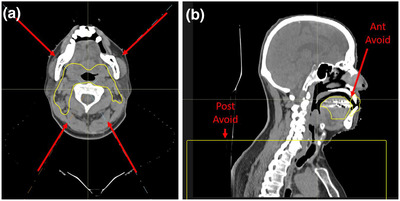
Pencil beam scanning (PBS) proton therapy offers dosimetric advantages for several treatment sites, including head and neck (H&N). However, to achieve the optimal target coverage and robustness, these plans can be complex and time consuming to develop and optimize. Automating the treatment planning process can ensure a high-quality and standardized plan, reduce burden to the planner, and decrease time-to-treatment. We utilized in-house scripting to automate a four-field multi-field optimization (MFO) H&N planning technique.
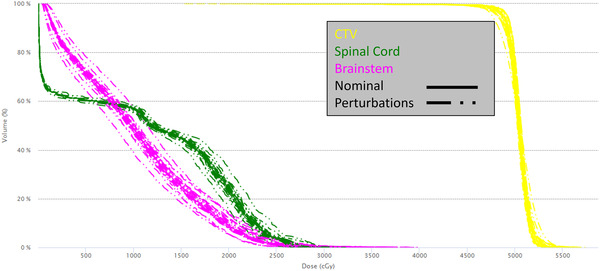
Ten bilateral H&N patients were planned in RayStation v6 with a four-field modified-X beam configuration using MFO planning. Automation included creation of avoidance structures to control spot placement and development of standardized beams, PBS spot settings, robust optimization objectives, and patient-specific predicted planning constraints. Each patient was planned both with and without automation to evaluate differences in planning time, perceived effort and plan quality, plan robustness, and OAR sparing.
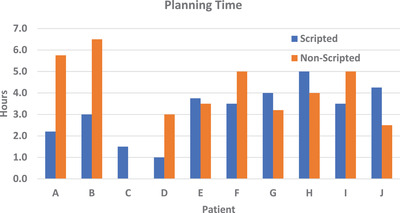
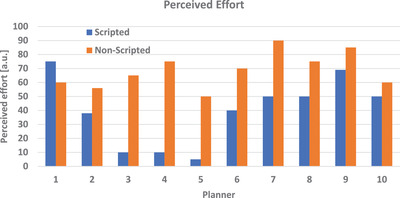
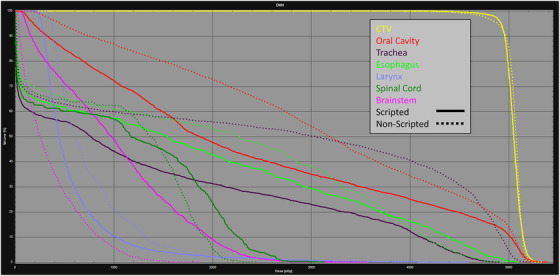
On average, scripted plans required 3.2 h, compared to 4.3 h without the script. There was no difference in target coverage or plan robustness with or without automation. Automation significantly reduced mean dose to the oral cavity, parotids, esophagus, trachea, and larynx. Perceived effort was scaled from 1 (minimum effort) to 100 (maximum effort), and automation reduced perceived effort by 42% (p < 0.05). Two non-scripted plans required re-planning due to errors.
Automation of this multi-beam, the MFO proton planning process reduced planning time and improved OAR sparing compared to the same planning process without scripting. Scripting generation of complex structures and planning objectives reduced burden on the planner. With most current treatment planning software, this automation is simple to implement and can standardize quality of care across all treatment planners.
铅笔束扫描(PBS)质子治疗为包括头颈部(H&N)在内的多个治疗部位提供了剂量学优势。然而,为了实现最佳的靶区覆盖和稳健性,这些计划的制定和优化可能会很复杂且耗时。自动化治疗计划过程可以确保计划的高质量和标准化,减轻计划者的负担,并缩短治疗时间。我们利用内部脚本为四野多野优化(MFO)H&N 计划技术实现自动化。
对 10 例双侧 H&N 患者在 RayStation v6 中使用四野改良-X 束配置进行 MFO 计划,采用四野多野优化(MFO)计划。自动化包括创建避免结构以控制点放置,开发标准化束、PBS 点设置、稳健性优化目标和患者特异性预测计划限制。每位患者均进行了有无自动化的计划,以评估计划时间、感知工作量和计划质量、计划稳健性和 OAR 保护方面的差异。
脚本化计划平均需要 3.2 小时,而无脚本则需要 4.3 小时。有/无自动化对靶区覆盖或计划稳健性均无影响。自动化可显著降低口腔、腮腺、食管、气管和喉的平均剂量。感知工作量从 1(最小工作量)到 100(最大工作量)进行分级,自动化可降低 42%的感知工作量(p<0.05)。由于错误,有两个非脚本计划需要重新计划。
与无脚本的相同计划过程相比,这种多束、MFO 质子计划过程的自动化可减少计划时间并改善 OAR 保护。脚本化生成复杂结构和计划目标可减轻计划者的负担。在大多数当前的治疗计划软件中,这种自动化很容易实现,并可以在所有治疗计划者中实现护理质量的标准化。