Biological Resource Center, Taizhou Hospital of Zhejiang Province, Wenzhou Medical University, Linhai, China.
Key Laboratory of Minimally Invasive Techniques & Rapid Rehabilitation of Digestive System Tumor of Zhejiang Province, Taizhou Hospital of Zhejiang Province, Linhai, China.
Front Immunol. 2021 Dec 6;12:788769. doi: 10.3389/fimmu.2021.788769. eCollection 2021.
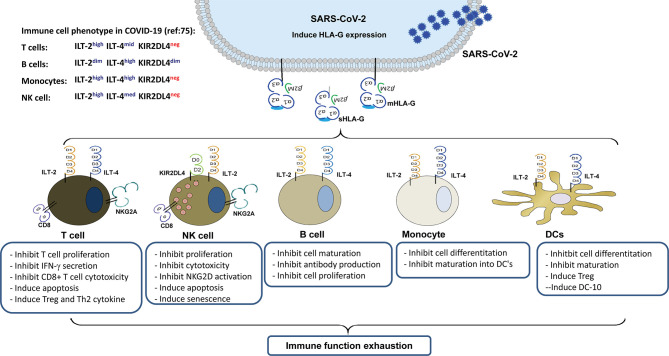
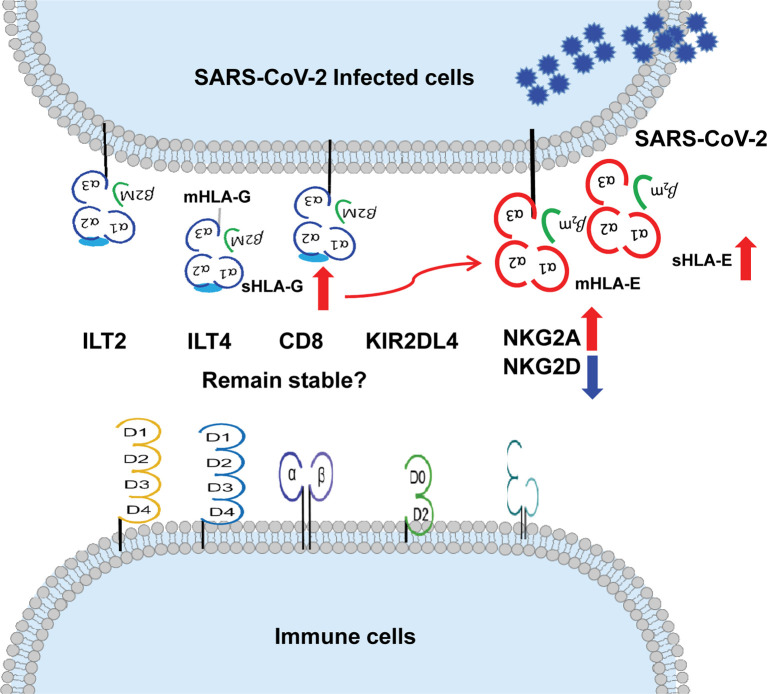
COVID-19, the disease caused by severe acute respiratory syndrome coronavirus 2 (SARS-CoV-2), has threatened public health worldwide. Host antiviral immune responses are essential for viral clearance and disease control, however, remarkably decreased immune cell numbers and exhaustion of host cellular immune responses are commonly observed in patients with COVID-19. This is of concern as it is closely associated with disease severity and poor outcomes. Human leukocyte antigen-G (HLA-G) is a ligand for multiple immune inhibitory receptors, whose expression can be upregulated by viral infections. HLA-G/receptor signalling, such as engagement with immunoglobulin-like transcript 2 (ILT-2) or ILT-4, not only inhibit T and natural killer (NK) cell immune responses, dendritic cell (DC) maturation, and B cell antibody production. It also induces regulatory cells such as myeloid-derived suppressive cells (MDSCs), or M2 type macrophages. Moreover, HLA-G interaction with CD8 and killer inhibitory receptor (KIR) 2DL4 can provoke T cell apoptosis and NK cell senescence. In this context, HLA-G can induce profound immune suppression, which favours the escape of SARS-CoV-2 from immune attack. Although detailed knowledge on the clinical relevance of HLA-G in SARS-CoV-2 infection is limited, we herein review the immunopathological aspects of HLA-G/receptor signalling in SARS-CoV-2 infection, which could provide a better understanding of COVID-19 disease progression and identify potential immunointerventions to counteract SARS-CoV-2 infection.
新型冠状病毒病(COVID-19)是由严重急性呼吸系统综合征冠状病毒 2(SARS-CoV-2)引起的疾病,已对全球公共卫生构成威胁。宿主抗病毒免疫反应对于清除病毒和控制疾病至关重要,然而,COVID-19 患者通常会出现显著减少的免疫细胞数量和宿主细胞免疫反应耗竭。这令人担忧,因为它与疾病严重程度和不良结局密切相关。人类白细胞抗原-G(HLA-G)是多种免疫抑制受体的配体,其表达可被病毒感染上调。HLA-G/受体信号,如与免疫球蛋白样转录物 2(ILT-2)或 ILT-4 的结合,不仅抑制 T 细胞和自然杀伤(NK)细胞免疫反应、树突状细胞(DC)成熟和 B 细胞抗体产生,还诱导调节细胞,如髓系来源的抑制细胞(MDSCs)或 M2 型巨噬细胞。此外,HLA-G 与 CD8 和杀伤细胞免疫球蛋白样受体 2DL4 的相互作用可引发 T 细胞凋亡和 NK 细胞衰老。在这种情况下,HLA-G 可诱导深度免疫抑制,从而有利于 SARS-CoV-2 逃避免疫攻击。尽管关于 HLA-G 在 SARS-CoV-2 感染中的临床相关性的详细知识有限,但我们在此综述了 HLA-G/受体信号在 SARS-CoV-2 感染中的免疫病理方面,这有助于更好地了解 COVID-19 疾病进展,并确定潜在的免疫干预措施以对抗 SARS-CoV-2 感染。