Atikilt Yemata Getaneh, Yenew Chalachew, Mamuye Melkalem, Tiruneh Mulu, Assfaw Tigabnesh, Mulatu Sileshi, Sisay Ermias, Tadele Fitalew
Debretabor University, College of Health Sciences, Public Health Department, Debre Tabor, Ethiopia.
Bahir Dar University, College of Medicine and Health Sciences, Department of Pediatrics and Child Health Nursing, Bahir Dar, Ethiopia.
Interdiscip Perspect Infect Dis. 2021 Dec 13;2021:1255187. doi: 10.1155/2021/1255187. eCollection 2021.
Typhoid fever is a major cause of morbidity and mortality around the globe, and it is a serious illness in developing countries. Typhoid fever is prevalent in Ethiopia, and the burden differs with diverse demography, environment, and climate. The study aimed to determine the incidence of typhoid fever cases by person, place, and time.
A descriptive cross-sectional study was conducted among the five years (2015-2019) of surveillance data of typhoid fever in the Jimma Zone, Oromia Region, Ethiopia. The data were extracted from the zonal health management information system database from May to June 2020. SPSS version 21 was used to enter and analyze the data. Descriptive analysis was used to assess the distribution of typhoid fever incidence in time, place, and personal groups.
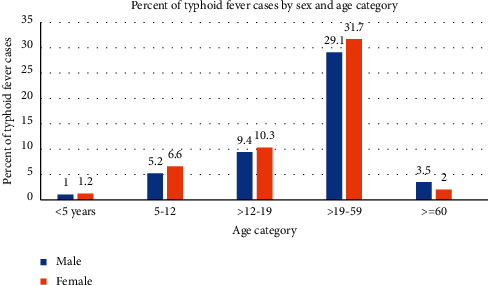
A total of 36,641 individuals suffered from typhoid fever during the five years. Among these, 18,972 (51.8%) were females and 17,669 (48.2%) were males. Incidence of typhoid fever was found as follows: 216, 198, 203, 264, and 299 cases per 100,000 persons were reported during 2015, 2016, 2017, 2018, and 2019, respectively. Typhoid fever cases were increased by 1.4 from 2015-2019. A high incidence of cases was observed at the start of wet months. The majority of the investigated cases were identified in Kersa, 4,476 (12.2%), Gomma, 4,075 (11.1%), and Mana, 3,267 (8.9%), woredas. Of the total, 151 (0.4%) of the reported cases were admitted for inpatient care. During the five years of surveillance data, death was not reported from all woredas. . Typhoid fever was a major public health problem in the Jimma Zone for the last 5 years, and it was increased through the years. Zonal health departments should strengthen the interventions focused on the woredas that had a high burden of typhoid fever at the start of the wet months.
伤寒热是全球发病和死亡的主要原因,在发展中国家是一种严重疾病。伤寒热在埃塞俄比亚很普遍,其负担因不同的人口统计学、环境和气候而有所不同。该研究旨在按人群、地点和时间确定伤寒热病例的发病率。
对埃塞俄比亚奥罗米亚州吉马地区五年(2015 - 2019年)的伤寒热监测数据进行了描述性横断面研究。数据于2020年5月至6月从地区卫生管理信息系统数据库中提取。使用SPSS 21版软件录入和分析数据。描述性分析用于评估伤寒热发病率在时间、地点和人群组中的分布情况。
在这五年中,共有36,641人患伤寒热。其中,女性18,972人(51.8%),男性17,669人(48.2%)。伤寒热发病率如下:2015年、2016年、2017年、2018年和2019年每10万人中分别报告216例、198例、203例、264例和299例。2015年至2019年伤寒热病例增加了1.4倍。在雨季开始时观察到病例高发。大多数被调查病例在克尔萨(4,476例,占12.2%)、戈马(4,075例,占11.1%)和马纳(3,267例,占8.9%)等县被确诊。报告病例中共有151例(0.4%)住院治疗。在五年的监测数据中,所有县均未报告死亡病例。过去五年,伤寒热一直是吉马地区的一个主要公共卫生问题,且多年来呈上升趋势。地区卫生部门应加强针对雨季开始时伤寒热负担较重县的干预措施。