Fernando Fiona, Robertson Harry Frederick, El-Zahab Sarah, Pavlů Jiří
Centre for Haematology, Imperial College London at Hammersmith Hospital, London, UK.
Clin Hematol Int. 2021 Nov 29;3(4):130-141. doi: 10.2991/chi.k.211119.001. eCollection 2021 Dec.
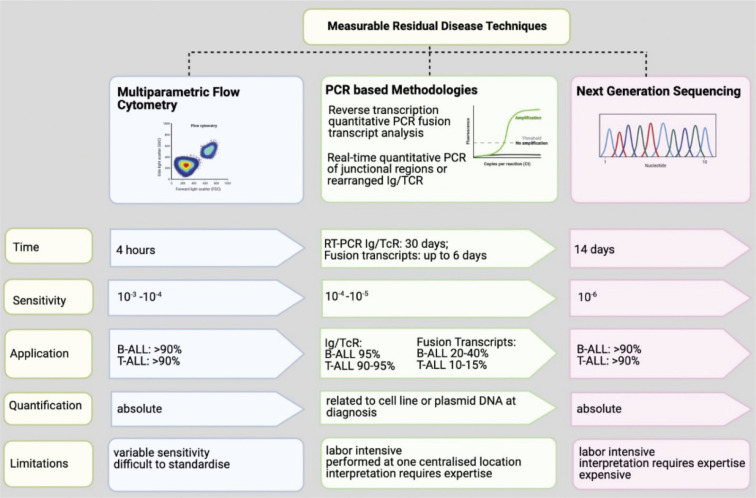
Over the last decade the use of measurable residual disease (MRD) diagnostics in adult acute lymphoblastic leukemia (ALL) has expanded from a limited number of study groups in Europe and the United States to a world-wide application. In this review, we summarize the advantages and drawbacks of the current available techniques used for MRD monitoring. Through the use of three representative case studies, we highlight the advances in the use of MRD in clinical decision-making in the management of ALL in adults. We acknowledge discrepancies in MRD monitoring and treatment between different countries, reflecting differing availability, accessibility and affordability.
在过去十年中,可测量残留病(MRD)诊断在成人急性淋巴细胞白血病(ALL)中的应用已从欧洲和美国的少数研究组扩展到全球范围。在本综述中,我们总结了目前用于MRD监测的现有技术的优缺点。通过三个具有代表性的案例研究,我们强调了MRD在成人ALL管理的临床决策中的应用进展。我们认识到不同国家在MRD监测和治疗方面存在差异,这反映了可及性、可获得性和可负担性的不同。